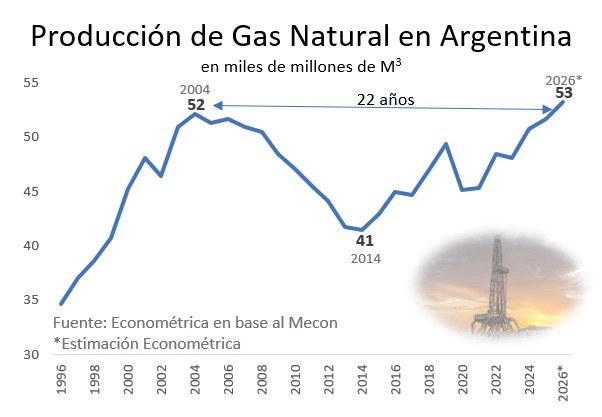
Argentina is on track to surpass its historical production high of natural gas recorded 22 years ago in 2026.
According to an estimate by Econométrica based on data from the Ministry of Economy, production is expected to reach 53 billion cubic meters (M³), surpassing the record of 52 billion M³ achieved in 2004.
This figure marks an unprecedented change compared to the trajectory the sector experienced during the following two decades. According to the estimate, after the peak in 2004, production began a sustained decline until it hit a low of 41 billion M³ in 2014.
This drop was primarily caused by the policies implemented during the Kirchnerist governments, including tariff freezes and price controls.
The report
Due to extreme regulations, local prices were set well below international levels, which ultimately reduced companies' incentives to invest in exploration and the development of new reserves.
The lower domestic supply, against a demand that continued to rise, artificially driven by subsidies, also led to a loss of self-sufficiency.
Argentina went from being an exporter to depending on imports of gas through pipelines from Bolivia and liquefied natural gas (LNG) ships.
The change in trend began later with the implementation of stimulus programs, deregulations, and measures aimed at creating more predictable conditions for companies. The goal was to reactivate the necessary investments to increase drilling and the development of reserves.
President Javier Milei
The impact of Milei's reforms
The arrival to power of President Javier Milei significantly accelerated the transformation process of the energy sector. Among the main reforms implemented is the Incentive Regime for Large Investments (RIGI), which established fiscal, customs, and exchange rate stability for 30 years, along with strong tax benefits.
This scheme allowed for the unlocking of massive private infrastructure projects, facilitated access to international financing, and advanced initiatives related to gas liquefaction for export.
Another change was the end of controls, deregulation, and the adjustment of tariffs. The official policy of not extending state intervention mechanisms allowed for the establishment of appropriate prices and aligned the sector's rules with international markets.
Thanks to these changes, there was a strong influx of foreign capital, and investments aimed at developing the gas potential of Vaca Muerta advanced, positioning Argentine production in international markets.
Thus, the estimate projects that 2026 could close with 53 billion M³ of production, a volume that would not only recover the level reached in 2004 but would even exceed it.