
Institutions begin to die long before they disappear. They die when they preserve their buildings, their ceremonies, and their speeches, but what they say stops producing consequences. A rule that can be broken indefinitely without cost stops behaving like a rule. And an organization that demands obedience where it has no mandate while being powerless where it does have it ends up emptying its own authority.
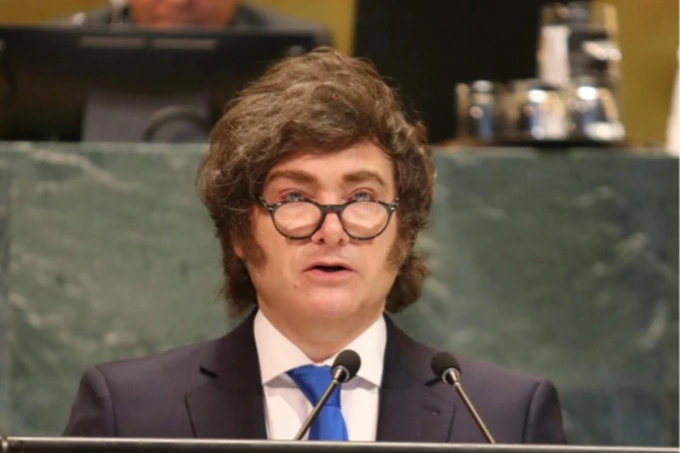
This was the heart of the first two blocks of Javier Milei's speech before the 81st United Nations General Assembly. The President structured his criticism around a brutal contradiction: first, what the UN should have done and did not do; then, what it should not have done and ended up doing anyway. The United Nations was born to uphold international law, preserve the sovereignty of states, protect fundamental rights, and offer mechanisms to resolve conflicts without resorting to violence. The problem is that its words no longer weigh on the facts.
The Malvinas is the most evident proof. Since Resolution 2065 of 1965, the United Nations recognizes the existence of a sovereignty dispute between Argentina and the United Kingdom and has repeatedly called for both parties to resume negotiations. However, the dispute remains open, and the United Kingdom continues to make unilateral decisions in the contested area. The UN acknowledges the problem, issues resolutions, and calls for negotiations, but fails to change the reality.
Here appears one of the most powerful ideas in Milei's speech: a rule that can be violated over and over again without consequences stops functioning as a rule. It does not matter how many stamps, committees, or declarations accompany it. If those who break the rule pay no cost and those who comply gain no benefit, authority ends up wearing thin. That is why the Government decided to take this conclusion to practical ground through sanctioning procedures against individuals and companies linked to hydrocarbon activities in the disputed area and new legal tools aimed at raising the cost of operating there without Argentine authorization. The shift is clear: stop treating sovereignty as a diplomatic folder and start treating it as a power relationship.
But the second problem pointed out by Milei is even more uncomfortable. While the organization has been losing effectiveness in the face of sovereignty disputes, dictatorships, terrorism, persecutions, and armed conflicts, it has progressively expanded its activities into economic, environmental, migratory, health, and cultural areas. The 2030 Agenda, gender policies, economic regulation, migration, and health guidelines have become part of an international machinery increasingly willing to guide decisions that previously belonged almost exclusively to states.
The contradiction can be summarized simply: where the UN should achieve results, it produces resolutions; where it should respect limits, it produces agendas. Milei described this combination as a mix of “anarchy and tyranny”: an inability to enforce rules against those who violate them and an expansion of bureaucratic power over those who remain within the system.