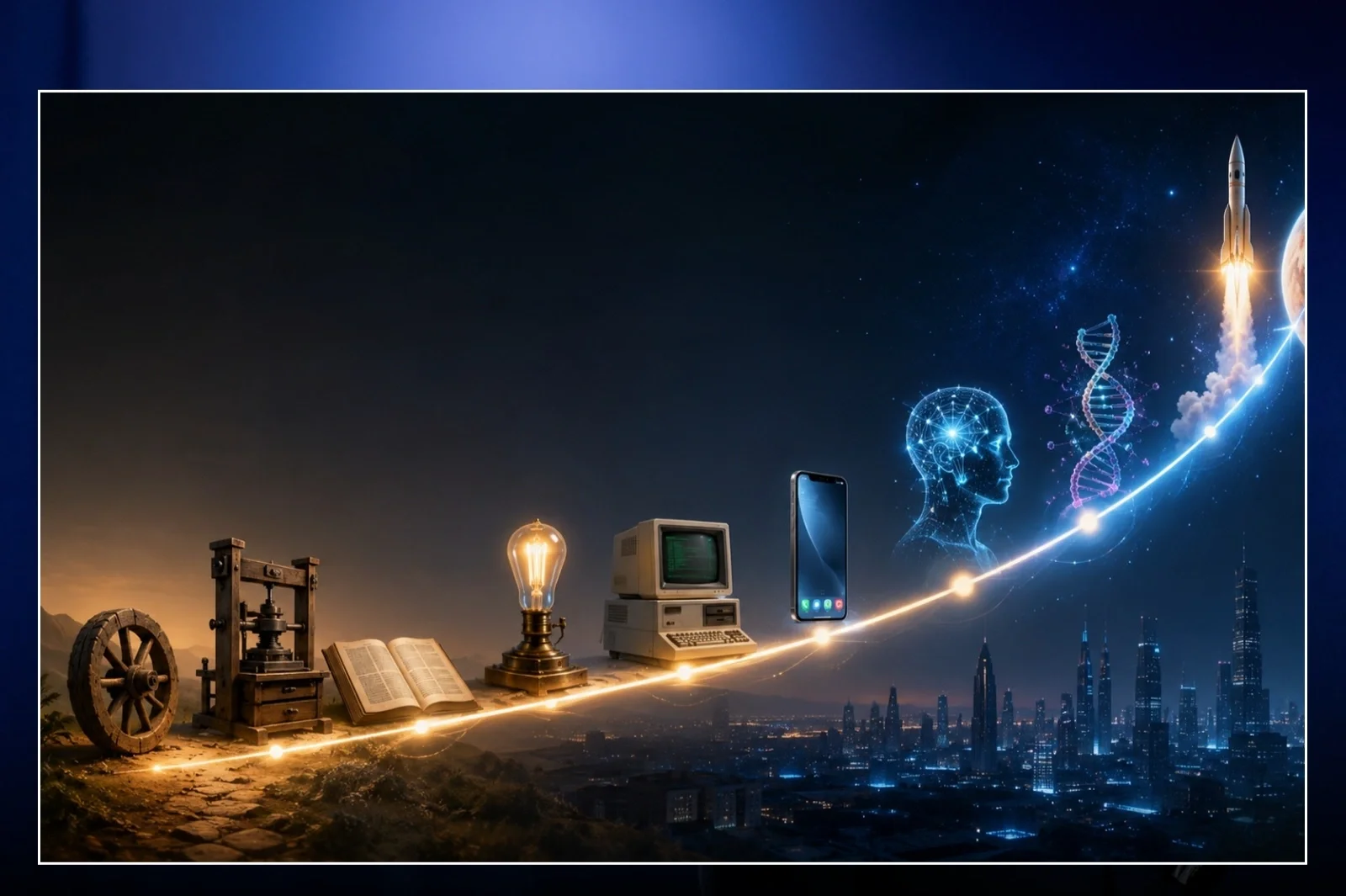
Capitalist progress turned ancient privileges into common goods, but traditional statistics continue to measure prices and production without capturing the true leap in well-being generated by technology, AI, and free digital goods.
The great transformation of capitalism was another: it turned ancient privileges of the rich into common goods for millions. Light, running water, heating, mobility, modern medicine, instant communication, music, information, and now perhaps personalized artificial intelligence: first they were privileges; then expensive goods; then mass goods; finally, a normal part of everyday life.
That is why measurements of inequality often capture the historical phenomenon poorly. They measure income or wealth, but do not adequately capture the brutal drop in the cost of living with dignity, accessing knowledge, communicating, healing, transporting, informing, or enjoying cultural goods. They also do not capture the consumer surplus that arises when millions of people access free or nearly free services that would have been unthinkable even for the richest in history.
An 18th-century monarch did not have modern anesthesia, antibiotics, MRI, airplane, telephone, GPS, air conditioning, unlimited music, contemporary dentistry, or safe water just by turning on a tap. An average worker in a capitalist country today has access to goods and services that would have seemed like magic for almost all of human history.
In 2005, Ray Kurzweil published “The Singularity is Near. When Humans Transcend Biology”. I clearly remember the impact it had on me to understand the idea of accelerating returns. It was not just a new technology or an intellectual fad from Silicon Valley. It was something deeper: a different way of looking at human history.
Kurzweil showed that computing power was growing exponentially and that this logic could extend to other areas: robotics, biotechnology, health, artificial intelligence, 3D printing, nanotechnology, and later, energy and space exploration. Moore's Law, which for decades roughly doubled chip capacity every two years, was not just a curiosity of the computer industry. It was the first visible manifestation of a much broader dynamic. In reality, throughout history, major inventions have been accelerating, but at first, extremely slowly, every hundreds of thousands of years, then every 10,000 years, then a few per millennium, but from 1800 to 2000 the exponential curve was already very clear.
For an economist trained in traditional aggregates, this idea was disturbing. Because if technology improves exponentially, then many of our economic measurements begin to lag behind. Not because they are useless, but because they were designed for another era: an economy of physical goods, positive prices, observable industrial production, and slower improvements. But in an economy where more and more goods are dematerializing and becoming digital, where the marginal cost tends to zero and where quality improves much faster than price, Gross Domestic Product starts to capture only an increasingly smaller part of the phenomenon.
William Nordhaus saw this with enormous clarity in a pioneering paper from 1996, Do Real-Output and Real-Wage Measures Capture Reality? The History of Lighting Suggests Not. His example was simple and devastating: for centuries, humans did not buy candles for the love of candles; they bought light. If we measure the price of candles, we miss the true phenomenon: the extraordinary drop in the cost of an hour of illumination. Nordhaus showed that the efficiency of lighting increased on a gigantic scale and that traditional measurements underestimated the true increase in well-being.
This intuition was central to my work “The Terms of Trade and Technological Change”, published in May 2008 in the Journal of Institutions, Ideas and Markets. There, I discussed the Prebisch-Singer thesis from another angle. The problem was not just whether the relative prices of primary and manufactured goods moved in one direction or another. The problem was deeper: many economists looked at the prices of manufactures without understanding the technological revolution embedded in those goods. They measured the cost of the candle, not the amount of light; the price of the car, not the safety, speed, reliability, heating, air conditioning, electronics, ABS brakes, or satellite navigation that were being incorporated.
In that same vein, Erik Brynjolfsson proposed moving towards an expanded GDP — the so-called GDP-B — to capture the value of free or nearly free digital goods that traditional GDP does not register well: search engines, maps, networks, videos, artificial intelligence, information, communication, and other services whose monetary price is zero, but whose value to the consumer can be enormous. The truth is that they also fail to capture the true impact.
Similarly, the old discussion about inequality is outdated, poorly framed. For millennia, the truly decisive inequality was not a difference in brands, square meters, or luxury consumption. It was a brutal difference in the basic conditions of human life. The poor lived in darkness; the rich had light. The poor ate little and of poor quality; the rich had access to a varied diet with many more calories. A belly was a symbol of wealth. The poor worked fourteen hours in physically grueling tasks; the rich could afford time, leisure, and education. The poor had no heating, running water, bathroom, dentist, doctor, anesthesia, antibiotics, comfortable transportation, or extended education. They dressed differently, smelled differently, got sick differently, aged faster, and died much sooner; and rarely ventured beyond a neighboring town.
This was a desperate inequality because it permeated everything: the body, health, nutrition, hygiene, life expectancy, access to knowledge, and everyday dignity.
In capitalist countries, that inequality has been extraordinarily reduced. Today, from the moment they wake up until they go to bed, the material life of an average citizen resembles much more that of a rich person than at any other time in history. Both have electric light, hot water, heating, refrigerators, washing machines, antibiotics, anesthesia, dentistry, vaccines, internet, GPS, music, movies, video calls, supermarkets, comfortable clothing, motorized transportation, and immediate access to global information with a smartphone.
The CEO of Google may have a bigger house, travel first class, or eat in more expensive restaurants. But that does not necessarily mean that his life is better than that of an employee who earns a tenth, but owns his free time, enjoys his children, converses with his friends, exercises, reads, listens to music, and lives with purpose. The good life is not measured only by consumption, wealth, or status.
That is the true miracle of progress: not that everyone has the same, but that the essentials cease to be a privilege.
The example of computers illustrates this even more clearly. Suppose that one year a million computers are sold at a thousand dollars each. That adds up to a billion dollars to GDP. Two years later, another million computers are sold at a thousand dollars each. The nominal contribution to GDP is again the same. But if those computers doubled their processing capacity, the actual amount of computational service available doubled. Traditional measurement may show zero growth in that category, while the effective capacity received by the consumer grew by 100%.
This problem becomes sharper with free digital goods. How much is Google Maps worth, Wikipedia, the camera and video recorder of the phone, instant messaging, machine translation, GPS, email, YouTube, podcasts, digital libraries, or nearly free access to courses from the best universities and millions of books and magazines? Since many of these services have a zero price for the user, GDP simply does not register them.
The paradox is that abundance reduces many prices to zero and, therefore, we cannot measure the subjective value of the surplus of millions of consumers who receive free or nearly free goods. And if we cannot measure it, we often end up concluding that well-being has not increased, or that productivity has stagnated, or that inequality has grown more than it actually has. It is the old illusion of looking only at what goes through the cash register and not what happens in the concrete lives of people.
The Impact of Artificial Intelligence
But now we are entering a deeper stage. If Moore's Law doubled capacity every two years, artificial intelligence is advancing at an even faster pace. The computing used to train cutting-edge models is growing at speeds that leave the old semiconductor curve behind. We are moving from significant technological acceleration to brutal acceleration.
This does not mean that artificial intelligence will solve all problems or that history has ended. It means something more precise: we are facing a general-purpose technology, of mass diffusion, with asymmetric impact and accelerated improvement. Like electricity, like the combustion engine, like the internet, but with one difference: this technology not only moves things or transmits information. It begins to reason, write, program, design, diagnose, translate, teach, simulate, research, and coordinate other technologies.
The acceleration of bits of information will translate in the coming years to the manipulation of atoms. Then, the intersection with biology will perhaps be the most impressive case. AlphaFold changed protein research and opened a huge field for new medicines, cancer treatments, biotechnology, longevity, agriculture, materials, and molecular design. Artificial intelligence is beginning to process life itself as it previously processed texts or images. This does not mean omnipotence, but rather a leap in scale. Millions of young people can use this technology for the most diverse purposes, impossible to anticipate.
We are moving from artificial intelligence as a word processor to artificial intelligence as a reality processor. First, it processes language. Then code. Then images. Then proteins. Then robots. Then perhaps complete systems of production, energy, health, education, and space exploration.
That is why the economic models taught in traditional economic science are beginning to age poorly; they fail to capture the change. Mises and Hayek had an advantage over narrow positivism: they understood that economics is not just a collection of equations about aggregate magnitudes. It is the study of human action, of prices as signals, of dispersed knowledge, of the discovery process, of incentives, of capital, of time, and of social coordination. Mises' catallactics is broader than much of conventional neoclassical economics, because it is not limited to physical goods.