The case of Mercado Libre is illustrative. The company accounts for approximately 19% of the delinquent individuals analyzed, but only 2.9% of the unpaid money, while the median debt in default is around $116,000. In contrast, private banks gather nearly 45% of the total amount and present a median exceeding $1.4 million.
A comprehensive analysis conducted on the Debtors' Central of the Central Bank of the Argentine Republic (BCRA) provided new data to gauge the growth of delinquency and contextualized some of the sensationalist claims that circulated in recent weeks by militant journalism.
The work was prepared by Matías Fernández, who downloaded the database corresponding to June 2026 and cross-referenced it with information from ARCA. The author himself clarified that his classification of the 518 financial entities is a personal elaboration, which is why he presented the report as an analysis open to corrections that quickly went viral due to the support of a large number of economists.
Most people owe "a little" and 15% owe a lot
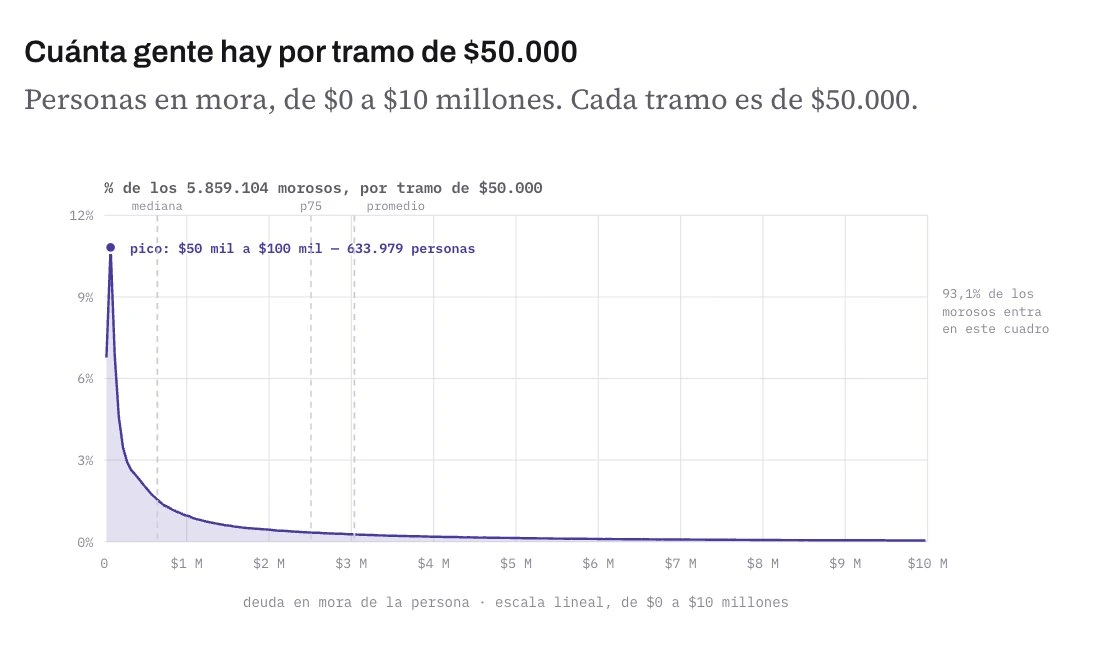
One of the main findings shows that 17% of delinquents owe less than $100,000, almost 25% owe less than $150,000, and nearly 40% have a debt of less than $400,000. At the opposite end, 14.5% of delinquents concentrate approximately 73% of all money in irregular situations.
While the number of people with at least one unpaid debt rose from 13.6% in October 2024 to 27.8% in June 2026, the indicators that the BCRA usually disseminates mainly measure the percentage of loaned money that is in irregular situations, and not simply the number of individuals involved.
The study also questions the idea that fintech companies are responsible for the majority of the problem. According to the survey, traditional banks concentrate around 65% of the total amount in default, while fintechs have a larger number of delinquent individuals, but generally for considerably lower amounts.
Another focus appears on non-bank quick credit entities, where the study calculates an average default rate close to 52%. This segment represents approximately 22% of delinquents, although only 7.7% of the unpaid money.
The report also warns about young people aged 18 to 25. Their access to credit has increased significantly over the past two years, but the proportion of young debtors in default is said to have risen from 24.7% to 40.8%, becoming one of the main challenges to follow.
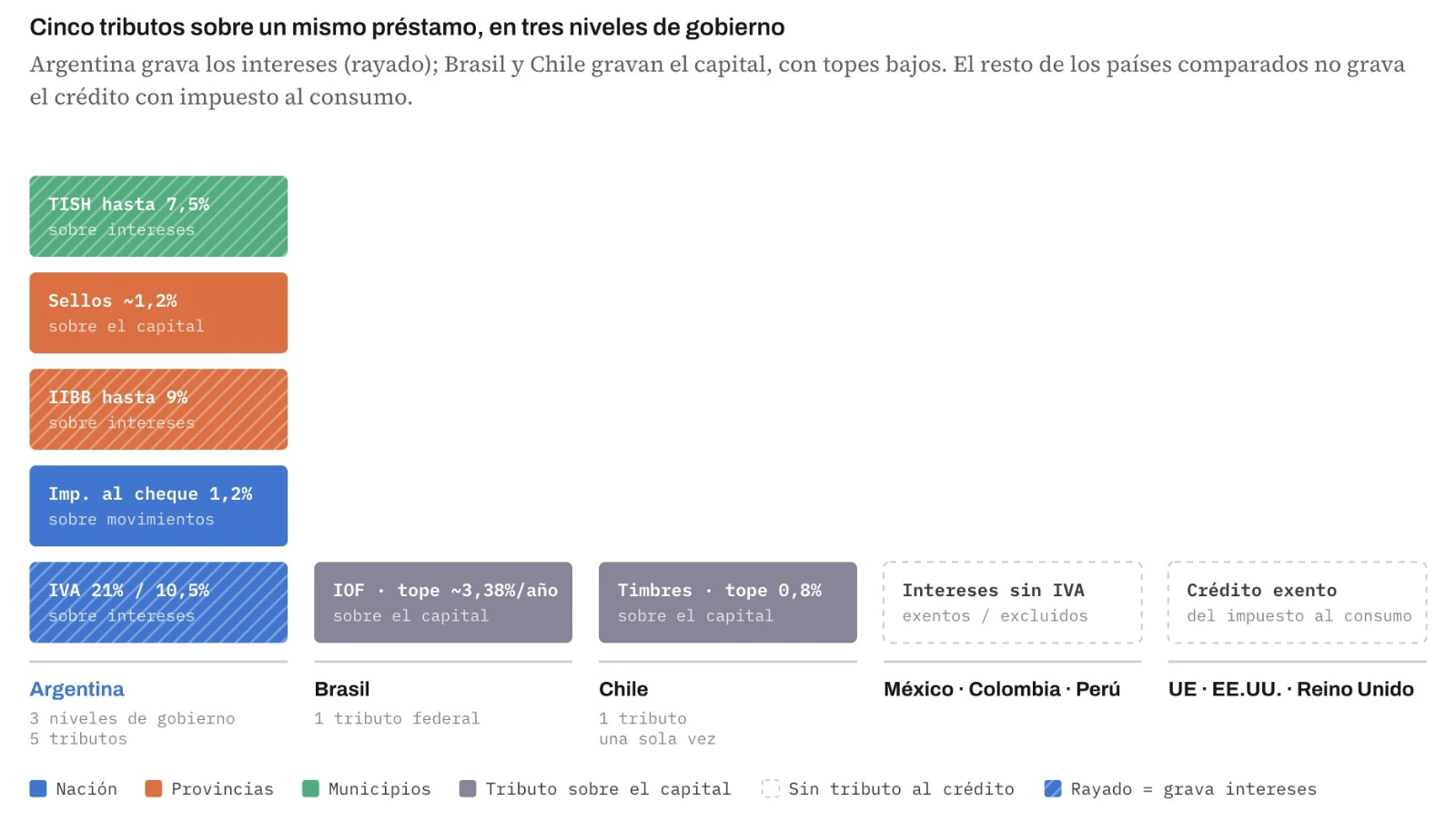
In Argentina, at least 5 taxes impact the same loan.
Despite the increase in irregularity, the analysis highlights a central fact: around 15 million people currently maintain some type of credit and regularly meet their obligations, far from any hypothesis of crisis. The expansion of financing, virtually nonexistent for years in Argentina, necessarily implies managing new risks without destroying access to credit again.
The survey also points out the high tax burden on financing and argues that VAT, Gross Income, Stamp Tax, check tax, and municipal fees significantly increase the final cost of loans. Thus, the problem of delinquency appears as a much more complex phenomenon than the simplified and alarmist explanation disseminated by leftist media.