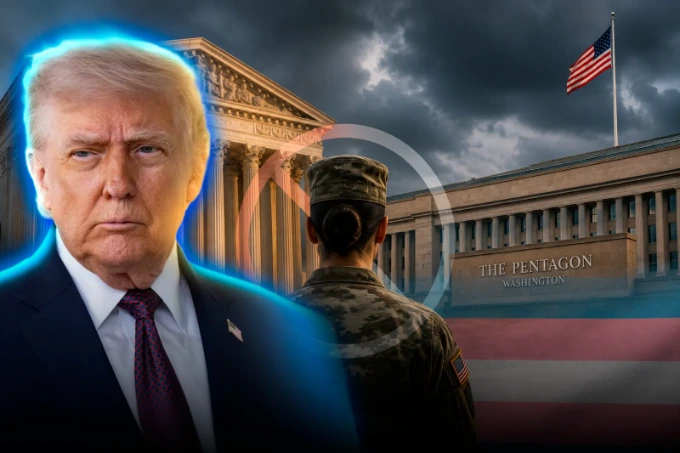

The administration of President Donald Trump formally requested this Friday that the Supreme Court of the United States allow the Pentagon to fully implement its policy restricting transgender individuals from serving in the armed forces, arguing that lower courts have improperly intervened in a matter that primarily falls under military authority.
In the petition submitted to the justices, Attorney General John Sauer argued that the decision of the D.C. Circuit Court of Appeals that partially blocked the policy was ''severely erroneous'' and requested that the Supreme Court review the case and overturn the ruling.
The Trump administration believes that determining who can serve in the armed forces constitutes an essential responsibility of military leadership. Sauer warned that upholding the appellate court's decision would represent an unprecedented judicial intervention in matters related to the organization, preparation, and functioning of the armed forces.
The dispute originates from an executive order signed by Trump in January 2025, through which the president established restrictions on military service for transgender individuals. The administration argued that the policy responds to considerations related to the readiness and effectiveness of the armed forces, and not solely to issues of personal identity.
Subsequently, the Secretary of War, Pete Hegseth, implemented the Pentagon's guidelines. The policy establishes restrictions on the enlistment of individuals with gender dysphoria and includes the separation from service of certain military personnel who meet the established criteria. Hegseth also urged affected transgender military members to voluntarily leave the armed forces before facing potential mandatory separation.
The administration maintains that decisions regarding the characteristics and conditions necessary for military service should primarily rest with the authorities responsible for national defense. From this perspective, the Executive believes that courts should grant a wide margin of deference to military judgment, especially when policies are justified in terms of readiness and operational capability.

In June, a panel of three judges from the D.C. Circuit Court of Appeals voted 2-1 to largely uphold a lower court's decision that concluded Trump's order likely ''violated the constitutional rights'' of transgender individuals. However, the scope of the appellate ruling was limited to the transgender plaintiffs directly involved in the litigation and did not extend to individuals seeking to enlist in the military.