Half a century after the civic-military coup of 1976, the Government of Javier Milei published a great audiovisual material entitled “The Victims They Wanted to Hide”, which reviews the events of the 70s from a a complete and critical view of the biased versions prevailing in recent decades
.
The video, released through the official account of the Casa Rosada, lasts one hour and fifteen minutes and focuses on the need to approach the period with a broader perspective, also showing the crimes and murders of left-wingterrorist organizations.
In this sense, the institutional message emphasizes: “History must be known in its entirety, when presented in a partial way, it ceases to be memory and becomes an instrument of manipulation”.
Since its inception, the material has introduced a strong criticism of the approach adopted by Kirchner governments, particularly since 2003.
The Government video.
At the opening, a voice-over says: “In 2003, the Argentine national government launched a massive political campaign using large public resources to impose on society a narrative about the tragic events of the 70s, with a biased and revanchist vision whose ultimate objective was to economically benefit a few and gain political gain to build new majorities of
power.”
Along the same lines, the video states that during this process, “thousands of victims of state, parastatal and guerrilla group actions were ignored, marginalized and silenced, because their recognition did not fit the narrative that was sought to consolidate.”
The production insists that, in addition to those “disappeared” by the State, those people killed by the left-wing terrorist organizations that acted during that period must also be made visible
.
The official message states that, two decades after what it defines as a “narrative experiment”, it seeks to promote a change of approach.
“Today, 20 years after that fatal narrative experiment that cost Argentines billions of dollars and which, instead of healing the disputes of the past, only exacerbated them, this Government set out for the first time to turn the page, giving visibility to the Complete Story,” says the narrative.
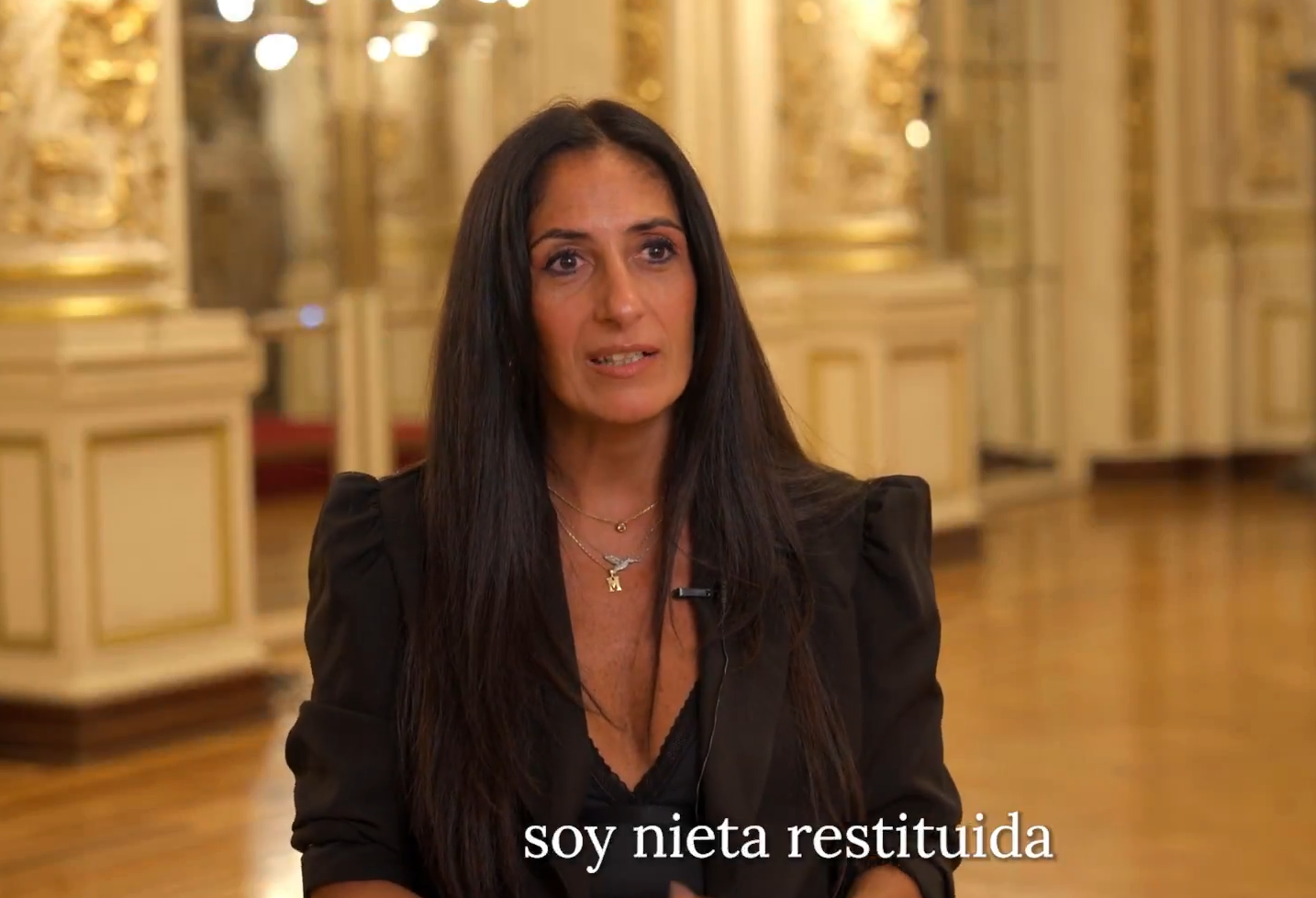
Miriam Fernandez.
Towards the close of the introduction, the idea of an unbiased historical reconstruction is reinforced. “New generations have the right to access a comprehensive and respectful vision of those years, free from ideological impositions, political convenience or censorship,” the text maintains, reiterating that a partial vision “ceases to be memory and becomes an instrument of
manipulation”.
Victims' testimonies
The video includes different testimonies that accompany this perspective. Among them, the participation of Miriam Fernández, recovered granddaughter 127, stands out, who affirms that society believed “a story that was not real” and points out: “To heal in this country and to heal as citizens, we have to
tell the true story”.
Also part of the material is Arturo Larrabure, son of the former Argentinian soldier from the Larrabure Valley, kidnapped in 1974 by the People's Revolutionary Army (ERP).
In his testimony, he recalls: “That night there were injuries and deaths. In Argentine history, this is the longest kidnapping, lasting more than a year. I think it's time to call for the union of Argentines, of all Argentines. We have a wonderful country and we have to take advantage of it
.”
In this way, the Government of Milei seeks to tell the full story about the 70s, to advance the need to expand historical memory.