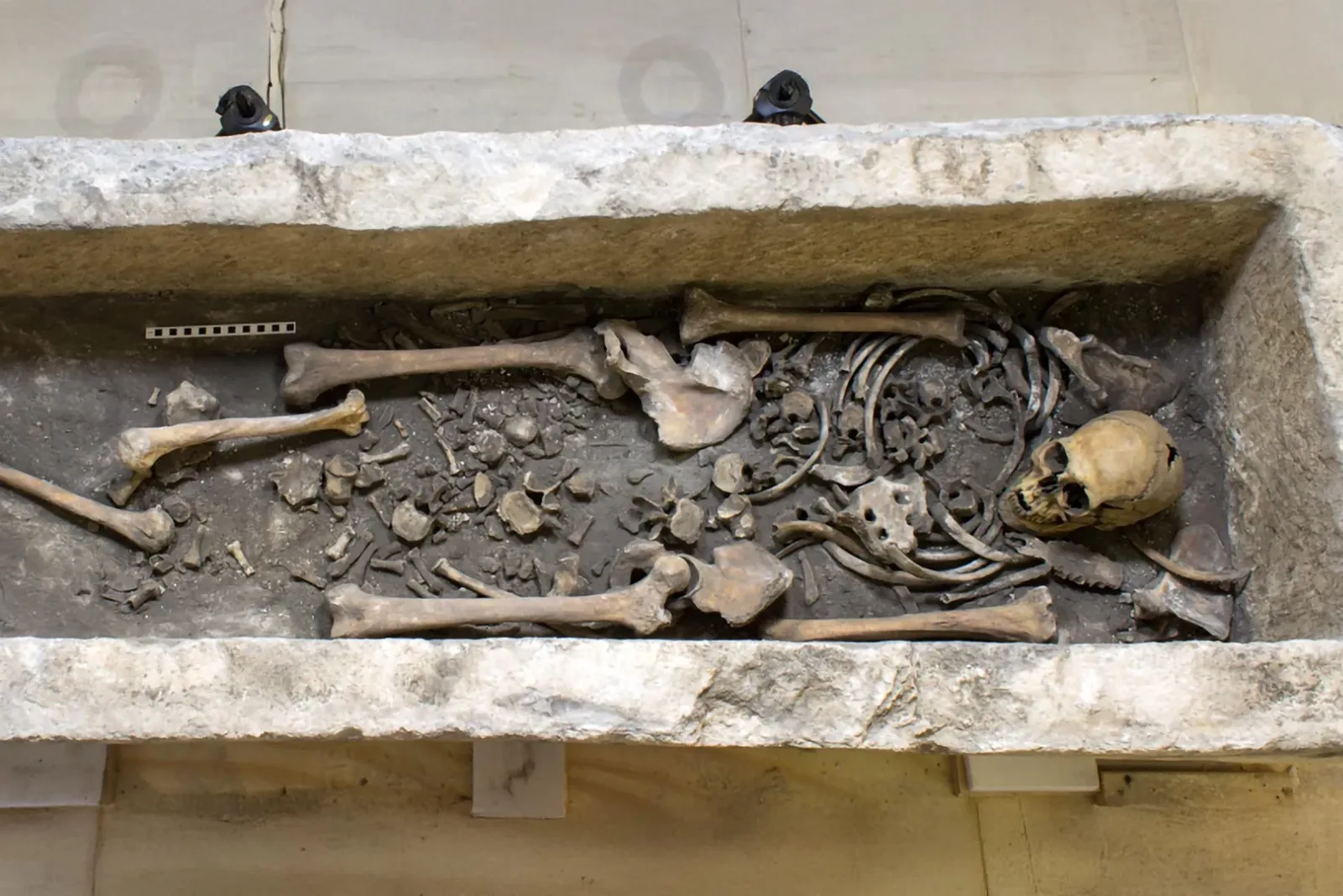
A skeleton found more than a century and a half ago inside a Roman sarcophagus at Westminster Abbey may have finally found its identity. According to new research, the remains belong to a high-ranking abbot from the medieval period, buried in a stone coffin that was already several centuries old when it was reused.
The limestone sarcophagus was formally excavated in 1869, although workers had accidentally discovered it in 1820. It bears an inscription mentioning Valerius Amandinus, a wealthy Briton who lived in London between 300 and 400 AD. However, a large Latin cross carved on the lid dates from the 10th or 11th century, indicating that the person resting inside lived much later than the original manufacture of the chest.
The latest findings, published in the Journal of the British Archaeological Association, are presented by Professor Warwick Rodwell, consulting archaeologist for Westminster Abbey. Rodwell points to two main candidates: Aelfwig, an abbot who died around 1020, and Wulnoth, who succeeded him and died in 1049. Both would have been buried in the Benedictine monastery that was then Westminster.
“We have two viable contenders for the occupant of the sarcophagus,” says Rodwell. He adds that either of the two would fit if it is assumed that the abbot was appointed in his early twenties and died near fifty. The fact that Aelfwig had already been a monk of Westminster could tip the scales in his favor.
A distinguished burial in a recycled chest
The elaborate burial form reinforces the idea that this was an important figure. Rodwell argues that the deceased was “honored” with a quality sarcophagus, an unusual distinction consistent with the status of an abbot. Instead of commissioning a new coffin, those who organized the funeral reused an existing Roman one. They placed the deceased's wooden coffin inside the stone and modified the lid with the Latin cross.
This gesture could be one of the earliest documented examples of recycling a valuable object for a completely different purpose. Recent analysis of the skeleton, conducted by human bones specialist James Young Langthorne from Pre-Construct Archaeology, indicates that the man was between 35 and 49 years old and approximately 1.75 meters tall. These data differ from the 19th-century assessment, which described him as a “robust young man” of no more than 30 years and about 1.70 meters.
One of the most compelling pieces of evidence came with radiocarbon dating. A bone sample analyzed at the Scottish Universities Environmental Research Centre yielded a range between 987 and 1052 AD. This interval coincides with the death dates of Aelfwig and Wulnoth and confirms that the repurposing of the sarcophagus occurred in the late Saxon period, nearly a thousand years after its original manufacture.
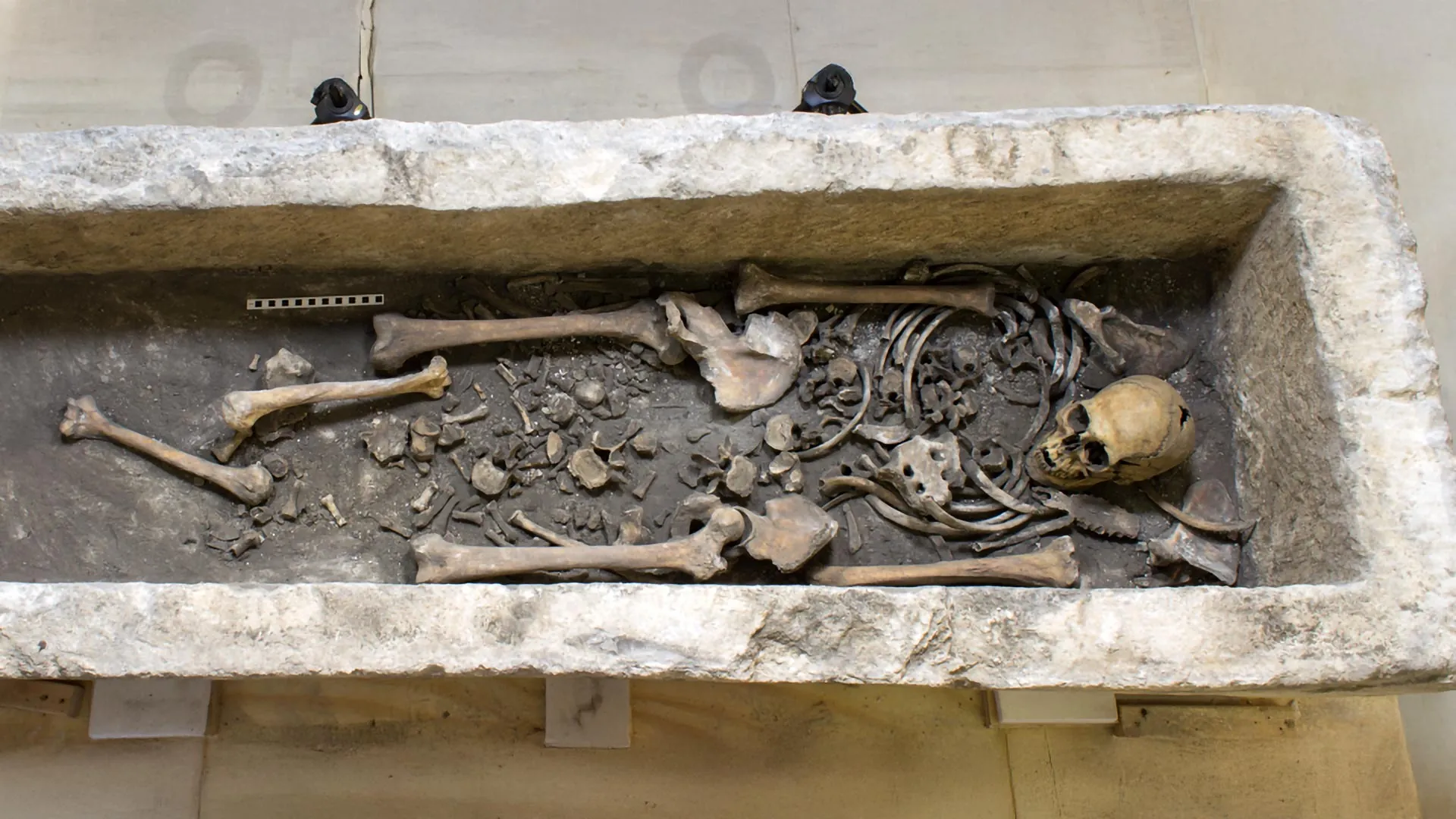
For years, it was believed that the skeleton had been lost. In 2016, when the sarcophagus was moved to a conservation workshop, researchers from Pre-Construct Archaeology removed the lid and found the almost complete remains still inside. They also detected the rectangular outline of a missing structure, marked by a white lime residue, a material historically used in burials. Rodwell interprets that trace as the remnant of the original wooden coffin, which completely decomposed over the centuries.
A visible piece for the public
The body of evidence —the rediscovered skeleton, the traces of the wooden coffin, and the scientific dating— has changed the understanding of this peculiar burial. Although the identity of the man is not definitively confirmed, everything points to a medieval abbot receiving the honor of resting in an already ancient Roman sarcophagus. Today, visitors can see the sarcophagus in the Queen’s Diamond Jubilee Galleries at Westminster Abbey.