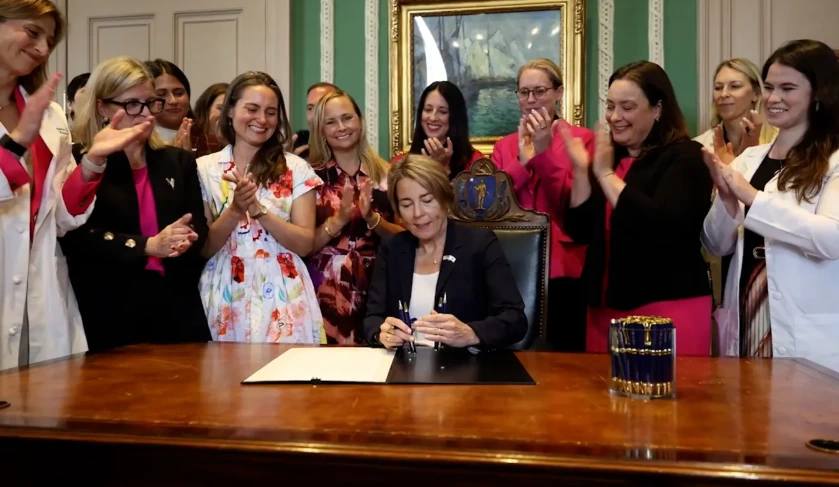
The Democratic governor of Massachusetts, Maura Healey, signed an outrageous law that removes the general 24-week limit for abortions and significantly expands the possibility of performing procedures in advanced stages of pregnancy.
The measure represents a new advance of the pro-abortion agenda in one of the most progressive states in the United States and was presented by Healey as a defense of the supposed "access to health." However, pro-life organizations harshly questioned the removal of restrictions that until now established a concrete time limit.
The new regulation will come into effect in 90 days.
Massachusetts removes the 24-week limit
The legislation known as Prioritizing Patient Access to Care Act modifies the rules that governed in Massachusetts. Until now, the state generally prohibited abortions after 24 weeks, although there were exceptions.
With the new law, healthcare professionals will have greater leeway to determine whether to perform an abortion during later stages of pregnancy, without being exposed to the penalties outlined by previous restrictions.
For pro-life sectors, the change represents a setback in the protection of human life and an expansion of the circumstances under which an abortion can be performed when the pregnancy is very advanced.
Massachusetts thus joins Alaska, Colorado, Maryland, Michigan, Minnesota, New Jersey, New Mexico, Oregon, and Vermont, as well as the District of Columbia, among the U.S. jurisdictions that do not establish a general gestational limit.
Maura Healey defended abortions in advanced stages
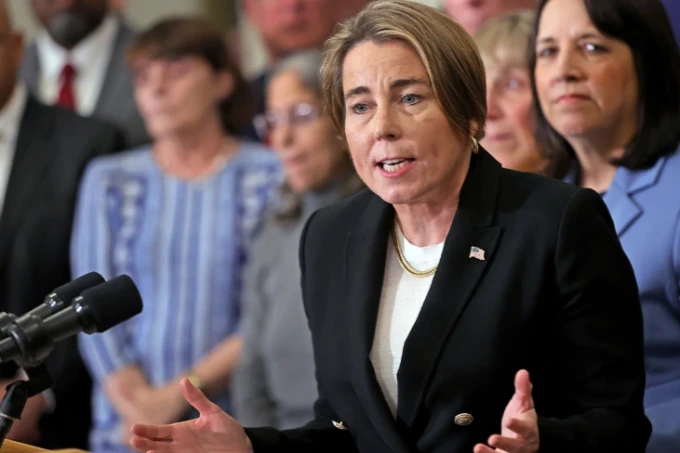
During the signing ceremony, Healey defended the reform and stated that decisions about abortion should rest solely in the hands of women, their families, and doctors.
"Decisions about healthcare should be made between women and families and their doctors, not by politicians", the governor stated.
Maura Healey defended late-term abortions
Healey justified the removal of the limit by arguing that there are families facing complications during the later stages of pregnancy who should be able to access an abortion within the state without having to travel to another jurisdiction.
The governor also took the opportunity to politically confront Donald Trump and the Republicans, whom she accused of seeking to reduce abortion protections at the national level.
Pro-life organizations condemned the decision
The organization SBA Pro-Life America condemned the signing of the law and labeled the measure as "extreme."
Its president, Marjorie Dannenfelser, particularly questioned the removal of limits for abortions performed in advanced stages of pregnancy and warned about the consequences of allowing these procedures to be performed with fewer restrictions.
The organization also called for Republicans to abandon the idea of leaving abortion regulation entirely in the hands of the states and to move towards national protections for unborn children.
The central argument of pro-life sectors is that the discussion cannot be reduced to a matter of "access to health," as it directly involves the protection of a human life in gestation.
A new chapter in the cultural battle in the United States
The decision in Massachusetts comes in a context of strong political and cultural confrontation in the United States.
Since the Supreme Court overturned Roe v. Wade, states have taken on a central role in regulating abortion. Democrats seek to consolidate access to the procedure in the states under their control, while Republicans and pro-life organizations push for greater restrictions and protective measures for unborn children.
Healey decided to make Massachusetts a bastion of that nefarious agenda, while also using the reform to openly challenge Trump and the conservative movement.
The new law will take effect in 90 days and will eliminate the general 24-week limit that existed until now. For its proponents, it represents an expansion of rights; for its critics, the removal of a legal barrier that protected life in advanced stages of pregnancy.