Another significant change was the recognition of the platforms as a private mobility service, a classification that differentiates them from traditional public transportation and that had been defended by La Libertad Avanza during the legislative debate.
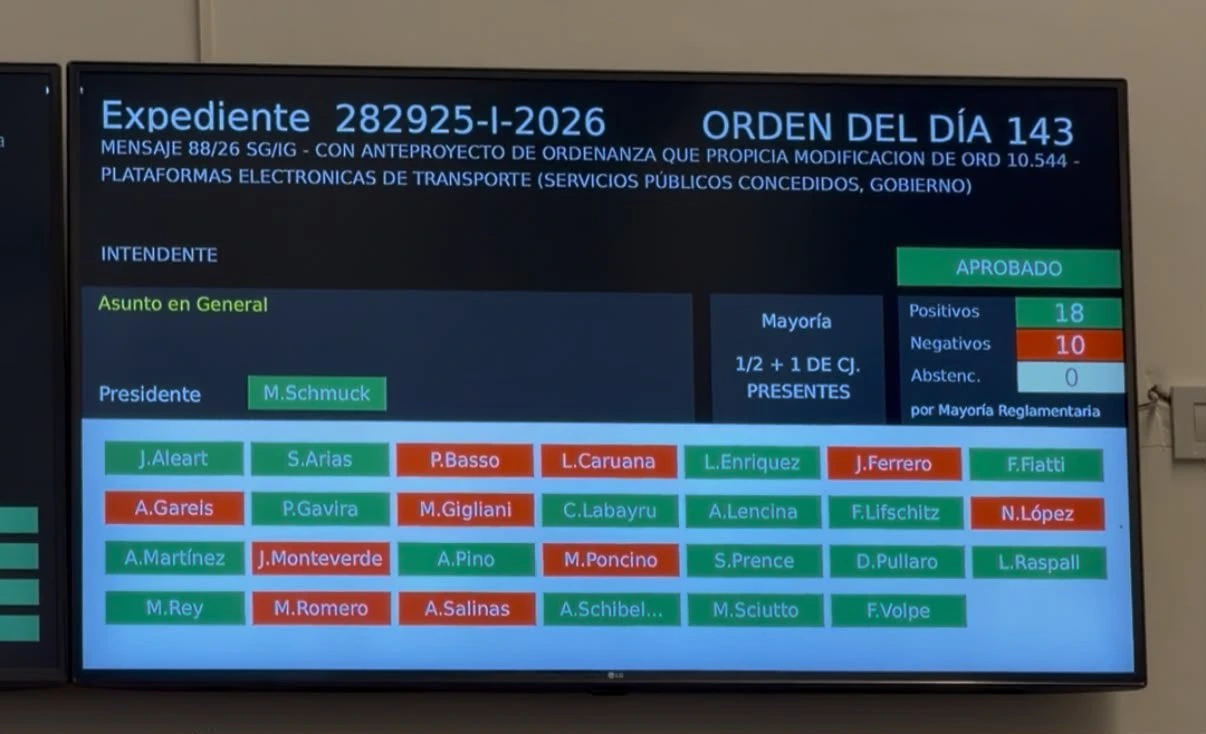
La Libertad Avanza managed to modify the municipal government's project in Rosario and eliminate the main restrictions that were intended to be imposed on transportation apps like Uber and DiDi. The new ordinance was approved this Thursday by the Municipal Council with 18 votes in favor and 10 against, and will allow the platforms to operate legally in the city.
The approval came after intense negotiations between the local government and the La Libertad Avanza (LLA) bloc, which conditioned its support on the elimination of various regulations that limited the freedom of contracting between drivers and passengers.
The vote in the Rosario Council.
Among the main changes promoted by the party of President Javier Milei are the elimination of mandatory minimum fares, the removal of new specific fees, and the recognition of the apps as private transportation services, instead of incorporating them into the public services regime.
Fewer restrictions and freedom to set fares
One of the central points of the negotiation was the elimination of the minimum fare that the original municipal government project contemplated. The proposal established a floor for the price of rides, a provision that was rejected by La Libertad Avanza. With the incorporated modifications, the platforms will be able to freely set their prices according to supply and demand conditions, without being subject to a minimum value imposed by the municipality.
The action of La Libertad Avanza stopped the practical ban on the use of platforms.
Additionally, the La Libertad Avanza bloc managed to have the new specific fees that were intended to be applied to these companies discarded, avoiding the imposition of additional tax burdens on their activity.
The requirements that platforms must meet
Despite the elimination of these restrictions, the ordinance maintains certain demands to ensure the service's operation.
Drivers must have a professional license, although they will have six months to adjust their permits, with the possibility of extending the deadline by another six months. Vehicles will also need to provide proof of the corresponding technical inspection and have insurance for passenger transport.
A measure aligned with Milei's deregulation agenda
La Libertad Avanza succeeded in curbing the communist regulation of apps.
The legislative outcome represents a step forward in the economic deregulation agenda promoted by La Libertad Avanza at the national level under the leadership of President Javier Milei, based on reducing state intervention and eliminating obstacles to the development of private activities.
From the libertarian space, they highlighted that the modifications allow for an expansion of the transportation alternatives available to the people of Rosario and facilitate new job opportunities without imposing fare controls or additional specific burdens.