A reflection on the future of Antarctica and the geopolitical scenario that looms for 2048. If Argentina wants to rise to the occasion, we must start today on a long journey of building capacities and power.
By the year 2048, the commercial exploitation of Antarctic resources will be renegotiated. The Protocol on Environmental Protection to the Antarctic Treaty, known as the Madrid Protocol and in force since 1998, explicitly prohibits in its Article 7 all activities related to the exploitation of mineral resources in Antarctica, except for those with scientific purposes. As stated there, starting in 2048 any Consultative Party to the Antarctic Treaty may convene a review conference on the functioning of the Protocol.
I repeat: Any Consultative Party may convene the review of the Protocol. According to the Antarctic Treaty Secretariat itself, these are the states that could convene the decision to review the Protocol.
Can we rely on the goodwill of all of them to ensure that NOTHING HAPPENS in Antarctica? List: Germany, Argentina, Australia, Belgium, Brazil, Bulgaria, Czech Republic, Chile, China, South Korea, Ecuador, Spain, United States, Russia, Finland, France, India, Italy, Japan, Norway, New Zealand, Netherlands, Peru, Poland, United Kingdom, South Africa, Sweden, Ukraine, and Uruguay.
Antarctica 2048: the resources at stake are enormous
The main hypothesis of conflict is a dispute over Antarctic resources. Citing Ignacio Rovira, from a geological point of view, the Antarctic Peninsula is part of the same system that gave rise to the Andes Mountain Range. This implies that, only there, reserves of copper, nickel, chromium, manganese, and graphite comparable to those of the American continent could be found.
Additionally, in the Weddell Sea, a Russian state-owned company found possible oil and gas deposits beneath the seabed. In the Scotia Sea, ferromanganese crusts composed of manganese, iron, cobalt, nickel, and rare earths were identified. All these resources are key in global supply chains in the 21st century.
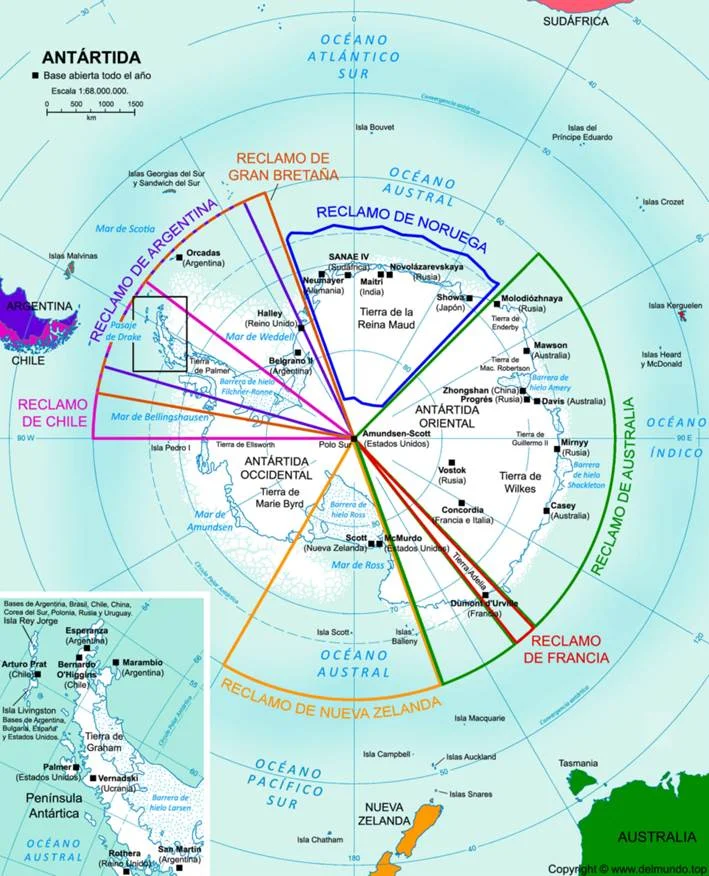
The reopening of the debate on resource exploitation will inevitably bring about the reactivation of sovereignty claims that the Antarctic Treaty of 1959 left in suspension but never resolved. Argentina, Chile, and the United Kingdom have overlapping sectors in the Antarctic Peninsula; the United States and Russia, for their part, expressly reserve the right to make claims if other countries assert theirs.
This scenario of conflicting interests among powers with disparate military capabilities cannot be analyzed solely in diplomatic terms. History shows that military instruments are one of the real ways to resolve these controversies. The question we must ask ourselves today is not whether there will be conflict, but whether we will be prepared when the balance of the Treaty begins to erode.
The value of Antarctic sovereignty is not defended solely with legal documents or diplomatic statements; it is sustained by effective presence, and effective presence depends on logistics. Argentina has maintained an uninterrupted presence in Antarctica since 1904, currently with seven permanent bases and six temporary ones, but that projection capacity rests on a logistics chain that shows its limitations every time it is subjected to operational stress.
Currently, the bulk of supplies, fuel, construction materials, and personnel relief are channeled through the icebreaker ARA "Almirante Irízar," operating in seasonal campaigns. Such a system, centralized on a single flagship vessel, with Antarctic bases that lack dock infrastructure to allow for real scaling, is fragile in the face of any hypothesis of greater operational demand.
Preparing for a hypothesis of Antarctic conflict, or even to maintain a credible deterrent presence, involves building redundancy, scale, and response capacity in compressed times. This requires port infrastructure capable of receiving large vessels simultaneously, storage, repair, and fuel facilities, integrated air connectivity with naval capacity, and advanced logistical nodes within the continent itself that allow for resource redistribution without exclusively relying on the bridge from the South American continent.
The logic is the same that governs any force projection doctrine: without logistics, there is no policy; without infrastructure, there is no logistics. Today, Argentina operates the icebreaker from Buenos Aires, a total logistical and economic absurdity, in a logic that is not planned for a high-intensity competition scenario.
Antarctica 2048: the Ushuaia - Dundee Island aeronaval bridge, the first firm step
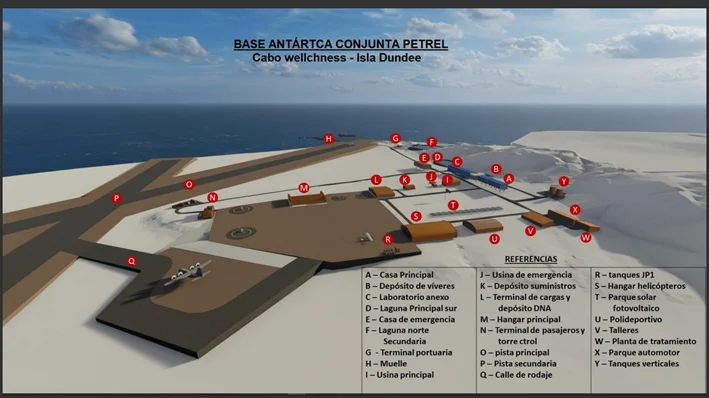
The two ongoing infrastructure projects of greatest strategic relevance for Antarctic projection are the Integrated Naval Base (BNI) in Ushuaia and the Joint Antarctic Base (BAC) Petrel on Dundee Island. At the BAC Petrel, the project is to build a dock that allows for the reception of logistical vessels and, additionally, an airfield enabled to constitute an aerial deployment platform.
Implementation/components of the project to readjust the Petrel Antarctic Base.
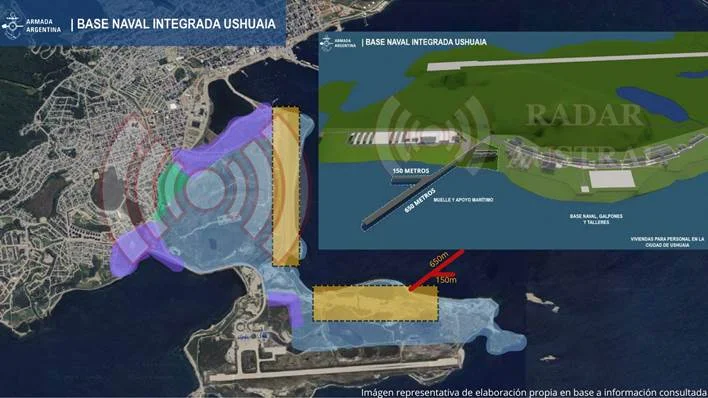
This is how the strategic Integrated Naval Base in Ushuaia will be: the future Antarctic Logistics Hub - Radar Austral
The Integrated Naval Base in Ushuaia: the node that Argentina needs. Located on the Peninsula of Ushuaia and near the airport, the design of the BNI contemplates an integration of aeronaval capabilities: a dock with a depth that allows for the operation of icebreakers, industrial warehouses for storage and repair, scientific laboratories, a fuel plant, and, among other things, a hangar over the airport with capacity for strategic cargo transport aircraft.
The logistical and diplomatic benefits of the Integrated Naval Base. First, it will allow Argentina to stop operating from Buenos Aires and from the small commercial dock in Ushuaia, a limitation that compromises both efficiency and operational confidentiality, and to have exclusive naval infrastructure capable of simultaneously receiving several large vessels.
The BNI will have its own ship repair workshops, fuel supply capabilities, national scientific laboratories (COCOANTAR, DNA, IAA, others), and housing for the increase of military personnel that the activity of the pole will demand.
This integration of functions turns the BNI into a true international Antarctic logistical hub, capable of providing support services not only to its own operations but also to other allied countries operating in the region, positioning Argentina as the gateway to Antarctica. Currently, most scientific missions depart from Punta Arenas in Chile, as they have developed the infrastructure to sustain the logistics that Argentina cannot provide.
The position of Ushuaia from a simple geopolitical perspective
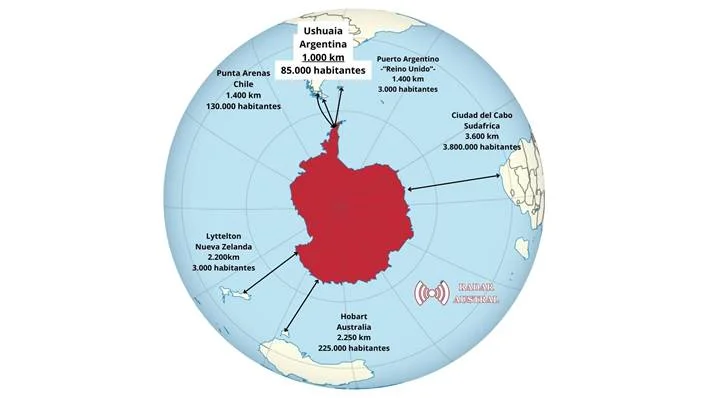
The geographical fact that defines the competitive advantage of the BNI is one that is rarely mentioned with the emphasis it deserves: Ushuaia is approximately 400 kilometers closer to the Antarctic Peninsula than Punta Arenas and Puerto Argentino (Falkland Islands).
Ushuaia is only 1,000 kilometers from the Antarctic Peninsula, with 150 kilometers to Cape Horn and then 480 nautical miles to the Drake Passage. Punta Arenas, which today acts as a logistical base for multiple scientific and tourist expeditions, is about 400 kilometers northwest of Ushuaia. That difference in distance translates directly into a reduction of 2 days (one way) in navigation time, lower fuel consumption, less wear on vessels, and greater operational response capacity.
In scenarios of urgency, rescue, emergency resupply, or force deployment, those kilometers make the difference between arriving on time or arriving late. Another detail is that Ushuaia is a more beautiful city than Punta Arenas and Puerto Argentino to visit, a not insignificant fact that tips the balance in favor of Argentina regarding Antarctic tourism.
This will be the strategic Integrated Naval Base in Ushuaia: the future Antarctic Logistics Hub - Radar Austral
Antarctic Tourism is a reality that can no longer be ignored. Antarctic tourism ceased to be a marginal activity a long time ago: in the 2023-2024 season, 122,072 visitors traveled to Antarctica according to IAATO data. In historical perspective, the leap is staggering: in the early 1990s, fewer than 8,000 people a year visited the white continent; today that figure has multiplied more than fifteen times. By 2034, the most conservative projections estimate that there could be 450,000 annual visitors.
This reality generates a dual strategic dimension that Argentina cannot overlook. On one hand, Antarctic tourism is a first-rate economic vector for Tierra del Fuego and for the country's soft sovereignty: each cruise that departs from Ushuaia reinforces the narrative of Argentina as the "gateway to Antarctica." On the other hand, the sustained growth of maritime traffic in the region imposes increasing demands for port infrastructure, nautical security services, maritime rescue, and environmental management that the Argentine state must be in a position to meet with solvency. Not adapting to this dynamic is literally ceding ground to those who do adapt.
The Argentine military power as another major pending debt
If logistics is the backbone of the Antarctic presence, military power is its ultimate guarantee. Argentina currently operates with a single icebreaker for intensive use, and despite being a vessel with significant capabilities to operate in Antarctica, relying on a single icebreaker is an unacceptable structural vulnerability for a country with the vocation and projection that Argentina must have on that continent. A mechanical incident, a simultaneous emergency at multiple bases, a fire like the one that has already occurred, or the escalation of geopolitical tension could collapse the entire support chain at the worst possible moment.
Argentina urgently needs to develop a strategy for diversifying its polar fleet. This implies exploring, at a minimum, the acquisition or construction of at least a second icebreaker that allows for simultaneous presence in different points of the Argentine Antarctic sector and sustain operations throughout the summer period without overloading the Irízar.
At the same time, the development of its own aeronaval capabilities is essential: maritime patrol aircraft capable of operating from Ushuaia, Petrel, and Marambio, greater availability of naval helicopters capable of extreme cold operations, and the sustained development of military aviation. Aeronaval power is the force multiplier that converts infrastructure into effective sovereignty; without it, the BNI and Petrel are valuable installations, but militarily hollow against actors with greater projection. The construction of these capabilities is dual, with implementation in peacetime, but with the possibility of also asserting themselves in times of conflict.
Development of specific Tactics, Techniques, and Procedures (TTPs) to operate in extreme cold and ice environments.
Argentina must urgently consider starting to create small units that formalize doctrine and knowledge in