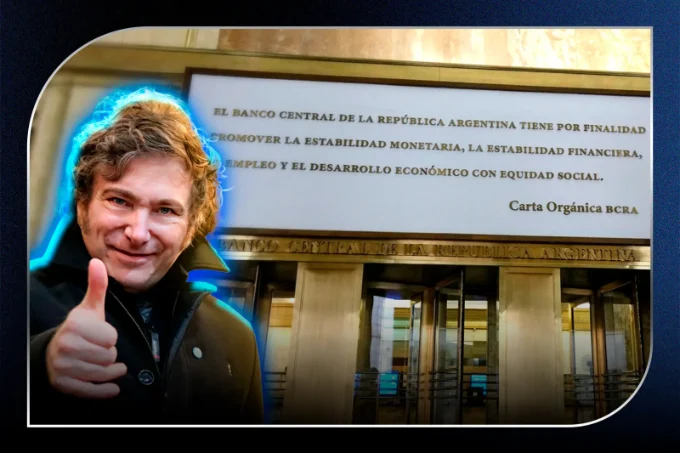

The reform of the Organic Law of the Central Bank is something we owe ourselves as a society. Changing its original mission is what led us to decades of inflation, a problem that unfortunately characterized Argentina for no less than the last 60 or 70 years.
The original mission of the Central Bank was to be the guardian of the value of the national currency, to preserve its value. However, in the last modification, they assigned it five different objectives, some even contradictory to each other, for which the Central Bank does not have the tools nor should it have the responsibility.
The mission of the Central Bank is very clear: it is a strictly monetary issue, linked to the management of the national currency.
The independence of the Central Bank from political power
Therefore, in addition to restoring that original mission, the reform seeks to strengthen its independence. To do this, it establishes measures aimed at making the removal of its authorities more difficult and preventing a recurrence of what we have seen several times over the last 30 years: politicians removing a Central Bank president at will because they were an obstacle.
The position of the president of the Central Bank is technical and needs continuity over time. That is why it seeks to make their removal more complicated. Specifically, it incorporates the Chamber of Deputies and requires the vote of both chambers.
The end of monetary financing to the Treasury
Another fundamental point is that the reform expressly prohibits monetary assistance to the Treasury. This assistance was precisely the reason for the spurious, unsupported monetary issuance that characterized the Central Bank for so long and that led Argentina, on various occasions, to episodes of mega or hyperinflation.
Inflation is a consequence of the imbalance between the supply and demand for money: a supply of pesos that does not find an equivalent demand. And it functions as a tax that is not voted on in Congress.
It is a hidden and deceptive tax. People only find out when they discover that the money they have in their pocket is worth less than they thought.
Moreover, the inflationary tax primarily affects the poorest, because they have a greater proportion of their capital in cash. Lacking assets that can protect them from inflation, as can happen with real estate, this tax affects a much more significant part of their wealth.
To prevent issuance aimed at supporting the Treasury, the reform expressly prohibits advances to the Treasury and also the purchase of sovereign bonds in the primary market, that is, at the time of their issuance.
The Central Bank can buy sovereign bonds, but in the secondary market. The difference is important: when it buys in the secondary market it pays a private entity that holds that bond, not the State.
The mechanisms that allowed the Central Bank to be drained and deteriorated
The reform also eliminates other deceptive devices for issuance and draining the Central Bank.
One of them was the non-transferable letters. During the Kirchner era, the Treasury withdrew reserves from the Central Bank to use them, for example, to pay debt, and exchanged those papers in return.
A non-transferable letter resembles a sovereign bond, but has a fundamental difference: it cannot be negotiated. This was systematically done for years and for tens of billions of dollars. In this way, the reserves were drained. That mechanism is also eliminated.
Another particularly perverse device was the distribution of pseudo-profits from the Central Bank.
The Central Bank can earn a small income from managing its international reserves. That would be a legitimate profit. But during the Kirchner era, profits generated by the revaluation in pesos of international reserves were distributed.
The balance of the Central Bank is expressed in pesos. Therefore, when the peso loses value against the dollar, the same reserves become worth more pesos.
Suppose the Central Bank has a thousand dollars and the dollar is worth a thousand pesos. Those reserves are worth one million pesos. If the following year the dollar rises to 1,500 pesos and the Central Bank still has exactly the same thousand dollars, the reserves account for one and a half million pesos. That 500,000 pesos difference was distributed as a profit.
But that supposed gain occurred precisely because the Central Bank had failed to fulfill its essential mission: to defend the value of the currency.
If the currency had maintained its value, that gain would not have existed. Therefore, it was not a true profit. It was exactly the opposite: profits were distributed when the Central Bank did not fulfill its mission.
The problem was even more serious because that liquidity did not exist either. To deliver that supposed profit to the Treasury, it had to be issued.