
The battle that defines Wall Street: artificial intelligence against rates

The battle that defines Wall Street: artificial intelligence against rates
Imagen de Editorial Team
porEditorial Team
Argentina

The FED raised rates again and the bond market demands even higher yields, while artificial intelligence keeps the big tech companies afloat

Add La Derecha Diario on
Share:

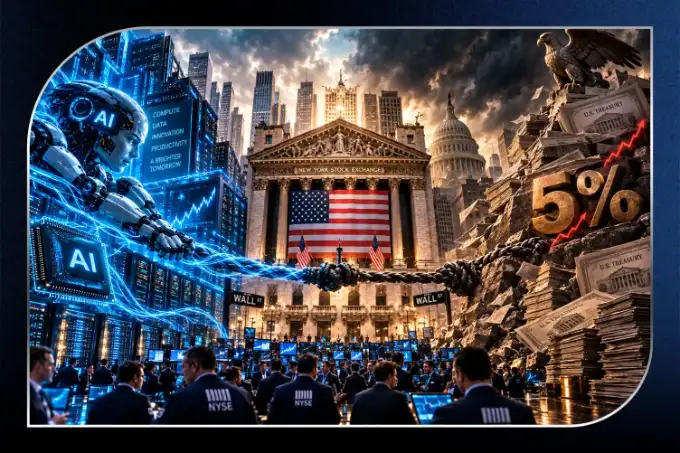
The week clearly laid out what is likely to be the most important discussion for financial markets in the coming months: Can the productivity boom associated with artificial intelligence continue to support Wall Street in the face of increasingly higher interest rates?

The Federal Reserve took a step this week that just a few months ago seemed improbable. On Wednesday, it raised the benchmark rate by 25 basis points, bringing it to a range of 3.75%–4.00%. This was the first increase in three years and, more importantly, the Fed made it clear that it is unlikely to be the last. Sixteen of the eighteen committee members expect at least one more hike before the end of the year. Kevin Warsh justified the decision by pointing out that the economy continues to show strength, that investment remains robust, and that inflation is not converging to 2% quickly enough.

It is important to understand what has changed. Until not too long ago, the big market debate was when the Federal Reserve would lower rates. Today, we are discussing how many more times it might raise them.

And the bond market is sending an even more important signal than the Fed's own decision.

The yield curve keeps rising

One might have imagined that a more aggressive Fed, demonstrating a willingness to combat inflation, would calm the medium- and long-term bond market. That did not happen.

If we compare last Friday's close with this Thursday's, practically the entire relevant part of the U.S. yield curve ended higher.

The yield on 1-year bonds rose from approximately 4.35% to 4.44%. The 2-year yield, much more sensitive to expectations about monetary policy, increased from 4.63% to 4.76%. The 5-year yield went from 4.78% to 4.86% and the 10-year yield rose from 4.96% to 5.01%. The 30-year Treasury ended around 5.34%, virtually unchanged from the previous week, although it did touch 5.40% during the week.

This data seems central to me.

The Fed raised rates and yet the market continued to demand higher yields to lend money to the U.S. government.

The 10-year Treasury closed again around 5%, a level that has become a true psychological barrier for the markets. Meanwhile, oil remains above US$100 per barrel, fueling inflationary concerns. Futures are already assigning a significant probability to another Fed hike in October.

This means that the market is beginning to incorporate an uncomfortable reality: perhaps high rates are not a transient phenomenon.

Why hasn't this hit the stock market harder yet?

Because on the other side, there exists an extraordinarily powerful force: artificial intelligence.

Tech companies continue to invest massive amounts of capital in data centers, chips, infrastructure, and artificial intelligence models. The market's expectation is that this investment will produce a huge leap in productivity over the next few years.

And that expectation is well-founded.

If a company can produce the same output using fewer hours of labor, automate tasks, improve programming, reduce administrative costs, or dramatically increase employee productivity, its margins can grow even in a less favorable economic environment.

This argument continues to support tech valuations.

This week, that divergence was clearly visible. The S&P 500 ended virtually unchanged, while the Nasdaq managed to close the week up mainly due to the boost from semiconductors. The Dow, much less exposed to the tech phenomenon, suffered its largest weekly drop since March. Technology now represents around 38% of the S&P 500 and has risen over 20% during 2026.

In other words: AI is still managing to neutralize much of the negative effect of rates.

But the question is, how long will this last?

The math of rates ultimately matters

A 10-year yield around 5% completely alters the valuation of assets.

To begin with, an investor can earn approximately 5% annually by lending to the U.S. Treasury without taking on corporate risk. This means that any stock must offer a sufficiently higher expected return to justify the risk.

Moreover, tech stocks are especially sensitive to the discount rate because a large part of their valuation depends on earnings expected far in the future.
When rates fall, those future cash flows are worth much more in present terms.

When rates rise, the opposite occurs.

And this is the problem that is beginning to emerge.

The artificial intelligence narrative says: more investment → more productivity → more profits → higher stock prices.

The bond market narrative says: more inflation → higher rates → greater cost of capital → lower valuations.

Both can be true simultaneously for a time.

But eventually, one of the two forces has to dominate.

What ultimately wins?

That seems to me to be the big discussion in the coming months.

The optimistic scenario holds that the United States is entering a new cycle of productivity comparable to other major technological leaps in history. If artificial intelligence can sufficiently boost corporate profits, companies could justify high valuations even with rates close to 5%.

The problem is that the market is already paying in advance for much of that future productivity.

In contrast, the effect of rates is immediate.

A higher rate increases the cost of financing businesses, mortgages, cars, acquisitions, and investment projects. It also forces the use of a higher discount rate to value stocks and makes bonds seriously compete with stocks for investors' capital.

And there is another fact that should not go unnoticed: although the S&P practically did not fall this week, market breadth was quite poor. On Friday, there were significantly more stocks declining than advancing both on the NYSE and Nasdaq. This means that beneath the major indices, the market shows much more weakness than suggested by the leading tech companies.

My impression is that this battle will ultimately be won by rates.

Not because the artificial intelligence revolution is false. It is probably exactly the opposite: it could become one of the biggest productivity shocks of the last few decades.

But good technology and good investment are not necessarily the same thing at any price.

If the 10-year Treasury remains above 5%, if the 2-year rate continues to incorporate new Fed hikes, and if inflation forces a restrictive monetary policy for a longer time, the cost of capital will ultimately weigh heavily.

The stock market can ignore this for weeks or even months while tech earnings continue to grow.

But historically, there is a hard-to-evade rule: when the price of money rises enough, sooner or later it changes the price of all other assets.

The question is no longer just how much artificial intelligence can improve American productivity.

The question is what interest rate Wall Street can withstand while waiting for that productivity to finally appear in earnings.

And with the 10-year Treasury again around 5%, we are probably much closer to knowing the answer.


La Derecha Diario logo
TwitterInstagramYouTubeTikTokFacebook
Derecha Diario TV

Nosotros

  • Quienes Somos
  • Autores
  • Donar

Privacidad

  • Protección de datos
  • Canales
  • Sitemap
  • RSS

Contacto

  • info@derechadiario.com.ar
PUBLICIDAD

Related news

No one saw penicillin coming: why slowing down artificial intelligence could also cost lives

No one saw penicillin coming: why slowing down artificial intelligence could also cost lives

Lula admitted the persecution against Jair Bolsonaro: "I want to win to keep him in jail"

Lula admitted the persecution against Jair Bolsonaro: "I want to win to keep him in jail"

The Official Response Office debunked one by one the fake news about the National Sovereignty Law

The Official Response Office debunked one by one the fake news about the National Sovereignty Law

Trump cut his break at Camp David due to the crisis in the Middle East and is considering attacking the Houthi terrorists in Yemen

Trump cut his break at Camp David due to the crisis in the Middle East and is considering attacking the Houthi terrorists in Yemen

The "March of Anger" against Milei failed: The left marched, achieved nothing, and went home

The "March of Anger" against Milei failed: The left marched, achieved nothing, and went home

A Central Bank that becomes the guardian of the currency's value

A Central Bank that becomes the guardian of the currency's value

La Derecha Diario logoLa Derecha Diario logo
ESX logoInstagram logoYouTube logoTikTok logoFacebook
ARGENTINAUNITED STATESECUADORISRAELMEXICODERECHA DIARIO TV
  • ES
    XInstagramYouTubeTikTokFacebook
  • DERECHA DIARIO TV
  • Sections
  • ARGENTINA
  • UNITED STATES
  • ECUADOR
  • ISRAEL
  • MEXICO
  • URUGUAY
  • Countries
  • La Derecha Diario logoLA DERECHA DIARIO
  • La Derecha Diario México logoLA DERECHA DIARIO MÉXICO
  • La Derecha Diario Uruguay logoLA DERECHA DIARIO URUGUAY
  • La Derecha Diario Ecuador logoLA DERECHA DIARIO ECUADOR
  • La Derecha Diario Israel logoLA DERECHA DIARIO ISRAEL
  • La Derecha Diario Estados Unidos logoLA DERECHA DIARIO ESTADOS UNIDOS
  • Topics
  • GUERRA EN IRÁN
  • The Newspaper
  • QUIENES SOMOS
  • AUTORES
  • PUBLICIDAD
  • DONAR