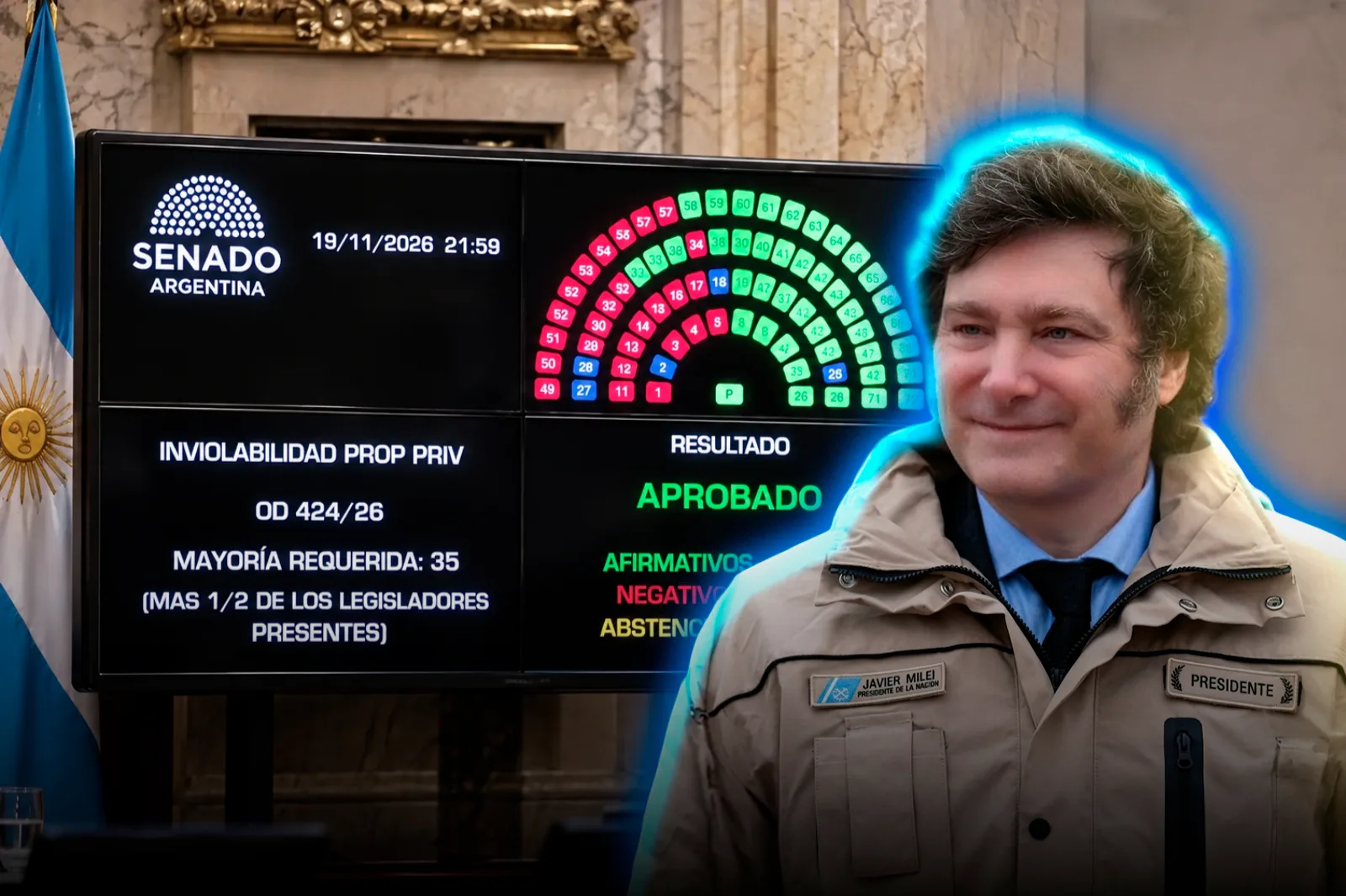
The Government of Javier Milei achieved a new legislative victory this Thursday: the Senate passed the Law of Inviolability of Private Property with 42 votes in favor and 26 against. The initiative strengthens guarantees against expropriations and streamlines judicial eviction procedures. The text returned to the upper house after the modifications approved by the Chamber of Deputies on October 21.
Regarding expropriations, the law establishes a restrictive interpretation of public utility and requires a concrete identification of the pursued objective. It also stipulates that the measure must be “suitable, necessary, and proportional”. It reaffirms that there will be no transfer of ownership without full payment of the corresponding compensation.
The Government has scored another legislative victory.
The compensation will include the market value, when it can be determined, and direct damages. It will also recognize documented lost profits: the earnings that are no longer received as a direct consequence of the expropriation. For this item, a limit of 30% of the emergent damage is set, unless proof of a greater impact is provided. The compensation amount will be adjusted for inflation and will accrue interest from the date of default.
In evictions, the reform stipulates that actions will be processed through the summary trial of the Civil and Commercial Procedural Code of the Nation and expands the possibilities of requesting early delivery of the property, subject to judicial evaluation and legal requirements. These national procedural changes will not automatically transfer to the provinces' codes, which retain their own procedural rules.
Milei's reformist agenda is advancing.
For unpaid residential rents, the prior notice of at least ten consecutive days must be maintained before initiating the lawsuit. The text also provides for the intervention of protection agencies before executing evictions when there are minors, persons with disabilities, or elderly individuals in a state of vulnerability, with measures to ensure a temporary housing alternative without halting the continuity of the process.
The reform also includes the regularization of ownership of unique and permanent homes for those who can prove possession with lawful, peaceful, ostensible, and continuous cause during the ten years prior to the request, along with the other requirements of the regime. In the registral aspect, it allows the submission of documents with digital signatures and sets a maximum of 30 days for their qualification, aiming to modernize real estate procedures.