Whenever large-scale artificial intelligence is discussed, the conversation ends up in the same place: the need for enormous amounts of GPUs. These chips stand out for their ability to perform many operations in parallel, ideal for training and running AI models.
However, China is exploring a different path. Instead of relying exclusively on GPUs, the Asian country is deploying supercomputers based solely on CPUs for high-performance tasks and artificial intelligence. This strategy largely responds to the limitations imposed by the United States that restrict access to the most advanced accelerators.
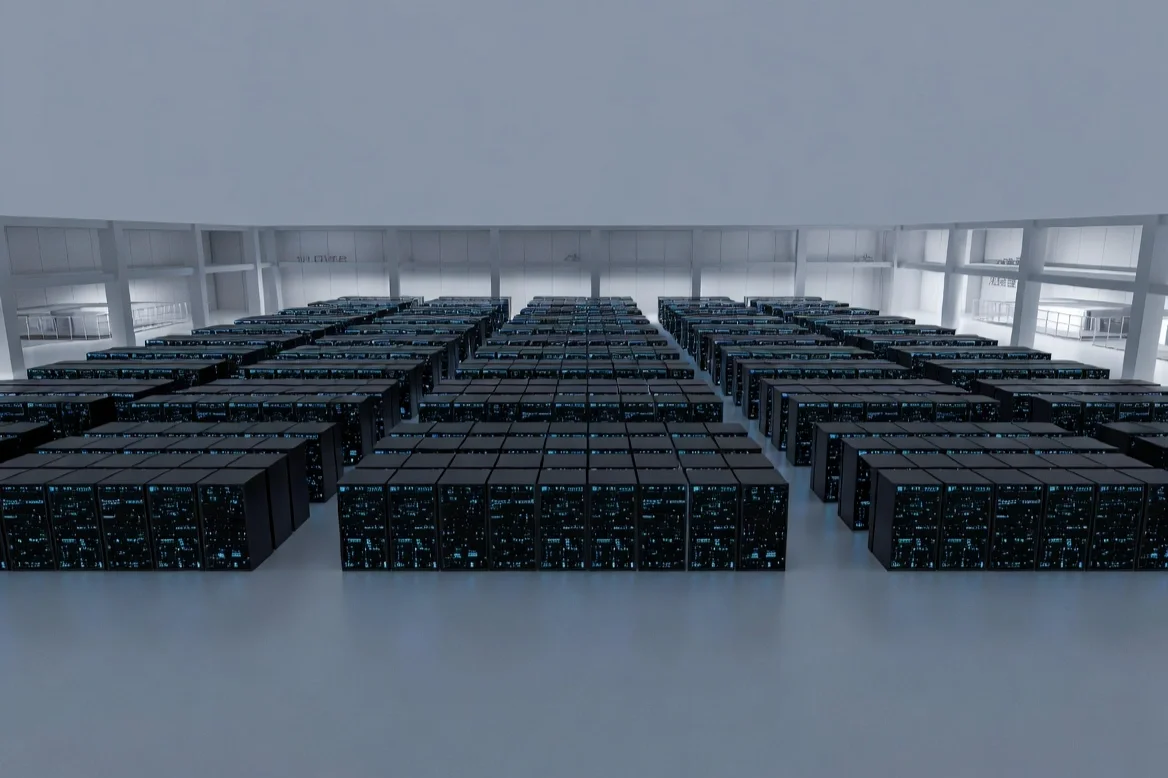
The most notable example is the LineShine, linked to the National Supercomputing Center in Shenzhen. It is a system built entirely with domestic processors, without any GPUs, and designed to handle both traditional high-performance computing and AI workloads.
The heart of the LineShine: the LX2 processor
The key processor is the LX2, an Armv9 chip optimized for these tasks. Each unit integrates two chiplets and has 304 cores organized into eight clusters. It includes SVE and SME units that accelerate vector and matrix operations, fundamental in training AI models.

Additionally, it combines HBM memory within the package with external DDR5, allowing for the rapid and capable movement of large volumes of data. The complete system uses 47,000 CPUs distributed across 92 computing cabinets.
According to the deputy director of the Shenzhen center, Huang Xiaohui, the LineShine has already completed its deployment by the end of 2025 and achieves a sustained performance of over 2 exaflops. With this mark, China aims to surpass the US's El Capitan, which currently leads with nearly 1.8 exaflops.
A geopolitical alternative with its limits
This bet on CPU-only architectures is not just a technical preference, but a response to the geopolitical context. By reducing dependence on foreign hardware, China seeks to strengthen its technological sovereignty and keep pace in the AI race.
Experts acknowledge that systems based solely on CPUs can be efficient for certain tasks, but GPUs still offer clear advantages in intensive and highly parallelizable workloads. That is why the majority of the global industry continues to bet on mixed architectures that combine general processors with graphic accelerators.
The LineShine then presents itself as a viable alternative path under specific restrictions. It does not demonstrate that the dominant GPU model is obsolete, but it does show that it is possible to advance with proprietary solutions when access to preferred hardware becomes complicated.
This initiative is part of a broader effort by China to develop independent technological ecosystems. While data centers around the world continue to consume massive amounts of GPUs, projects like this explore how to maximize CPUs to avoid falling behind in cutting-edge computing.
The future will tell if this pure CPU route can scale competitively in the long term or if it will end up complementing, rather than replacing, the hybrid solutions that currently dominate the artificial intelligence landscape. What is clear is that Chinese innovation is advancing despite external barriers.