When a political center refuses to choose, it always ends up choosing another in its place. France currently offers the clearest illustration of this. Since Emmanuel Macron dissolved the National Assembly in June 2024, the country has had three prime ministers (Michel Barnier; François Bayrou, and Sébastien Lecornu, twice), something improbable for this stable country.
The resulting Assembly has eleven distinct political groups, a record under the Fifth Republic, with none approaching the 289 seats needed to govern alone. This fragmentation is a direct consequence of Emmanuel Macron's weakness and his weak policies, making the country ungovernable.
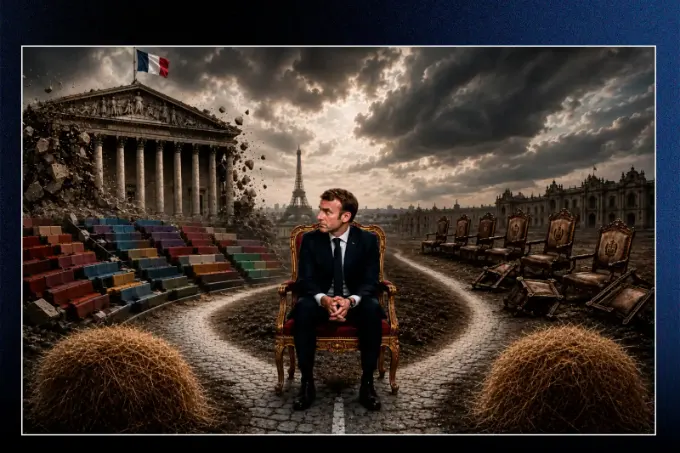
Buridan's donkey
Medieval philosophy has a name for this paralysis: Buridan's donkey. The animal, placed equidistant from two identical bales of hay, dies of hunger for not having chosen which one to approach.
For his part, Max Weber, in The Politician and the Scientist (1919), distinguished between ethics of conviction, which judges an action by the purity of its intention, and ethics of responsibility, which judges it by its assumed consequences.
The famous "en même temps," which means at the same time (or in this case, the ability of our President Emmanuel Macron to choose without choosing) belongs neither to the ethics of conviction nor to the ethics of responsibility, because it borrows the vocabulary of responsibility without ever consenting to the choice that would commit him.
The pension reform of 2023, neither fully embraced nor ever repealed, remains its perfect illustration. The result is not a compromise; it is an absence, and that void has an electoral price: according to IFOP (Institut français d'opinion publique), at the beginning of July 2026, Marine Le Pen (right) reaches 36% of voting intention for 2027, compared to 19% for centrist Édouard Philippe and 15% for Jean-Luc Mélenchon (far left), her best result ever measured.
When a politician is unable to choose and make decisions (which is their main objective), they pave the way for the extremes, which, for their part, are decisive in every aspect where resoluteness is required.
Refusing to choose preserves nothing; it simply exacerbates the problem and empties the space that someone else will eventually occupy. Buridan's donkey does not avoid hunger by refusing to choose between the two bales: it dies anyway, believing it has bought time.