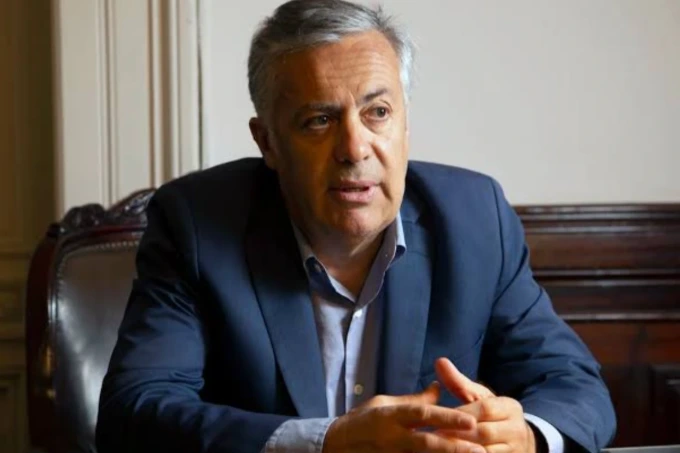

Cornejo called for a tax reform to change incentives and produce more

Cornejo called for a tax reform to change incentives and produce more
Imagen de Editorial Team
porEditorial Team
Argentina

Cornejo called for a comprehensive tax reform to organize spending and promote investment, production, exports, and employment

Add La Derecha Diario on
Share:

The governor of Mendoza, Alfredo Cornejo, called for advancing a comprehensive tax reform that allows for modifying the incentives of the Argentine tax system and promotes production, investment, exports, and job creation.

The Mendoza leader participated in Buenos Aires in the panel “Listening to Build. How Does a Federal Country Transform?”, where he shared the debate table with governors, business leaders, officials, and specialists to analyze the necessary changes in the fiscal scheme between the Nation and the provinces.

During his presentation, Cornejo stated that there is a political opportunity to reach agreements and emphasized that the main problems of the system are already identified.

Cornejo called for discussing spending before taxes

One of the governor's main points was that the fiscal discussion cannot be limited exclusively to a reduction of taxes, but must include a thorough review of public spending.

“I don’t think we are so far apart as to attempt to reach a consensus on a comprehensive tax reform,” said Cornejo, who recalled that tax reform is part of the structural transformations outlined in the Pact of May.

In this sense, he suggested that before defining which taxes should be modified, it is necessary to determine what kind of State is sought to be financed and what level of public spending is acceptable.

“Many times, there is too much focus on lowering taxes and not enough importance given to spending,” the governor noted. For Cornejo, it is necessary to change that perspective and first analyze how the State uses its resources.

From that definition, he considered that a tax scheme should be designed that allows financing state functions without becoming an obstacle to the growth of the private sector.
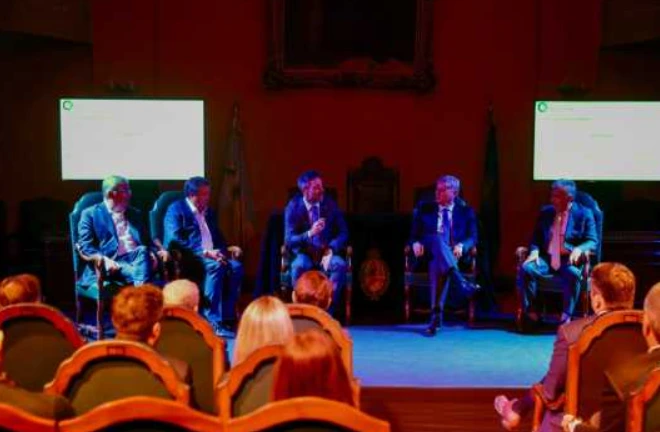
Cornejo requested to discuss spending before taxes

The governor called for organizing State responsibilities

Another key point of the presentation was related to the distribution of responsibilities between the Nation, provinces, and municipalities.

Cornejo recalled that provinces are responsible for fundamental services such as public education, health, a large part of security, the administration of justice, and public transportation.

He also highlighted the role of provincial justice in the functioning of the economy and the business climate, particularly in matters related to contracts and legal security.

In this context, he questioned the overlapping responsibilities that have accumulated over decades and called for establishing clearer rules regarding the functions of each level of government.

“We need to be clear about what competencies each one has, what obligations the Nation has, what obligations the provinces have, and what obligations the municipalities have,” he stated.

Cornejo called for modifying federal co-participation

The federal co-participation was another central point raised by the Mendoza governor.

Cornejo considered that it is not possible to carry out a deep tax reform without reviewing the system that determines how resources are distributed between the Nation and the provinces.

“You cannot make that reform without touching a law that is key to fiscal federalism, which is the co-participation law,” he asserted.

As he explained, the current scheme generates different incentives among the various jurisdictions. Therefore, he deemed it insufficient to analyze only the pressure of certain provincial taxes without also considering the resources that each province receives through co-participation.

A tax reform to boost investment, exports, and employment

For Cornejo, the goal of a new tax structure should be to generate incentives to produce, invest, and hire workers.

In this sense, he criticized the tax system for burdening activities that the country needs to expand.

“We need more exports, and we have export taxes; we need more investment, and we impose taxes on investment; we need more jobs, and we impose taxes on work. All of that needs to be organized,” he stated.

The proposal aims for fiscal policy to stop generating contradictory signals and instead favor the growth of private activity.

Cornejo proposed gradually eliminating Gross Income tax

Among the provincial taxes that should be modified, the Mendoza governor mentioned Gross Income tax, a tax he deemed necessary to eliminate gradually.

However, he clarified that its modification cannot be done in isolation but must be part of a broader fiscal agreement that simultaneously addresses public spending, co-participation, and the distribution of competencies.

Additionally, Cornejo pointed out that national taxes must also be reviewed. Among them, he mentioned the Bank Debits and Credits Tax, known as the check tax, due to its impact on production, financing, and investment decisions.

Cornejo called for discussing all changes within the same agreement

The governor of Mendoza insisted that a sustainable tax reform requires an integral agreement between the Nation and the provinces.

From his perspective, modifying a tax in isolation could create new imbalances if issues related to public spending, co-participation, and the responsibilities of each level of the State are not resolved at the same time.

“Once we reach that consensus, everything needs to be addressed together,” summarized Cornejo.

The proposal from the Mendoza leader thus aims for a reform that does not have as its sole objective the reduction of tax pressure but rather to change the structure of incentives in the Argentine economy to favor investment, production, exports, and private employment.


La Derecha Diario logo
TwitterInstagramYouTubeTikTokFacebook
Derecha Diario TV

Nosotros

  • Quienes Somos
  • Autores
  • Donar

Privacidad

  • Protección de datos
  • Canales
  • Sitemap
  • RSS

Contacto

  • info@derechadiario.com.ar
PUBLICIDAD

Related news

The Government confronted the University of Mar del Plata over the attacks on libertarian students and demanded sanctions

The Government confronted the University of Mar del Plata over the attacks on libertarian students and demanded sanctions

A leftist teacher called for the aggression against libertarian students at the University of Mar del Plata

A leftist teacher called for the aggression against libertarian students at the University of Mar del Plata

Raúl Jalil highlighted the productive potential of Catamarca to entrepreneurs

Raúl Jalil highlighted the productive potential of Catamarca to entrepreneurs

Revealing the millionaire credit card expenses of Tini Stoessel's father

Revealing the millionaire credit card expenses of Tini Stoessel's father

Since the assumption of Milei's Government, more than 500,000 jobs have been created

Since the assumption of Milei's Government, more than 500,000 jobs have been created

This is Leonardo Ponzio's coaching staff at River Plate

This is Leonardo Ponzio's coaching staff at River Plate

La Derecha Diario logoLa Derecha Diario logo
ESX logoInstagram logoYouTube logoTikTok logoFacebook
ARGENTINAUNITED STATESECUADORISRAELMEXICODERECHA DIARIO TV
  • ES
    XInstagramYouTubeTikTokFacebook
  • DERECHA DIARIO TV
  • Sections
  • ARGENTINA
  • UNITED STATES
  • ECUADOR
  • ISRAEL
  • MEXICO
  • URUGUAY
  • Countries
  • La Derecha Diario logoLA DERECHA DIARIO
  • La Derecha Diario México logoLA DERECHA DIARIO MÉXICO
  • La Derecha Diario Uruguay logoLA DERECHA DIARIO URUGUAY
  • La Derecha Diario Ecuador logoLA DERECHA DIARIO ECUADOR
  • La Derecha Diario Israel logoLA DERECHA DIARIO ISRAEL
  • La Derecha Diario Estados Unidos logoLA DERECHA DIARIO ESTADOS UNIDOS
  • Topics
  • GUERRA EN IRÁN
  • The Newspaper
  • QUIENES SOMOS
  • AUTORES
  • PUBLICIDAD
  • DONAR