The financial plan is distinguished by an unprecedented intertemporal solvency logic in recent history. As detailed by the head of the Palacio de Hacienda, “new debt is issued exclusively to refinance the capital of inherited debt”, while he sharply emphasized that “interest is paid with fiscal surplus”.
The Argentine Republic is experiencing a day of financial euphoria that confirms the path of economic recovery outlined by the administration of Javier Milei. Following the official presentation of the financial program until 2027, both international and domestic markets reacted with overwhelming optimism, primarily reflected in the drop of the country risk, which fell by six units to settle at 408 basis points.
This figure represents a historic milestone, being the lowest point of the Milei era and the minimum recorded since April 24, 2018, when it marked 403 points.
The president, Javier Milei
The Minister of Economy, Luis Caputo, along with his team composed of José Luiz Daza and Federico Furiase, provided the strategic guidelines to address dollar debt payments, ensuring that the ultimate goal by the end of Javier Milei's second term is to regain the status of "investment grade".
In a message of institutional firmness, Caputo stated: “It must be understood that from day one this is a Government that chose to meet all obligations”.
This strategy aims to systematically reduce the debt-GDP ratio, ensuring that the burden of commitments relative to the economy becomes increasingly lighter. In light of the imminent maturity of USD 4.3 billion (or USD 4.2 billion according to Treasury records) on July 9, the minister confirmed that the funds will come from loans with international financial institutions.
Stock Rava
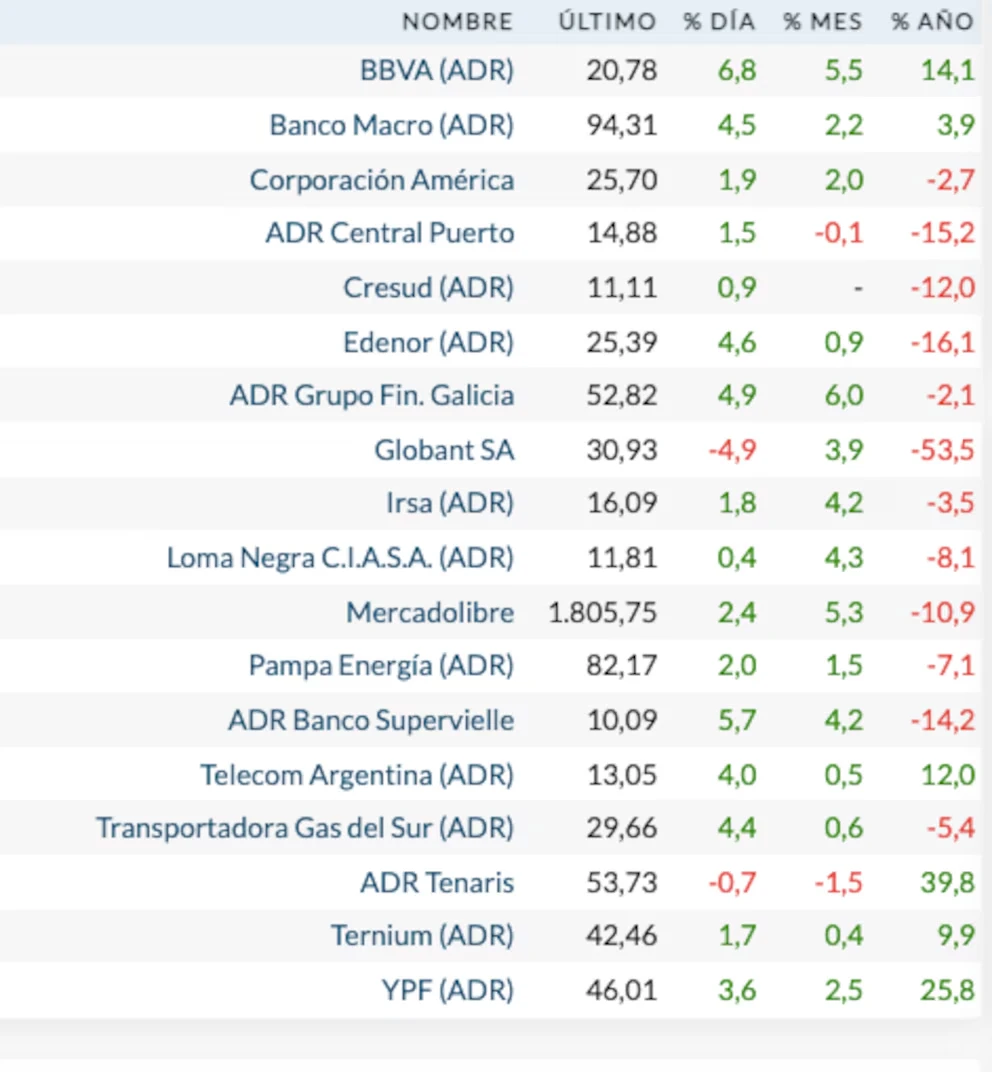
In operational terms, the stock and bond market reflected this renewed confidence. The ADRs of Argentine companies on Wall Street experienced spectacular increases, led by the banking sector: BBVA surged by 6.8% (or 6.7% according to the closing of operations), followed by Banco Supervielle with 6%, Grupo Fin. Galicia with 5.9%, Banco Macro with 5.3%, Edenor with 4.5%, and YPF with 4.4%. Additionally, the rebound of 8.6% in Bioceres shares was notable. In the local market, the S&P Merval index rose between 2.2% and 2.4%, reaching 3,266,960 points.
Meanwhile, the sovereign bonds in dollars —Globals and Bonares— advanced by an average of 0.2%, with peaks of up to 0.8% in certain parities. Regarding the currency market, the dollar remained stable at $1,510 on the Banco Nación screens, while the MEP dollar traded at $1,524 and the Contado con Liquidación (CCL) experienced a healthy drop of 1.7%, settling at $1,570. In the wholesale market, the currency fell to $1,486.50 with an operating volume exceeding USD 700 million.
Finally, Caputo emphasized that the return to international markets, although a feasible “option” for this year or next due to the country financing at 6% for 10 years, is not a desperate goal but rather another tool within a “conservative program”. The minister concluded with a definition that summarizes the new era: “The macroeconomic order shields the country from external or internal shocks”.