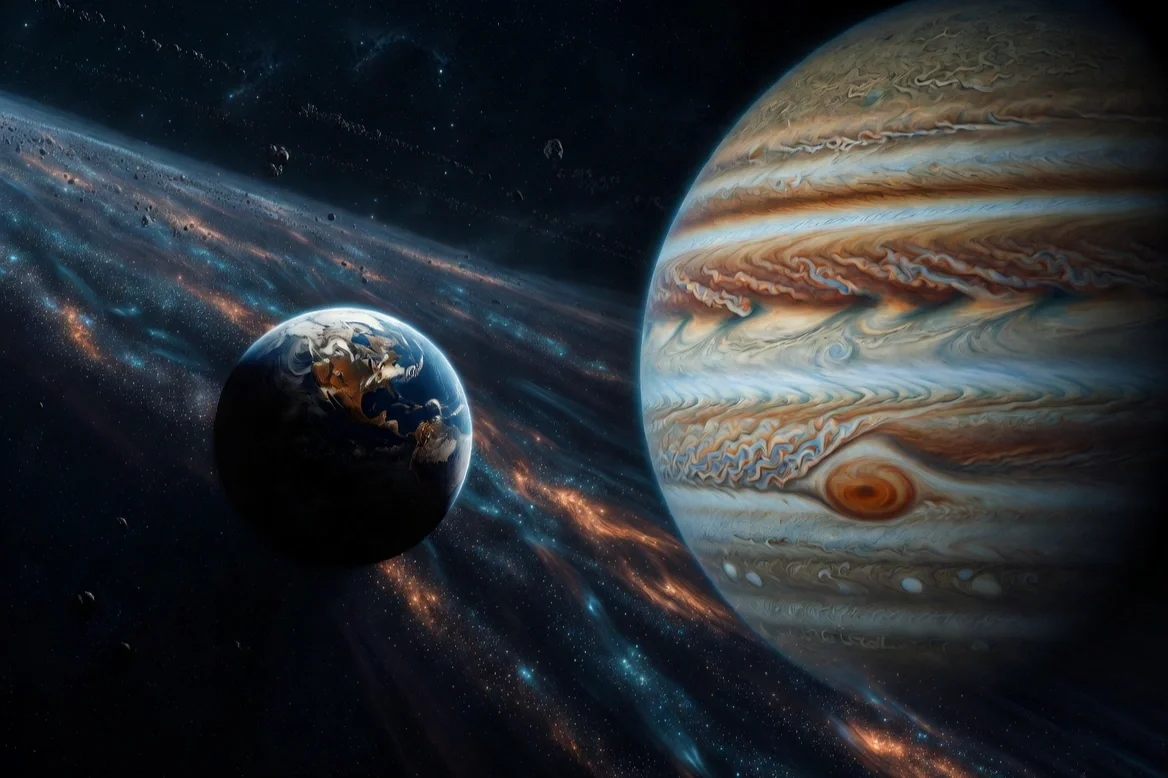

The Earth was very fortunate in its formation. Although Jupiter is a huge and inhospitable planet, it seems we owe much to its early presence. According to a study by scientists from Rice University, with support from NASA, this gas giant acted as a kind of gravitational dam that retained essential ingredients for life.
Phosphorus and nitrogen are fundamental elements in the correct proportions. The researchers analyzed the ratio of these two (P/N) in different meteorites and found that, initially, the proper ratio was concentrated in the outer regions of the Solar System, far from where the Earth formed.
When Jupiter was born, its enormous mass changed everything. It created a barrier that prevented phosphorus from continuing to escape outward, allowing it to concentrate in the inner region. Thus, our planet received just what it needed for life to eventually emerge.
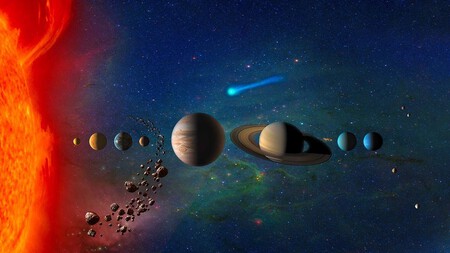
The formation of the Solar System
About 4.5 billion years ago, a cloud of gas and dust gave rise to the planetesimals that later formed the planets. Some fragments remained as asteroids and, when they fell to Earth, became meteorites. There are two main types: metallic iron ones, which are older, and rocky chondrites, which appeared a few million years later.
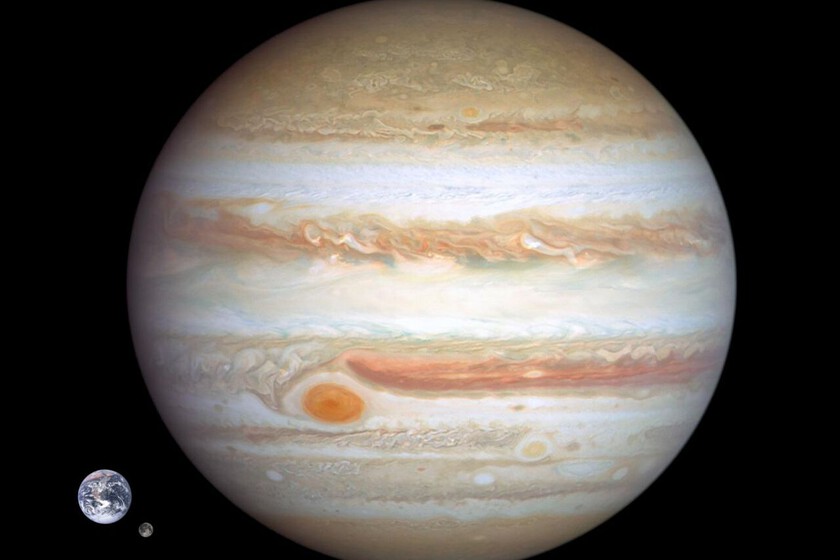
By analyzing these meteorites, especially through nickel and molybdenum isotopes, scientists determined their internal or external origin in the Solar System. This was key to understanding how phosphorus and nitrogen were distributed in the early times.
In the initial stages, the protoplanetary disk was hot and turbulent. Phosphorus condensed into minerals like schreibersite in the interior and was then dragged outward by currents. Nitrogen, being more volatile, remained at low levels in the outer regions, generating a high P/N ratio far from the Sun.
 The key change thanks to Jupiter








