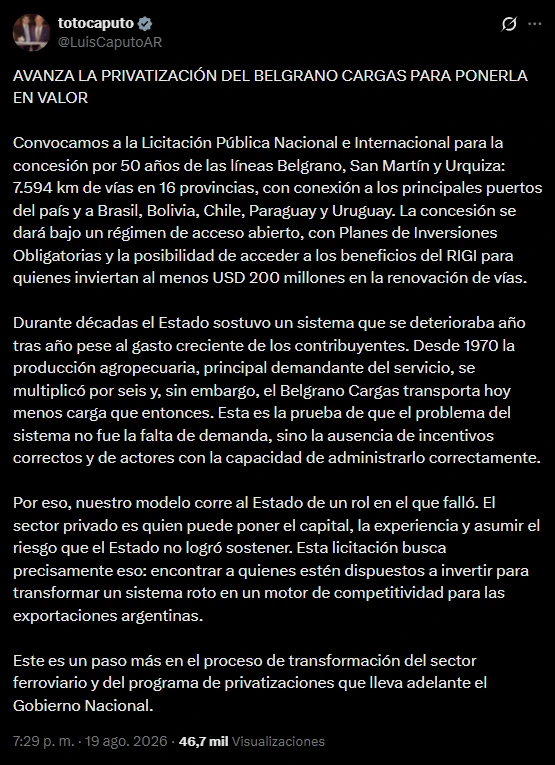
This Thursday, the documents for granting the concession of the 7600-kilometer network will be published. Companies controlled by foreign states will not be able to participate, and there will be benefits from the RIGI
Interested companies will be able to choose between two bidding modalities. One consists of competing solely for the concession and operation of the tracks. The other allows adding to that proposal the acquisition of the corresponding fleet of locomotives and wagons for each line. The goal is to diversify the actors involved in the system, from infrastructure maintenance to train operation.
The bidding documentation also includes the possibility for the awardees to access the benefits of the Incentive Regime for Large Investments. With this tool, the government seeks to generate greater interest among companies and obtain more competitive proposals.
Once the concessions are awarded and contracts signed, Belgrano Cargas y Logística S.A. will be dissolved and subsequently liquidated. This completes the transfer of freight railway operations to the private sector.
Bidding schedule
The call will be a national and international public invitation and will be managed through the CONTRAT.AR platform. The publication will take place over ten days in the Official Gazette, on the World Bank site known as DGMarket, and on the website of the Ministry of Economy.
Interested firms will have until November 11 at 9:59 to submit their bids. The opening of envelopes is scheduled for the same day, after 10. With this schedule, the government aims to complete the process before the end of the year and effectively initiate the private operation of the freight network.
The national government will take a key step this Thursday by publishing the resolution that enables the privatization process of Belgrano Cargas y Logística S.A. The measure includes long-term concessions and establishes clear rules to attract private capital to the freight railway system.
One of the central conditions is that the concessions will last for 50 years. Additionally, the participation of companies controlled by foreign states is expressly prohibited. This aims to ensure that operational control remains in the hands of private actors without external state ties.
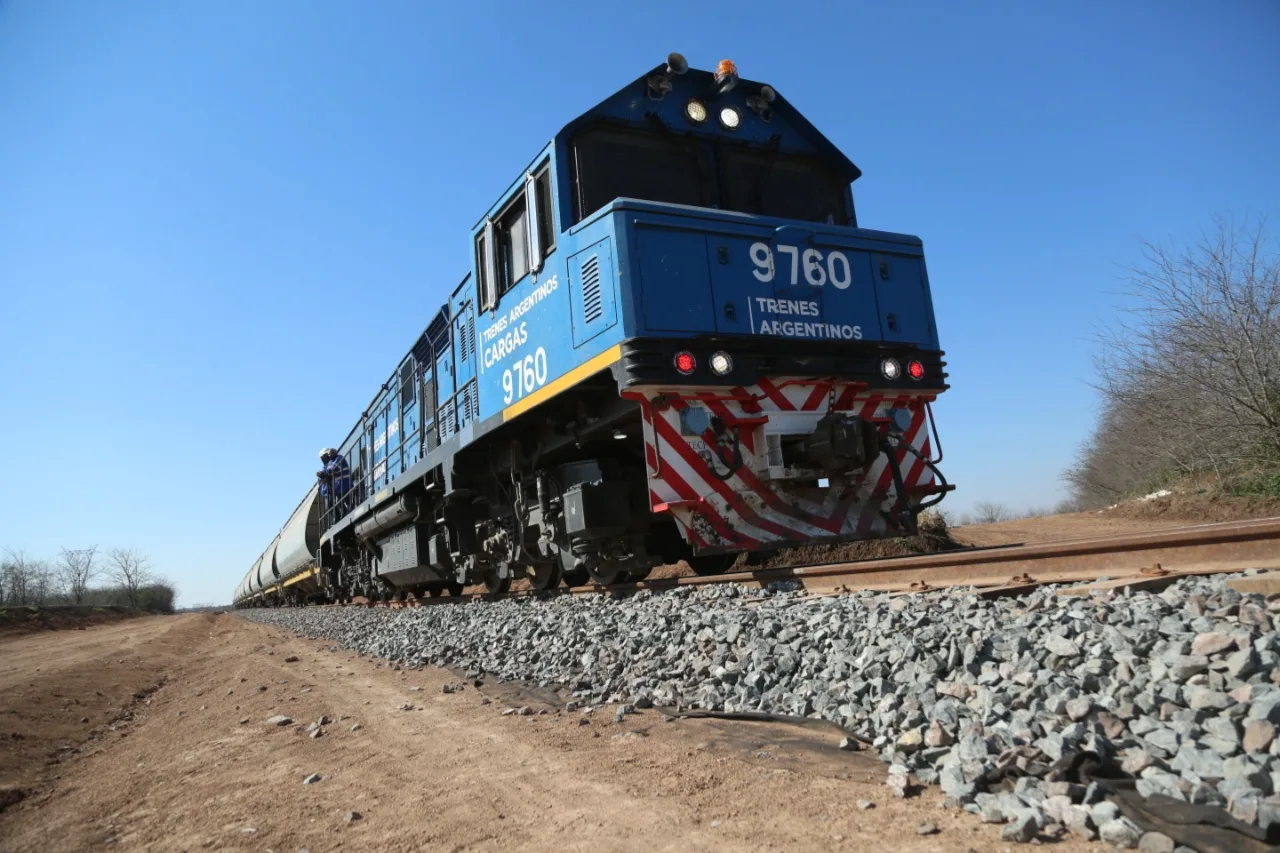
The state-owned company manages a network of 7,600 kilometers that spans sixteen provinces and the City of Buenos Aires. The three lines involved are the General San Martín, the General Urquiza, and the General Belgrano, which connect productive areas in the north, the coast, and the center of the country with the main consumption and export centers.
The privatization scheme is divided into three independent axes. On one hand, the tracks and adjacent properties will be granted to two private operators. They will be responsible for maintaining the infrastructure and may charge tolls for the use of the branches.
Workshops, rolling stock, and bidding options
In parallel, two other concessionaires will receive the workshops for the same fifty-year term. Their responsibility will be to repair and prepare the trains that run on the different lines. The third component is the sale of railway material: locomotives and wagons that currently belong to the state will be transferred to private hands through public auction.

 Bidding schedule