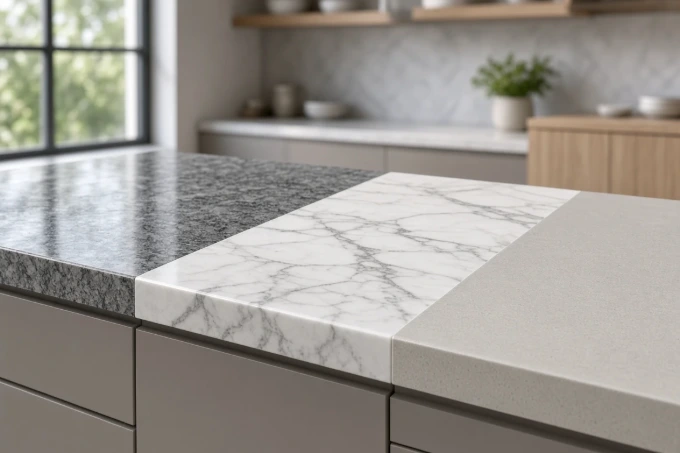

Choosing the material for the kitchen countertop is one of the most important decisions when setting up or renovating this space. It has to withstand impacts, stains, humidity, and high temperatures every day. That’s why many people hesitate between granite, marble, and quartz, three of the most popular options.
Although all three yield good results, they are not the same. Each has strengths and weaknesses in terms of durability, maintenance, and appearance. Before deciding, it’s advisable to carefully consider how the kitchen is used, how much you want to invest, and how much maintenance you are willing to do over time.
Granite is a natural stone known for its hardness. It tolerates impacts, scratches, and heat very well. It is a solid option for kitchens with heavy use. However, being porous, it requires periodic sealing to prevent it from absorbing liquids or staining easily.
Marble is also a natural stone and is often chosen for its aesthetics. The veining makes each piece unique. However, it is more vulnerable to stains, scratches, and acidic substances. Therefore, it requires more care if you want to maintain its original appearance for years.
Key differences between the three materials
Quartz, on the other hand, is an industrial material. It is made from mineral particles bonded with resins. Its surface is less porous, easy to clean, and highly resistant to stains. The downside is that high temperatures can damage the resins, so it’s not advisable to place hot pots or pans directly on it.
In practice, quartz often appears as the most convenient option for those seeking low maintenance and simple cleaning. It also offers many finishes and colors, making it easier to adapt the design to any kitchen.