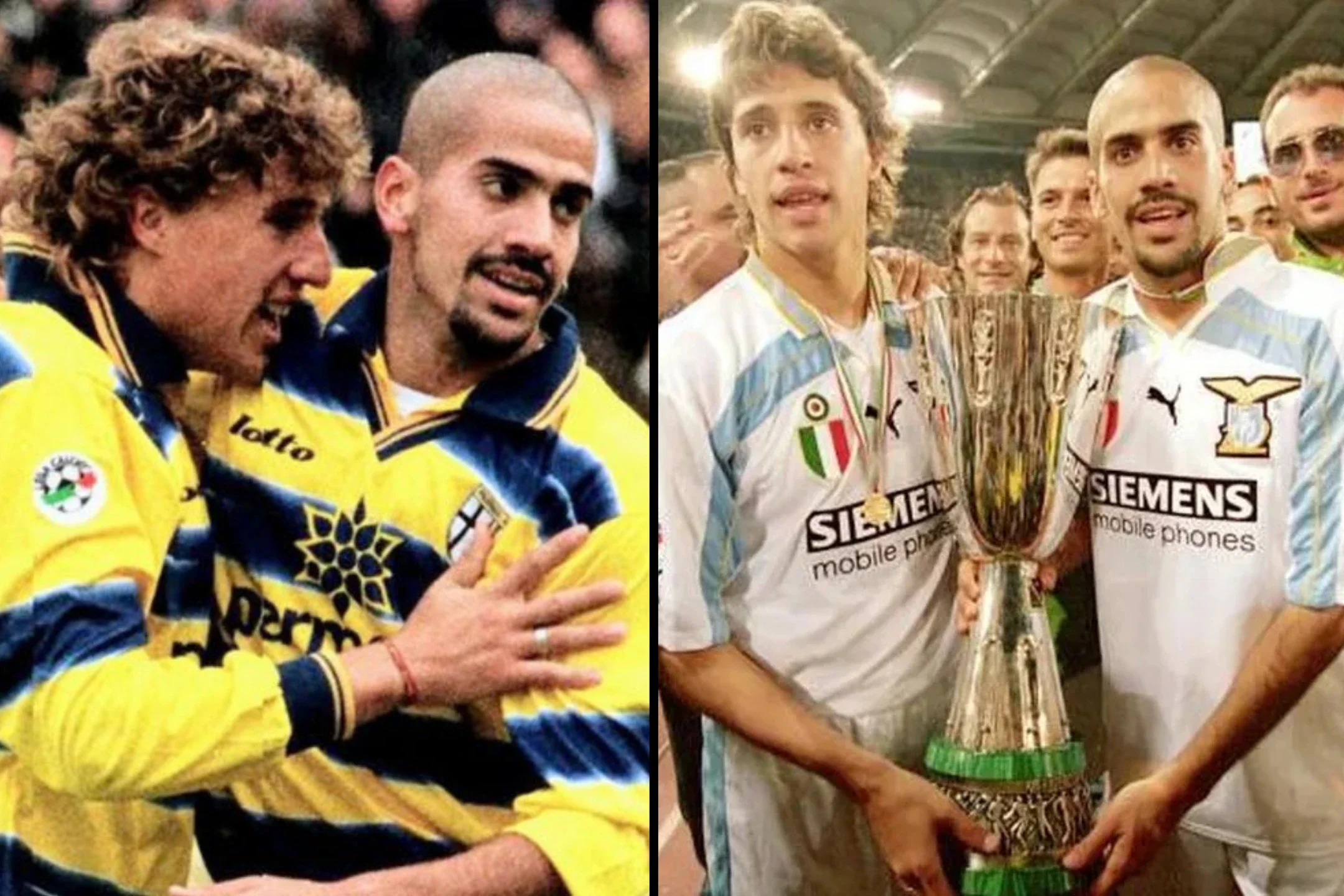

"He is the best player of the penultimate pass." "He improved everyone," were the phrases of the historic forward about his "best partner."
Nuevo
Agregar La Derecha Diario en
Compartir:
Recognizing the level of Juan Sebastián Verón as a footballer does not surprise anyone, but the assessment takes on a different weight when it comes from a reference in the field. Hernán Crespo, a historic forward of the Argentine National Team, publicly chose Verón as his best partner on the field and placed him among the most decisive figures of his career. In an interview with F90 (ESPN), the current coach explained that the influence of La Brujita went far beyond an assist: he was the player who built the play before the final pass.
The television inquiry led him to review names and roles, but Crespo was direct in defining his ideal partnership. “My partner was Verón. El Piojo (López) logically yes because he was the last pass, but Seba is, for me, the best player of the penultimate pass. He set up the other player so that they could give it to me,” he described. The phrase is not just a technical compliment: it defines a way of understanding football, where the true differential lies in the pass that organizes and conditions everything that comes after.
The “penultimate pass” as art: Crespo's tactical explanation
Crespo explained that the bond with Verón was not limited to a specific connection, but to a system that repeated itself game after game. In his view, the “penultimate pass” is the one that opens the scenario, accelerates the play, and leaves the team at an advantage, even before the final assist.That’s why he placed Verón above a simple statistic: he highlighted him as the player who “set up” the teammate so that the last pass arrived cleanly.
The former scorer also marked a difference that is often lost in superficial analysis. His idea is that the partner of the forward is not just the one who provides the goal pass, but the one who creates the context for that pass to exist and be simple.In that sense, Crespo positioned Verón as the type of footballer who understands timing, spaces, and receiving profiles, and who makes the forward receive the ball where it really hurts.
The way he said it also points to a football hierarchy. When Crespo states that Verón is “the best player of the penultimate pass,” he is placing him as an elite specialist in an action that defines rhythm, advantage, and emotional control of the match.That type of reading usually comes from those who have lived the area from the inside: the forward who needs the play to “start well” in order to finish it.
“Those who played with Verón…”: silent leadership and collective improvement
Crespo did not stop at the personal bond: he expanded the idea to Verón's impact on the entire group. “Those who played with Verón around hardly did not go to the National Team, anywhere in the world,” he began.The phrase suggests a contagious effect: around Verón, teammates elevated their performance, and that translated into recognition and call-ups.

He then reinforced that idea with an even more direct description of his influence. “He improved everyone… everyone improved with Verón. And if everyone improved with Verón, it was easier for me because I was the one who had to finish what Verón started to build,” he added.The concept is twofold: on one hand, Verón enhances the team; on the other, he simplifies the task of the “9” because he provides a more favorable scenario for finishing.
This reading also explains why Verón often appears as a total footballer, even when he was not the one providing the last assist. Crespo describes him as an organizer who raises the level of the rest, and that type of player tends to modify collective confidence: the team dares to do more because they feel that the play will end well.In high performance, that certainty can be the difference between a forced attack and a fluid play.
Moreover, Crespo positioned him as an internal value in the squads. The idea of “improving everyone” is not just technical: it also speaks of football leadership, of organizing the team with the ball, and of giving it a recognizable structure.A player like that not only appears in the pass but also in the way the team positions itself, breathes, and decides.
Italy, goals, and titles: the golden years of a decisive partnership
Crespo grounded the praise in concrete facts from his European career. He recalled that together with Verón they achieved important titles in Italy and that this partnership coincided with his most productive seasons.The mention was not nostalgic: it was a way to emphasize that individual performance is often linked to collective functioning and to a partner who “leaves you facing the goal.”
The former forward detailed specific moments where he feels he reached his peak as a scorer. “You talk about the best seasons… with Verón at Lazio and the third year at Parma too, I scored 30 goals in the year and Verón was there when we won the UEFA Cup, the Coppa Italia,” he recounted. The phrase combines statistics and titles, marking that the influence of the midfielder was not aesthetic but decisive in performance and results.
The reference to Parma and Lazio also provides context of maximum competition. Crespo is not talking about a good streak in a minor tournament: he is talking about top seasons in a demanding league with big objectives, where the difference is made by the quality of the internal game and decision-making.In that framework, placing Verón as “the best of the penultimate pass” is equivalent to saying that he was a structural piece of his success.
Finally, Crespo's praise builds a strong idea about elite football. The “9” can finish, but he needs a partner who reads the game and creates advantages before the ball reaches the area.For Crespo, that partner had a name and surname: Juan Sebastián Verón, the footballer who “started to build” what he finished.