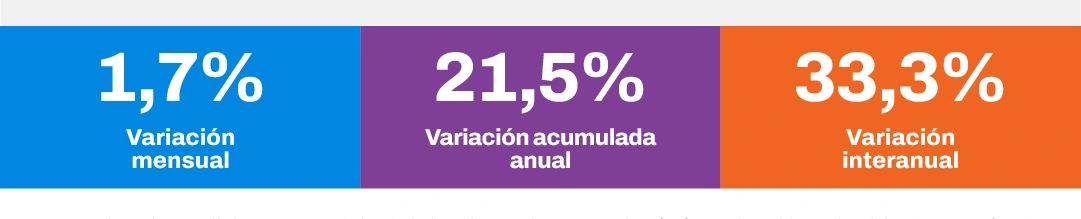
The inflation in the City of Buenos Aires showed a strong slowdown during August and stood at 1.7%, according to the Consumer Price Index of the City of Buenos Aires (IPCBA).
The result represents a marked decline compared to the 2.9% recorded in July and shows a favorable signal regarding the evolution of prices.
With the August data, the IPCBA accumulated an increase of 21.5% during the first eight months of 2026, while the year-on-year variation reached 33.3%.
Inflation in August
The Buenos Aires record was known before the publication of the national index corresponding to August. In that scenario, market expectations also pointed to a new decrease in monthly inflation.
According to the latest Market Expectations Survey (REM) from the Central Bank (BCRA), the median of projections had placed August inflation at 1.7%, exactly in line with the result reported for the City of Buenos Aires.
The data also represents a continuation of the deceleration trend compared to the previous month. In July, the national Consumer Price Index had shown an increase of 2.1%, with a cumulative of 19.3% for the year and a year-on-year variation of 33.8%.
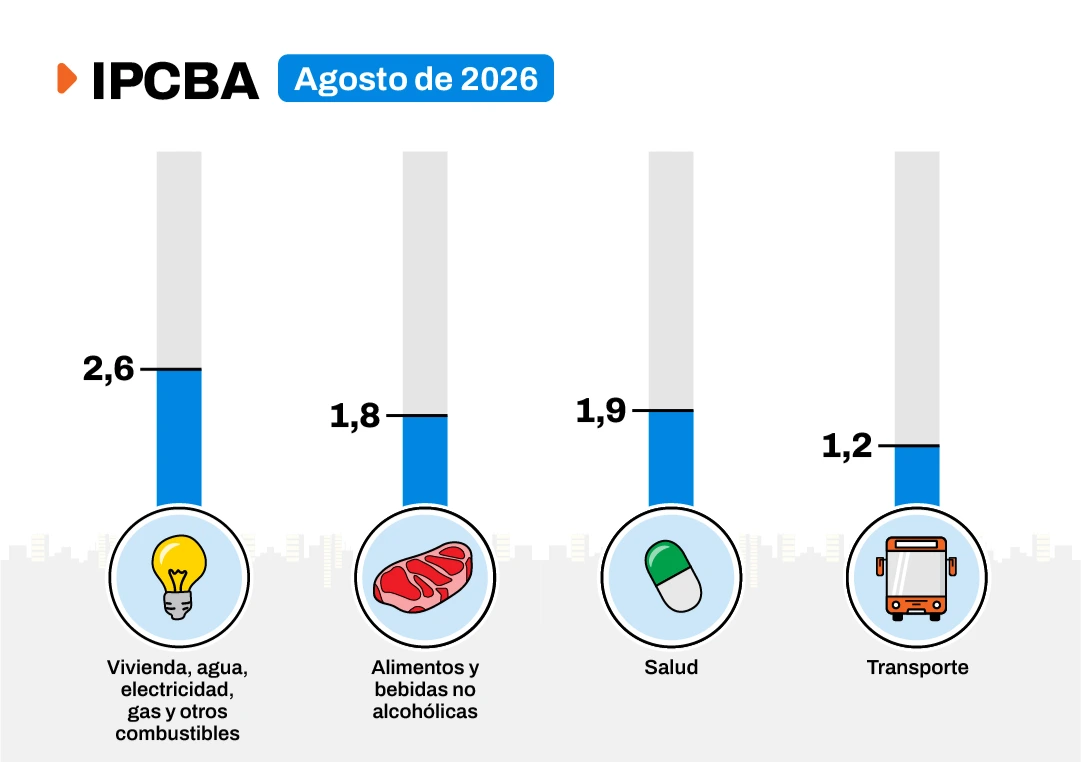
Among the components that explained the behavior of the IPCBA during August, various divisions of the Buenos Aires basket stood out. Together, Housing, water, electricity, gas, and other fuels; Food and non-alcoholic beverages; Health; and Transportation contributed 1.16 percentage points to the variation of the General Level.
Inflation in CABA
The behavior of Seasonal goods and services was also notable, which recorded an average decline of 2.9% during the month, driven by decreases in tourist accommodation and vacation packages. In year-on-year terms, this grouping marked a variation of 20.2%.
The evolution of prices also showed moderate increases in the main aggregates. Goods increased by 1.6% in August, while services advanced by 1.8%. In the cumulative of 2026, goods recorded an increase of 17.2% and services of 24%.
In year-on-year terms, goods reached a variation of 28.5%, while services reached 36.2%.
Thus, the result of August consolidated a strong signal of inflation slowdown in the City of Buenos Aires, with a monthly record of 1.7% and a difference of 1.2 percentage points compared to July.