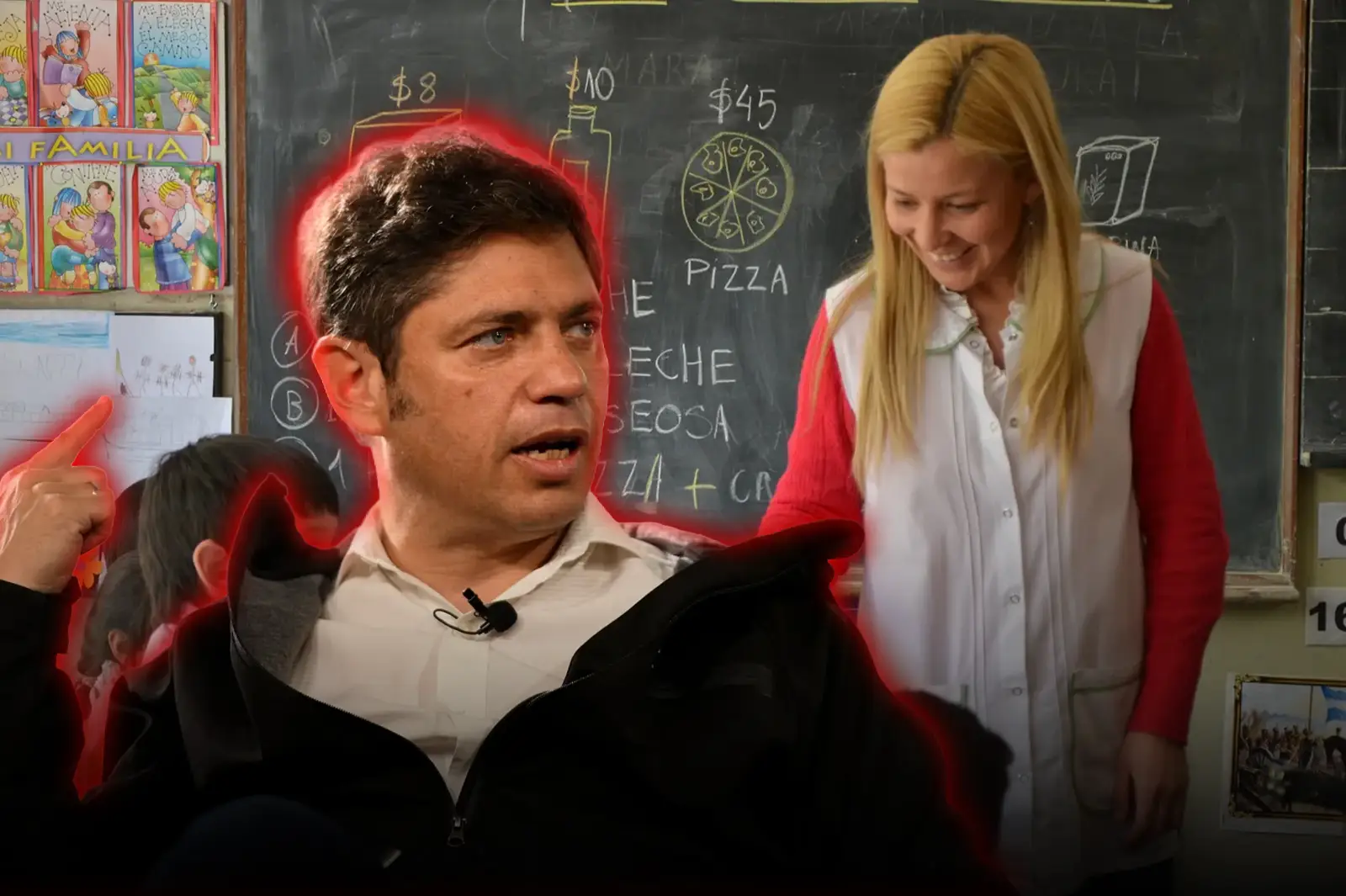
The province of Buenos Aires agreed this Wednesday with the teacher and state unions of Law 10430 on a poor salary increase of 7% staggered in July and August. The understanding was reached after the majority of the union organizations accepted the proposal presented by the government of Axel Kicillof at the bargaining table.
However, this agreement highlights the limitations and the deficit management of Governor Axel Kicillof. With a 5% increase this month and 2% in August on June salaries, it represents more of a temporary relief than a true reallocation.
The agreed offer includes the commitment to resume salary discussions in September, which again postpones the structural resolution of a problem that teachers and state workers have been denouncing for months.
The negotiation was marked by the unions' demands and resulted in a teachers' strike carried out at the end of June by the Association of Technical Education Teachers (AMET), the Federation of Educators of Buenos Aires (FEB), the Unified Union of Workers of Education of Buenos Aires (Suteba), and the Union of Teachers of Buenos Aires (Udocba). This conflict did not arise out of nowhere: it reflects the frustration with a management that has prioritized other fronts while education in Buenos Aires accumulates historical debts.
Limited salary impact and revealing examples
The increase will be calculated based on June salaries and will be applied in two installments. Suteba detailed some examples of the impact without seniority. For a preceptor, the improvement represents 8.9%; for a classroom teacher, 8%; and for a professor, 7.5%.
An increase that barely exceeds the average of 7% in installments leaves the vast majority of workers below recent inflation and without clear prospects for recovery. Kicillof's management again demonstrates that all the weight of poor management falls on Buenos Aires teachers.
The Minister of Labor, Walter Correa, highlighted the “political value” of the collective agreement reached by the government of Axel Kicillof with the state unions. This statement is revealing: more than solving concrete problems, the government seeks to politically capitalize on a very poor agreement.
Pending demands: violence, IOMA, IPS, and FONID
The bargaining took place in a context where the unions were demanding, in addition to a salary reallocation, issues related to violence in schools, the situation of the Medical Assistance Work Institute (IOMA), the Social Security Institute (IPS), and the restoration of the National Fund for Teacher Incentives (FONID).
Although the agreement included an addendum to the Collective Bargaining Agreement for Prevention, Eradication, Protection, and Repair for acts of violence and harassment against education workers, and a campaign called “Let’s Protect Those Who Teach” will be created, these measures sound more like statements of intent than concrete and urgent solutions.
For the workers covered by Law 10430, the agreement includes the transition to permanent staff for personnel hired between 2024 and 2025, the modification of selection processes for hierarchical positions, and the establishment of technical committees to continue discussions on collective labor agreements and administrative careers.