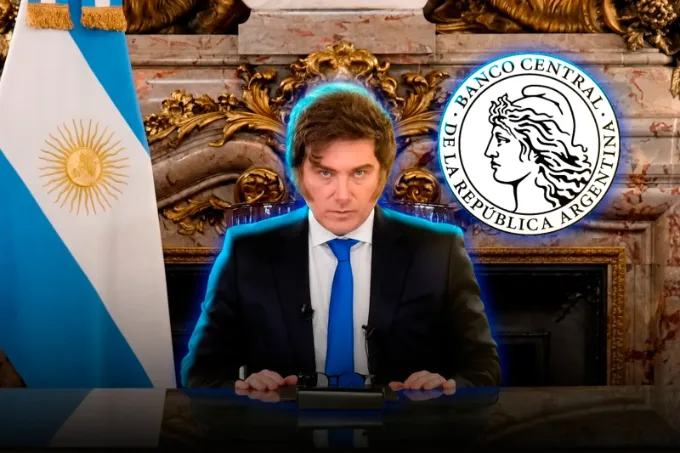

The president Javier Milei announced via national broadcast the project to reform the Organic Charter of the Central Bank of the Argentine Republic (BCRA), in a speech focused on questioning historical economic policy and particularly the role of the monetary entity.
Accompanied by members of his Cabinet and the economic team, the president defined the initiative as a structural turning point.
“We are here to present the most important set of structural reforms in the last 91 years. In particular, the reform of the Organic Charter of the Central Bank aims to put an end to the scam of counterfeiting money to finance high politics,” he stated.
The core of the message was centered on the relationship between monetary issuance and inflation. In this context, the President asserted: “The reform of the Organic Charter aims to put an end to the scam of counterfeiting money to finance high politics, whose most evident manifestation is the inflation rate, also known as the inflation tax.”
To support his diagnosis, Milei reiterated historical figures on price evolution: “The accumulated inflation rate since the creation of the Central Bank amounts to 12,819,532,788,614,400,000 percent. I repeat: 12,819,532,788,614,400,000 percent. It is a 20-digit figure.”
Additionally, he added: “The very creation of the Central Bank led to an increase in monetary issuance that sextupled the inflation rate and, over a decade, robbed Argentines of 50% of their salaries.” In that vein, he reinforced his criticisms of the role of the monetary authority: “The Central Bank has been a tool that enabled the theft of high politics.”
The Central Bank Reform of Milei
During the announcement, the president detailed five central premises of the reform. First, he indicated that the objective of the agency will be redefined: “The absurdity of five objectives for one instrument ends, and the fundamental mission of the Central Bank will again be to preserve the value of the currency.” He also anticipated that “the financing of the State is strictly prohibited,” including the Treasury, provinces, municipalities, and the purchase of public securities in the primary market.
Another key point focuses on the governance of the agency: “The third modification is related to shielding the president of the Central Bank and the board from political abuses. Removal will require two-thirds not only from the Senate but also from the Chamber of Deputies.”
This is complemented by restrictions on dividend payments and the elimination of instruments introduced in 2012: “Other changes introduced by the 2012 Organic Charter are completely eliminated, while the scam of non-transferable letters is also abolished.”