The Government of Javier Milei reached a new milestone in its economic deregulation policy in October 2026, surpassing 18,000 modifications or eliminations of regulatory articles since the beginning of the administration.
The announcement was made by the Minister of Deregulation and State Transformation, Federico Sturzenegger, who highlighted the result through a post on his X account.
"We have finally reached 18,000 deregulations. The genesis of productivity increases. Thanks to the entire Deregulation Ministry team and all the ministers who support us day by day to, as President Javier Milei says, make Argentina the freest country in the world. VLLC!", wrote the official.
The official report.
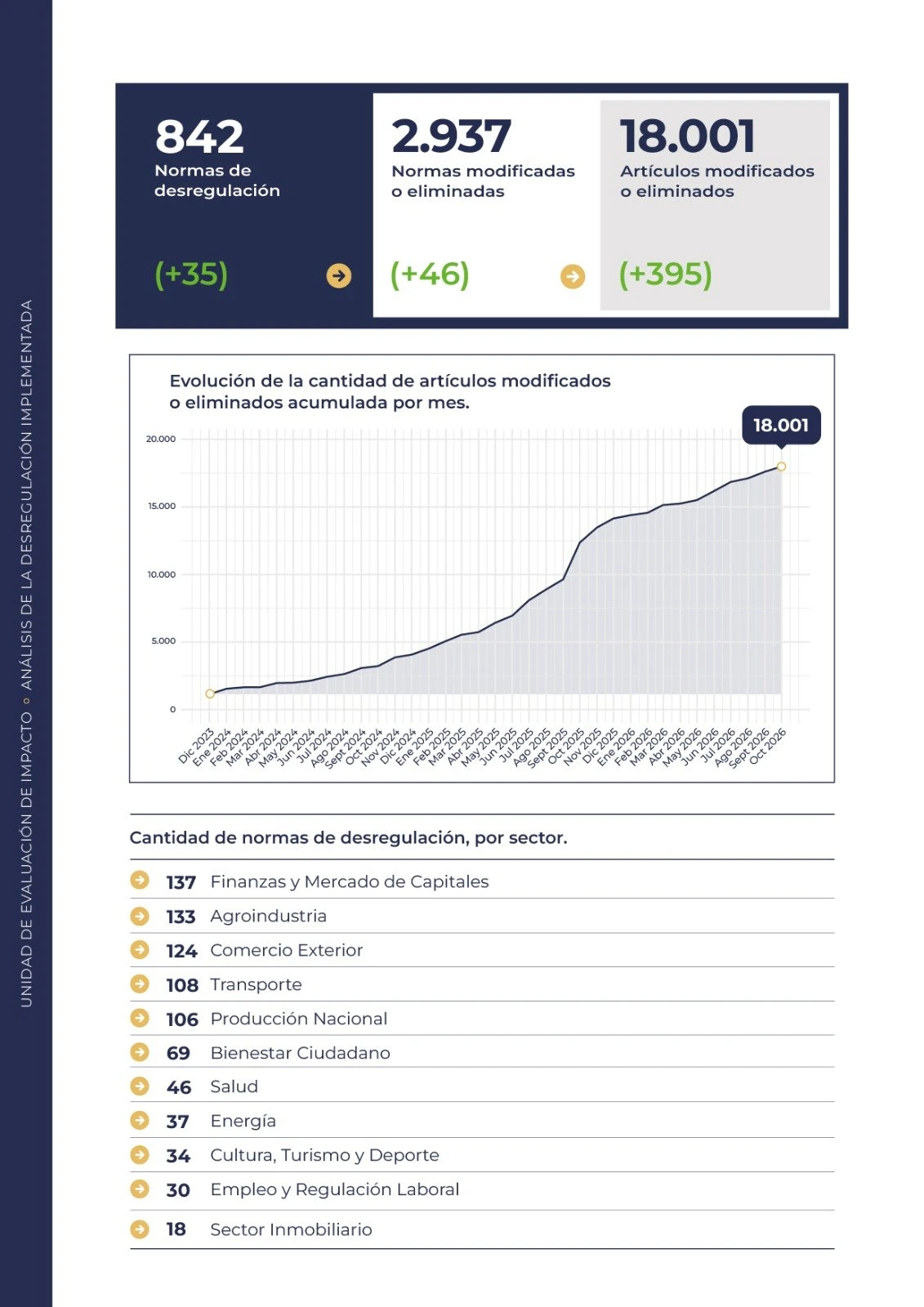
The data released by the Ministry shows that, up to October, 18,001 articles were modified or eliminated, as part of a process that accumulates 842 deregulation norms and 2,937 modified or eliminated norms.
During the last month, 35 new deregulation norms were added, 46 other norms were modified or eliminated, and progress was made on 395 articles.
Finance, agro-industry, and foreign trade lead deregulations
The official report also allows us to see how the measures were distributed by economic activity. Finance and Capital Markets tops the list with 137 deregulation norms, followed by Agro-industry with 133, and Foreign Trade with 124.
Further back are Transportation with 108 norms; National Production with 106; Citizen Welfare with 69; Health with 46; Energy with 37; Culture, Tourism, and Sports with 34; Employment and Labor Regulation with 30; and the Real Estate Sector with 18.
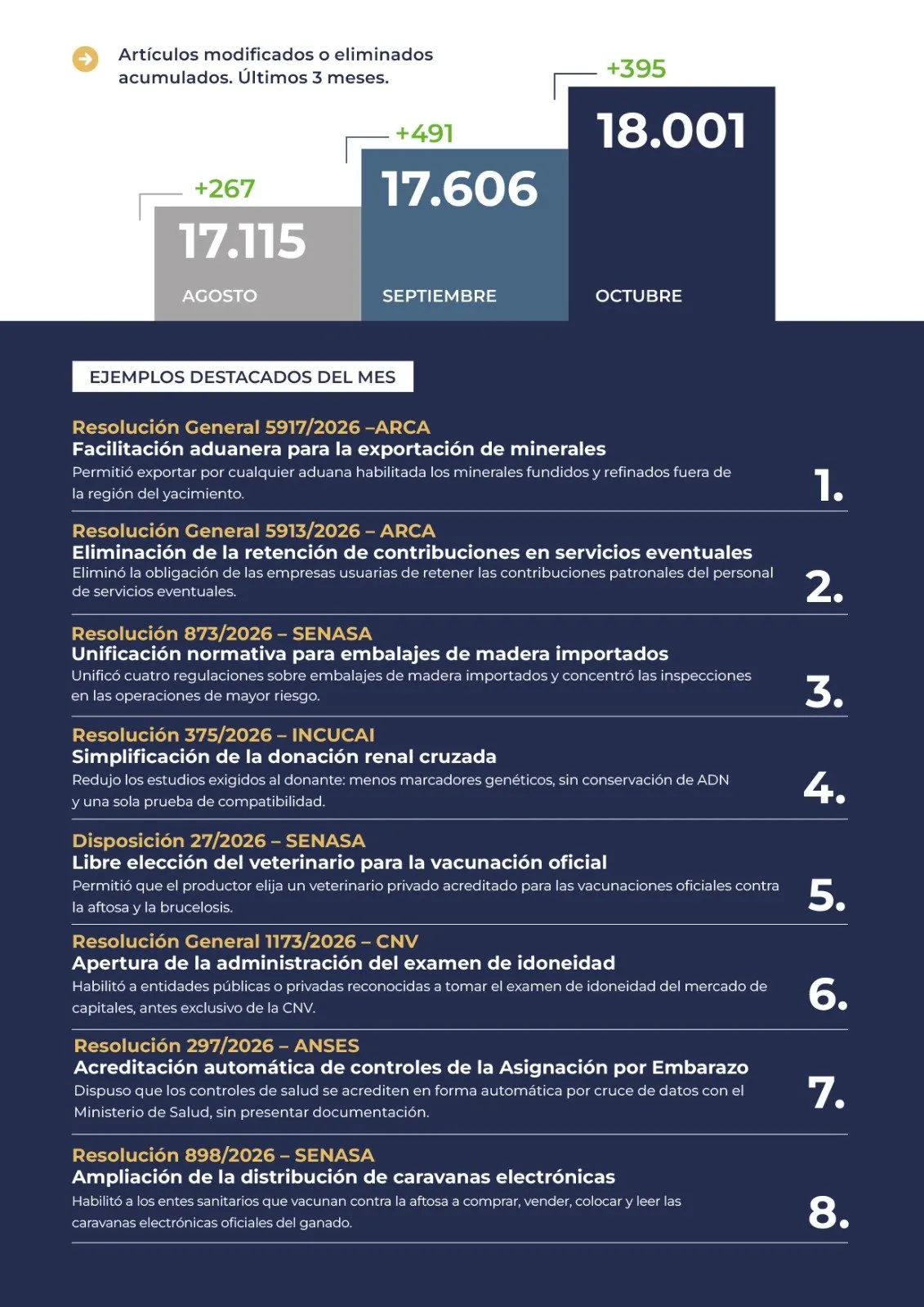
The monthly evolution of modified or eliminated articles also reflects the progress recorded during the last quarter. In August, the total reached 17,115 articles, with an increase of 267. In September, it reached 17,606, after adding 491 modifications or eliminations, while October closed with 18,001, another 395 additions.
The official report.
Highlighted measures from October
Among the highlighted measures from the last month are various resolutions and provisions aimed at modifying administrative procedures and reducing requirements in different activities.
In the mining sector, General Resolution 5917/2026 of ARCA facilitated the export of smelted and refined minerals outside the mining region, allowing them to be carried out through any authorized customs.
In labor matters, General Resolution 5913/2026 eliminated the obligation for user companies to withhold employer contributions corresponding to temporary service personnel.
There were also modifications in sanitation and agricultural production. SENASA unified four regulations on imported wooden packaging and concentrated inspections on higher-risk operations. Additionally, it allowed producers to choose accredited private veterinarians to carry out official vaccinations against foot-and-mouth disease and brucellosis.
Other measures included the simplification of requirements for cross kidney donation, through a resolution from INCUCAI; the opening of the suitability exam for the capital market to public and private entities recognized by the CNV; and the automatic accreditation of health controls for the Pregnancy Allowance through data cross-referencing with the Ministry of Health.
Finally, SENASA expanded the participation of health entities in the distribution of official electronic tags for livestock.
With this balance, the Ministry of Deregulation presented the new progress of the agenda promoted by Milei in October, with more than 18,000 articles modified or eliminated and measures distributed across various sectors of the Argentine economy.