Argentina could achieve a significant leap in its capacity for foreign currency generation over the next few years through the joint development of mining and the Oil & Gas sector, driven by the reforms and deregulation carried out by the Government of Javier Milei.
According to estimates from the Ministry of Economy, the country has the potential to accumulate around USD 477 billion in energy and mining trade surplus between 2028 and 2035, with an average close to USD 60 billion annually.
The projection considers the performance of strategic sectors such as Vaca Muerta and mining, which emerge as relevant sources of dollar generation for the Argentine economy.
The projection
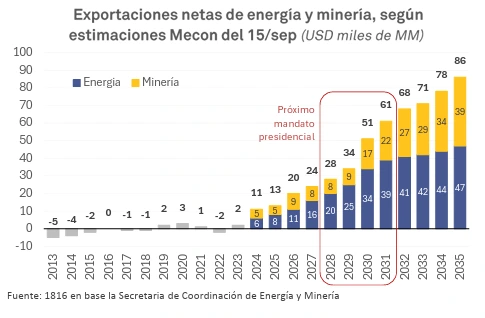
According to the estimates, during the next presidential term, Argentina could generate approximately USD 174 billion in accumulated trade surplus over four years from these activities.
Furthermore, the calculation projects that the result could exceed USD 300 billion during the following four years, bringing the total for the 2028-2035 period to around USD 477 billion.
The graph of the estimates with data from the Secretariat of Energy and Mining Coordination shows a growing evolution of the trade balance in these sectors.
By 2028, the projection reaches USD 28 billion, while for 2029 it rises to USD 34 billion. In the following years, growth continues until reaching USD 86 billion in 2035.
Javier Milei and Luis Caputo
External Debt
The projected expansion also has a direct impact on the country's ability to meet its external commitments. In particular, 2028 appears as a relevant year, due to the foreign currency debt maturities expected for that period.
According to the presented calculation, in 2028 the maturities will reach USD 27.8 billion, considering global and local bonds in private hands, commitments with the IMF, and Bopreales. In that same year, the Ministry of Economy estimates that energy and mining could generate approximately USD 28 billion in trade surplus.
Thus, the projected result for both sectors would be practically equivalent to the amount of private debt maturities expected for that year, highlighting their importance in generating dollars for the country.
The comparison also focuses on the weight that mining and hydrocarbons could acquire within Argentine foreign trade. The estimate suggests that Vaca Muerta along with mining could contribute 50% more in annual trade surplus than all of agriculture combined.
On the other hand, the foreign currency generation from these sectors has a lower exposure to climatic factors. Unlike activities directly linked to weather conditions, energy and mining production allows for the expansion of structural sources of dollar income.
In this way, the projections position energy and mining as two potential pillars for trade surplus generation in the coming years, with an accumulated estimate close to USD 477 billion and sustained growth of the annual balance throughout the period.