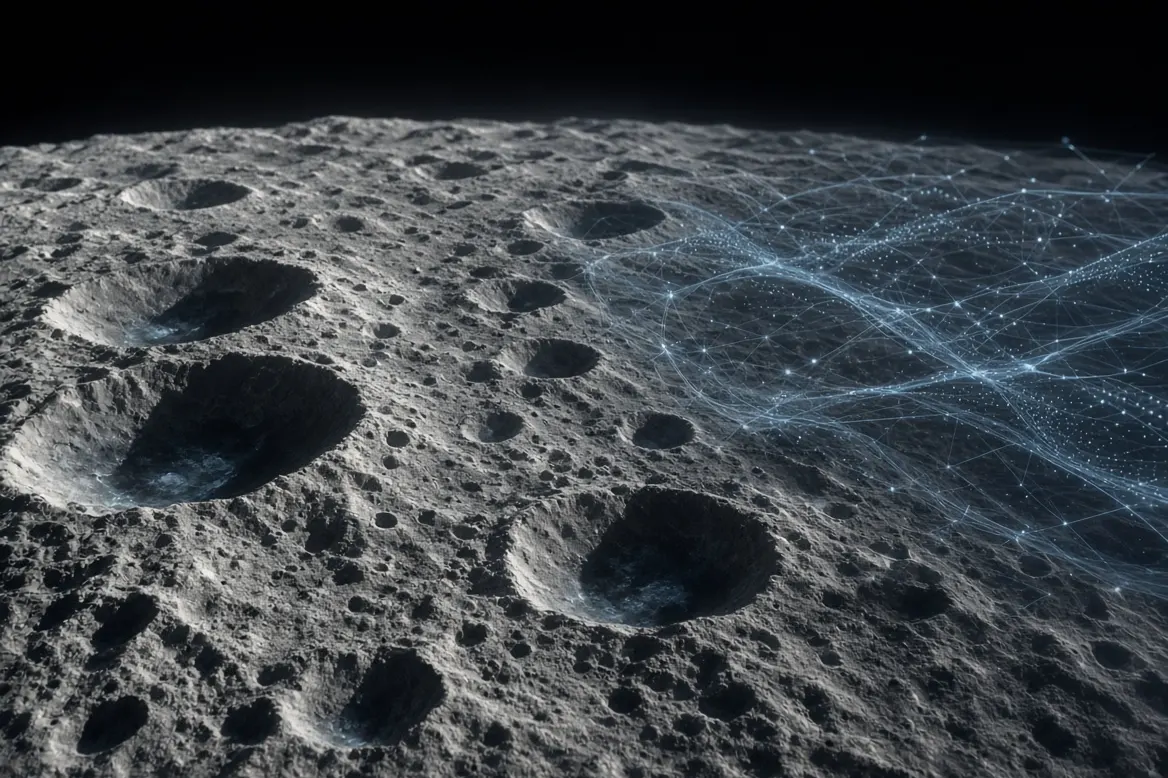

NASA and IBM launch an open AI model to explore the Moon

NASA and IBM launch an open AI model to explore the Moon
Imagen de Editorial Team
porEditorial Team
Argentina

The system, designed for the Artemis era, enhances ice detection and crater classification and comes with an unprecedented dataset for the scientific community

Add La Derecha Diario on
Share:

NASA and IBM presented the NASA-IBM Lunar Foundation Model, an open-source artificial intelligence system aimed at facilitating the study of the Moon within the framework of the Artemis missions. The model is already available for download on Hugging Face and seeks to become a useful tool for researchers working with lunar images and instrumentation.

As explained by Dr. Juan Bernabé-Moreno, director of IBM Research Europe for the UK and Ireland, the model particularly excelled at identifying areas of the lunar surface where ice might exist. In a comparative test against a map created with a published scientific workflow that combines terrain, thermal, and environmental data, the system reduced errors by 23 percent compared to SwinV2-B, a vision model from Microsoft commonly used as a reference in high-resolution image analysis tasks.

They also measured its ability to identify and classify craters. There, the NASA and IBM model outperformed SwinV2-B by 19 percent while using half the training data. A recent verification occurred when a SpaceX Falcon 9 rocket impacted the Moon on August 5. Upon receiving the image of the impact, the system correctly recognized the site as a new crater, despite it almost completely overlapping with an existing one. “It worked fantastically,” said Bernabé-Moreno, highlighting that it was correct on the first attempt.

Training the model was not easy. In Earth observation, images often have soft shadows because the atmosphere scatters light. On the Moon, however, shadows are sharp and completely black, meaning that shadowed pixels do not provide information. The same crater can appear very differently depending on the time of day the photo is taken.
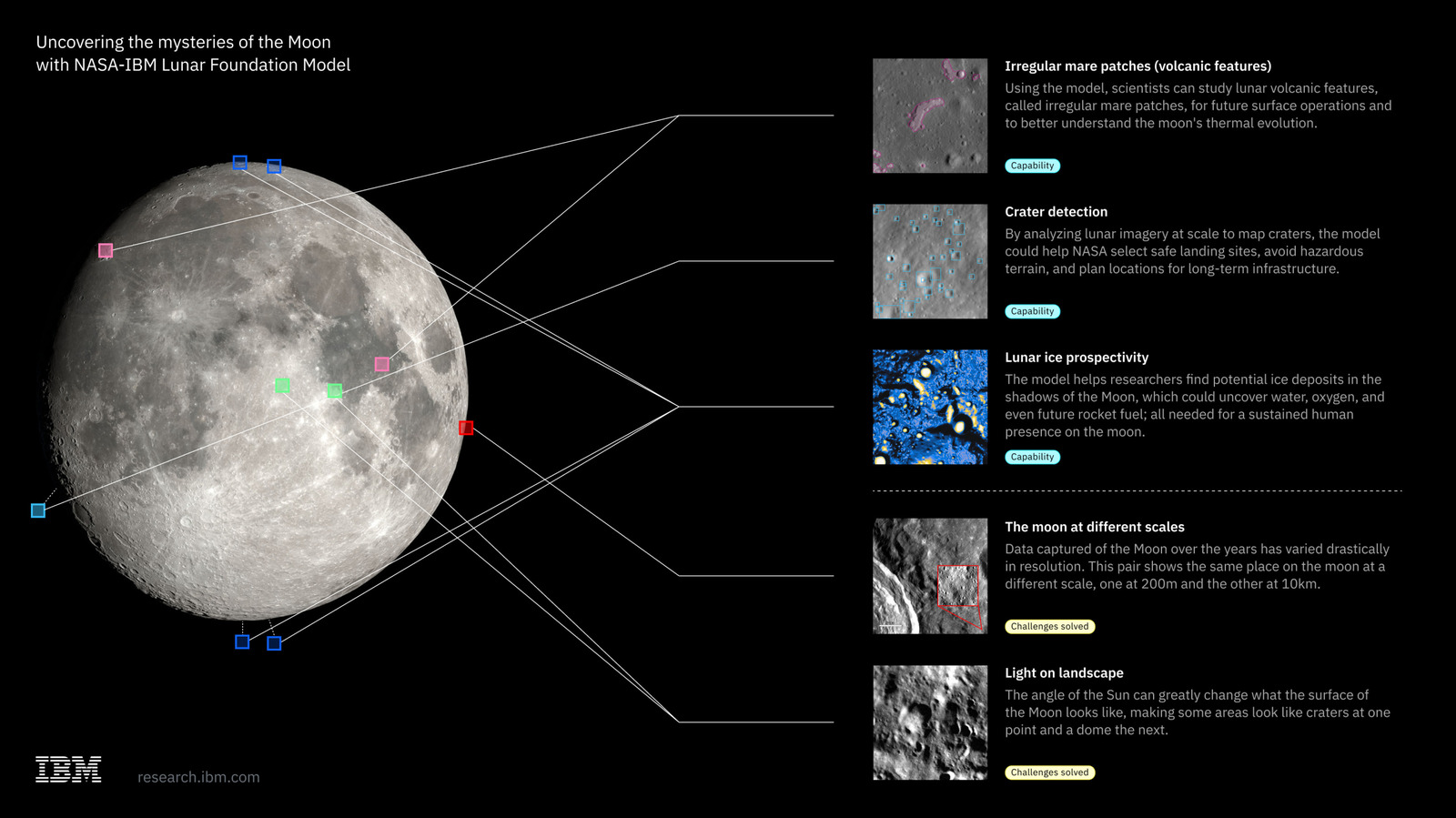

NASA and IBM made an AI model for exploring the Moon - Engadget

How they solved the problem of shadows and similar craters

Traditional model training methods were also not useful. Typically, parts of an image are hidden, and the system is asked to reconstruct the missing parts. On the Moon, that strategy failed because many craters look too similar when photographed from orbit. Bernabé-Moreno noted that the first attempts were “a total disaster.”

The solution they found was to divide the Moon into sections as if it were an orange and completely separate the areas used for training from those used for testing. This way, the model gained greater consistency and was able to learn patterns without being contaminated with data from the same regions.

In addition to the model, NASA and IBM released a first-time open-source dataset. It includes tens of thousands of images and instrument data from NASA's Lunar Reconnaissance Orbiter and Gravity Recovery and Interior Laboratory missions, along with information from Japan's SELENE mission. The material is co-registered: each image pixel corresponds to other modalities of data that the model can leverage.

Bernabé-Moreno emphasized that this organization of information represents a significant scientific contribution. “The community now has a co-registered dataset with over two million data points,” he noted. He added that while artificial intelligence models are often surpassed by later versions, the data is what truly supports the development of this industry.


La Derecha Diario logo
TwitterInstagramYouTubeTikTokFacebook
Derecha Diario TV

Nosotros

  • Quienes Somos
  • Autores
  • Donar

Privacidad

  • Protección de datos
  • Canales
  • Sitemap
  • RSS

Contacto

  • info@derechadiario.com.ar
PUBLICIDAD

Related news

A Kirchnerist mayor confronted Kicillof over the serious security crisis in PBA

A Kirchnerist mayor confronted Kicillof over the serious security crisis in PBA

The United States approved the sale of 4 Blackhawk helicopters to Argentina for USD 140 million

The United States approved the sale of 4 Blackhawk helicopters to Argentina for USD 140 million

The Chilean ambassador supported Argentina's claim over the Malvinas and called for Chileans to adopt the cause as their own

The Chilean ambassador supported Argentina's claim over the Malvinas and called for Chileans to adopt the cause as their own

Inflation fell to 1.7% in August, marking the lowest record for that month since 2017

Inflation fell to 1.7% in August, marking the lowest record for that month since 2017

With two new faces and Paredes affected, Arruabarrena defined the players called up to face Central Córdoba

With two new faces and Paredes affected, Arruabarrena defined the players called up to face Central Córdoba

Blanca Rodríguez proposes to censor social media

Blanca Rodríguez proposes to censor social media

La Derecha Diario logoLa Derecha Diario logo
ESX logoInstagram logoYouTube logoTikTok logoFacebook
ARGENTINAUNITED STATESECUADORISRAELMEXICODERECHA DIARIO TV
  • ES
    XInstagramYouTubeTikTokFacebook
  • DERECHA DIARIO TV
  • Sections
  • ARGENTINA
  • UNITED STATES
  • ECUADOR
  • ISRAEL
  • MEXICO
  • URUGUAY
  • Countries
  • La Derecha Diario logoLA DERECHA DIARIO
  • La Derecha Diario México logoLA DERECHA DIARIO MÉXICO
  • La Derecha Diario Uruguay logoLA DERECHA DIARIO URUGUAY
  • La Derecha Diario Ecuador logoLA DERECHA DIARIO ECUADOR
  • La Derecha Diario Israel logoLA DERECHA DIARIO ISRAEL
  • La Derecha Diario Estados Unidos logoLA DERECHA DIARIO ESTADOS UNIDOS
  • Topics
  • GUERRA EN IRÁN
  • LAS MALVINAS SON ARGENTINAS
  • The Newspaper
  • QUIENES SOMOS
  • AUTORES
  • PUBLICIDAD
  • DONAR