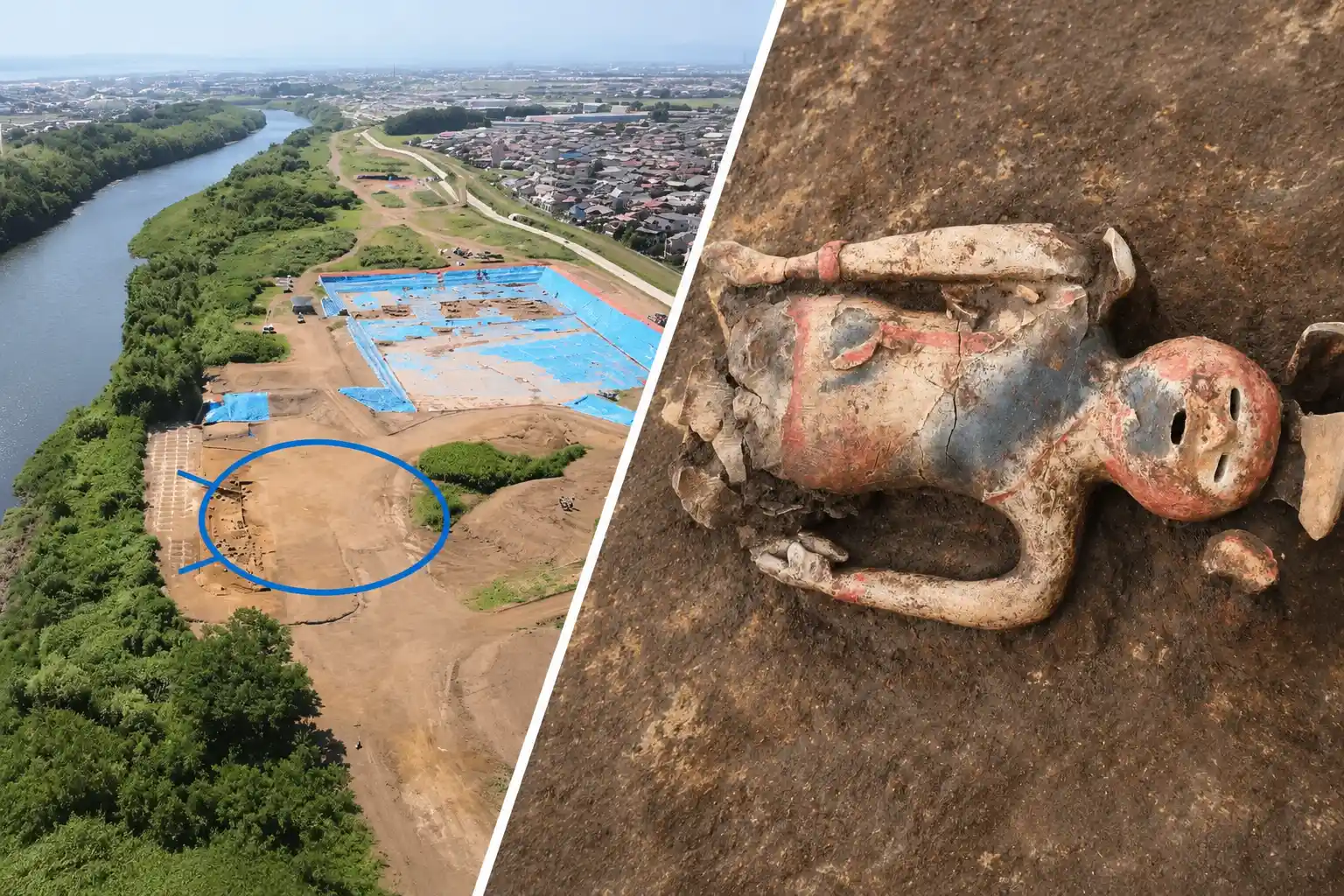
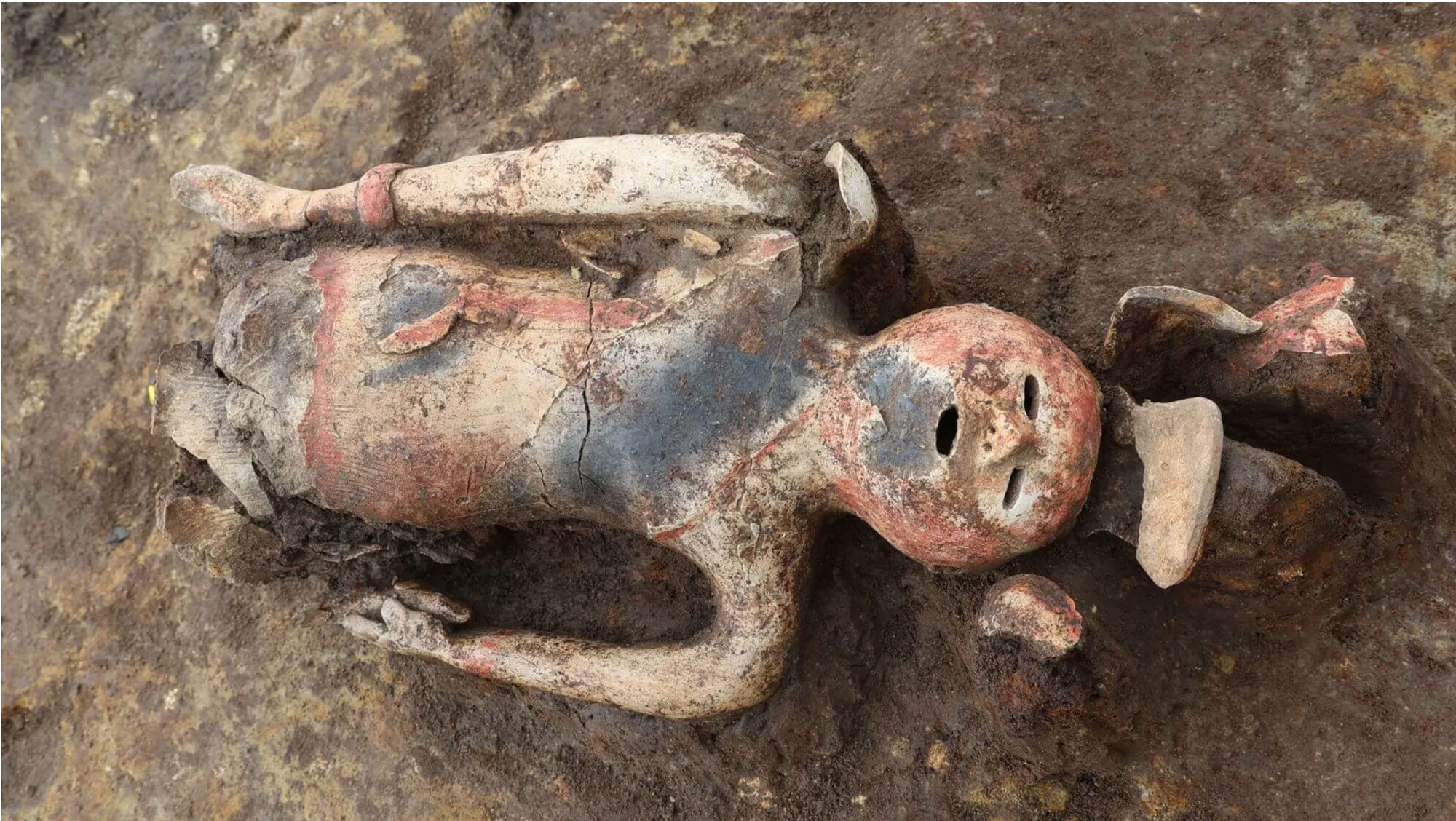
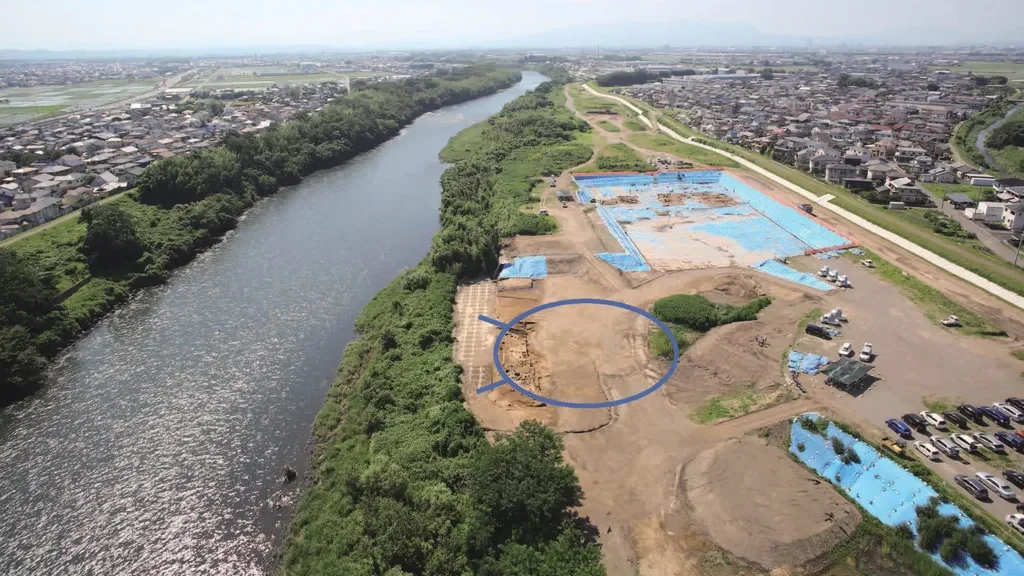
The figure was found in the moat of an ancient funerary monument in Gunma Prefecture. Researchers believe it represents a priestess responsible for conducting religious ceremonies and connecting the world of the living with that of the spirits
Its name comes from the kofun, large mounds built to bury members of the elite.
In these monuments, haniwa sculptures representing people, animals, houses, and other elements related to the society of the time were placed.
Specialists believe that these figures served ceremonial functions and could act as funerary offerings. Some traditions also attributed to them the ability to house the spirits of the deceased.
Excavations conducted since 2020 at Nishikaminomiya have identified eleven burial mounds corresponding to the 5th and 6th centuries.
How the priestess ended up in the moat of a tomb
The monument where the figure appeared has an approximate diameter of 45 meters and retains evidence of a stone sarcophagus shaped like a boat.
According to researchers, the sculpture was likely originally located near that sarcophagus, forming part of the ceremonial elements accompanying the deceased.
Over the centuries, the piece would have slid down the slope of the mound until it ended up deposited in the outer moat, where it was eventually recovered.
This hypothesis explains why a figure intended for an important funerary space appeared outside its original location.
Where the discovered figure is currently located
The discovery was officially announced by the authorities of Gunma in October 2026 and subsequently disseminated by international media specialized in archaeology.
The sculpture began to be publicly exhibited on October 28 at the Gunma Archaeological Research Center's Excavation Information Museum, located in the city of Shibukawa.
The initial exhibition was organized for one month to bring the finding closer to the public.
The figure constitutes a valuable testimony of the beliefs, traditions, and funerary practices of Japan fifteen centuries ago, in addition to providing information about the representation of women linked to religious ceremonies.
A team of Japanese archaeologists discovered an extraordinary clay figure approximately 1,500 years old, which may represent a priestess associated with the funerary rituals of ancient Japan. The finding occurred at the archaeological site of Nishikaminomiya, located in Gunma Prefecture on Honshu Island, northwest of Tokyo.
The sculpture was found in the moat surrounding a burial mound constructed during the 5th century. Although only the head and torso survived, the fragments retain details that allowed for the identification of its possible religious function.
A mysterious 1,500-year-old clay figure
The piece belongs to a category of sculptures known as haniwa, funerary figures made of clay that were placed around Japanese tombs.
The recovered fragments measure approximately 40 centimeters, although specialists believe the original sculpture would have been considerably larger.
Among its features are a prominent nose, carefully modeled fingers, and a traditional Japanese hairstyle gathered on top of the head, known as shimada.
The figure also features bracelets made of clay and red pigment, a red band painted across the torso, and an elongated ceremonial object held in its left hand.
These elements led researchers to interpret that it could represent a miko, a traditional Japanese priestess.
Who were the miko priestesses of ancient Japan
The miko performed religious functions related to communication between the human and spiritual worlds.
In ancient Japanese traditions, these women participated in ceremonies, funerary rituals, and practices aimed at establishing connections with deities and spirits.
Their presence in a funerary monument could be related to the spiritual protection of the deceased and the rites accompanying their burial.
However, the identity of the figure constitutes an archaeological interpretation based on its appearance and the objects it carries, not a definitive identification.
The authorities of Gunma particularly highlighted the care dedicated to the elaboration of details that could likely not even be observed from a considerable distance.
The Kofun period and the mysterious Japanese funerary monuments
The sculpture belongs to the Kofun period, which developed approximately between the 3rd and 8th centuries, a fundamental stage for understanding the formation of the first political and social structures of the Japanese archipelago.