Added to this are announcements worth $14 billion that have not yet been formally submitted. However, implementation will be gradual: at least $5.6 billion will be disbursed between 2025 and 2028, while most projects will take 15 to 20 years
.
Among the most advanced projects is the development of Liquefied Natural Gas (LNG) promoted by the Southern Energy consortium, comprised of Pan American Energy, YPF, Pampa Energía, Harbour Energy and Golar LNG, with an investment of USD 6,878 million.
The initiative plans to install two ships in Rio Negro and disburse USD 2.8 billion by mid-2027. In this context, the president and CEO of YPF, Horacio Marín, had summarized the importance of the regime with a strong phrase: “Without RIGI there is
no LNG”.
In parallel, the Vaca Muerta Oil Sur (VMOS) pipeline, with an investment of about USD 2.9 billion, seeks to expand the capacity to transport crude oil from the Neuquén basin to the coast of Rio Negro for export, mainly to the United States.
In mining, large-scale initiatives such as Rincón, from Rio Tinto, with USD 2,744 million for lithium production in Salta, and Los Azules, from McEwen Copper, with US$ 2,672 million in San Juan for copper extraction, also stand out. Added to these are developments in gold, silver, steel and renewable energy
.
For now, the provinces of Rio Negro, Neuquén, San Juan, Salta and Catamarca concentrate the main benefits in terms of investment and economic activity.
With these million-dollar investments, the Government of Milei seeks to promote industrial development, employment generation and greater productive integration at the federal level.
The Incentive Regime for Large Investments (RIGI) of the Government of Javier Milei has already accumulated investment commitments close to 80 billion dollars.
Almost two years after its legislative approval, the libertarian administration seeks with this measure to strengthen foreign exchange inflows and improve Argentina'scompetitiveness vis-a-vis countries such as Chile and Peru.
The initiative, regulated in August 2024, was conceived as the central vehicle for transforming natural resources into economic development, accelerating postponed projects and enabling others that, without this framework, would not have advanced.
In this regard, the objective of the Government of Milei is to increase energy and mining exports to USD 60 billion annually starting in 2030, as anticipated by the Secretary of Energy and Mining Coordination, Daniel González, before AmCham.
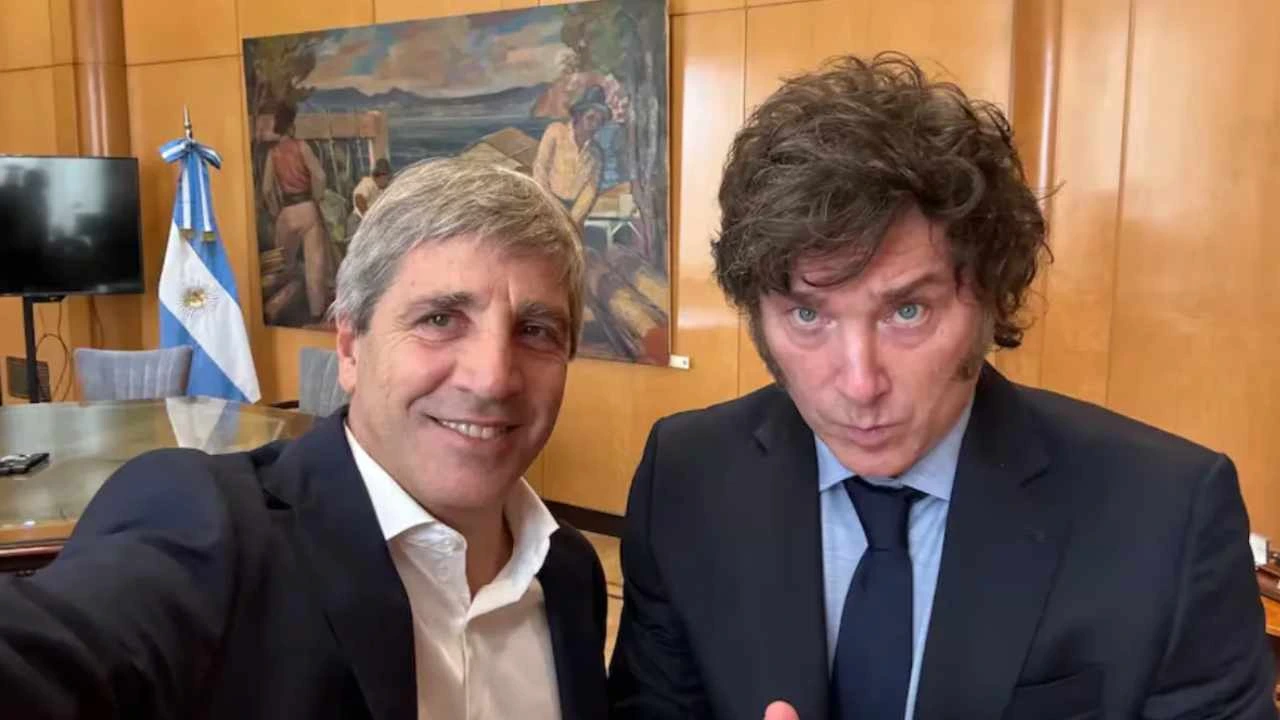
Javier Milei and Luis Caputo.
The regime's attractiveness lies in its conditions: fiscal stability for 30 years, tax and customs benefits, free access to foreign exchange and legal guarantees
in the face of possible regulatory changes.
These are requirements considered minimum by large companies after years of economic crisis and exchange restrictions. Access to RIGI will be enabled until July 2027, with the official promise that its conditions will then be extended to the rest of the economy
.
Approved and pending investments
According to the survey by Juan José Carbajales, from the consulting firm Paspartú, there are already more than USD 17.6 billion with official approval, while another USD 46 billion are in process