
Scientists solve the mystery of Earth's largest mass extinction

Scientists solve the mystery of Earth's largest mass extinction
Imagen de Editorial Team
porEditorial Team
Argentina

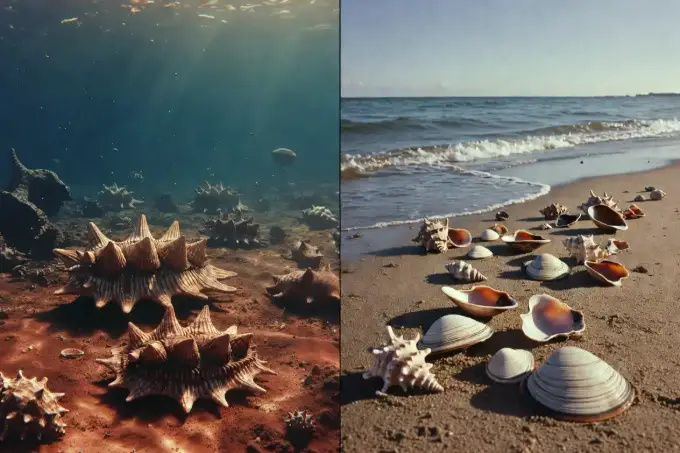
Why are today's beaches filled with shells of clams and snails instead of brachiopods?

Add La Derecha Diario on
Share:

Scientists have finally explained why today we collect shells of clams and snails on the beaches, and not of brachiopods, those organisms that dominated the seabeds for millions of years. A new study from Stanford University points out that the key lies in the largest mass extinction in Earth's history, known as the Great Dying Event, which occurred about 252 million years ago.

During this cataclysm, around 96% of marine species and 70% of terrestrial species disappeared. It was not a uniform event: some groups were much more affected than others. Brachiopods, which resembled clams but had distinct characteristics, ruled the oceans before the crisis. Afterward, they nearly vanished, while mollusks like clams and snails suffered fewer losses and ended up dominating the seas.

Researchers combined biological data from the groups that went extinct massively and those that survived. The main factor was the metabolic capacity to tolerate warmer waters with less oxygen. Massive volcanic eruptions released huge amounts of carbon dioxide and methane, which warmed the planet and reduced oxygen levels in the oceans.

The role of metabolism in survival

Paleozoic animals, such as brachiopods and crinoids, were mostly sedentary filter feeders with slow movement. Their metabolisms could not adapt to the rising temperatures, which increased the demand for oxygen faster than they could handle. In contrast, bivalve mollusks and other more active groups, with higher energy requirements but better equipped to extract oxygen, fared better.


Scientists finally solved the mystery of Earth's greatest mass extinction

This difference explains the radical ecological shift. Before the extinction, brachiopods vastly outnumbered bivalves. Today, there are only about 400 species of brachiopods, compared to between 10,000 and 15,000 bivalve species. As one of the authors pointed out, that’s why we eat clam chowder and not brachiopod chowder: the latter have almost no meat.

The study reinforces that ocean warming and oxygen loss were the main drivers of the crisis. Although ocean acidification also played a role, it was less decisive than changes in temperature and oxygen.

Lessons for the current climate

The oceans before the Great Dying were relatively cold and well-oxygenated, similar to those that existed before the Industrial Revolution. The massive injection of carbon created conditions that today feel familiar due to climate change caused by human emissions.

The findings serve as a warning: modern marine species could face similar situations if waters continue to warm and lose oxygen. Projections indicate that in worse scenarios we could approach warming levels similar to those of 252 million years ago, although over a much shorter time frame.

However, researchers emphasize that we still have time to act. Understanding how ecosystems responded in the past can help predict and mitigate future impacts on marine life. The work, published in the Proceedings of the National Academy of Sciences, is based on measurements of oxygen consumption at different temperatures, conducted both in the lab and with live organisms collected in the field.


La Derecha Diario logo
ESX logoInstagram logoYouTube logoTikTok logoFacebook
ARGENTINAUNITED STATESECUADORISRAELMEXICODERECHA DIARIO TV
  • ES
    XInstagramYouTubeTikTokFacebook
  • DERECHA DIARIO TV
  • Sections
  • ARGENTINA
  • UNITED STATES
  • ECUADOR
  • ISRAEL
  • MEXICO
  • URUGUAY
  • Countries
  • La Derecha Diario logoLA DERECHA DIARIO
  • La Derecha Diario México logoLA DERECHA DIARIO MÉXICO
  • La Derecha Diario Uruguay logoLA DERECHA DIARIO URUGUAY
  • La Derecha Diario Ecuador logoLA DERECHA DIARIO ECUADOR
  • La Derecha Diario Israel logoLA DERECHA DIARIO ISRAEL
  • La Derecha Diario Estados Unidos logoLA DERECHA DIARIO ESTADOS UNIDOS
  • Topics
  • GUERRA EN IRÁN
  • The Newspaper
  • QUIENES SOMOS
  • AUTORES
  • PUBLICIDAD
  • DONAR
La Derecha Diario logo
TwitterInstagramYouTubeTikTokFacebook
Derecha Diario TV

Nosotros

  • Quienes Somos
  • Autores
  • Donar

Privacidad

  • Protección de datos
  • Canales
  • Sitemap
  • RSS

Contacto

  • info@derechadiario.com.ar
PUBLICIDAD

Related news

China detained a U.S. scientist who investigated North Korea's nuclear tests

China detained a U.S. scientist who investigated North Korea's nuclear tests

Missions: a woman killed her 8-year-old son and the father reported judicial delays

Missions: a woman killed her 8-year-old son and the father reported judicial delays

The British police concluded that the murder of Ann Widdecombe was a "targeted attack"

The British police concluded that the murder of Ann Widdecombe was a "targeted attack"

Donald Trump announced the withdrawal of U.S. troops from Iraq after a 23-year mission

Donald Trump announced the withdrawal of U.S. troops from Iraq after a 23-year mission

Trump announced that the next step in the war against Iran will be to destroy bridges and power plants

Trump announced that the next step in the war against Iran will be to destroy bridges and power plants

Milei moves forward with Brazil, Chile, and Paraguay towards an open skies market

Milei moves forward with Brazil, Chile, and Paraguay towards an open skies market