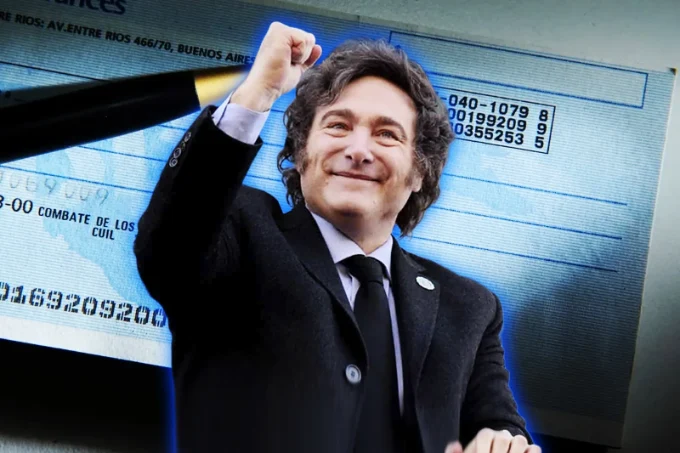
The Government of Javier Milei is moving forward with the gradual elimination of the tax on bank debits and credits, known as the check tax, as part of the tax reform that will be sent to Congress before 2027.
The measure is part of the official policy aimed at reducing the tax burden, while maintaining fiscal balance as the central axis of the economic plan.
According to reports, the initiative will include a gradual mechanism similar to that applied in the reduction of export duties. In this case, the scheme would allow the amount paid for this tax to be increasingly used as advance payment on Income Tax, until reaching 100% and, ultimately, its total elimination by 2028.
Javier Milei and Luis Caputo
The proposal has been developed since the beginning of the administration in the offices of the Ministry of Economy, under the direction of Minister Luis "Toto" Caputo and Secretary of Finance, Carlos Guberman.
However, its progress was initially conditioned by economic factors, such as the need to maintain a fiscal surplus, and political factors, in a context of reduced legislative strength at the beginning of the administration.
The project responds to a horizon of lower tax pressure, but an unnegotiable fiscal balance. In this sense, one of the main objectives is to reduce the impact of taxes on economic decisions, seeking a more neutral and equitable system.
Within that diagnosis, the check tax is one of the most distorting taxes. Currently, it taxes bank debits and credits at a rate of 0.6% at each end of the transaction, which implies a total burden of 1.2% on the formal financial circuit.
The Government is making progress in the gradual elimination of the check tax
The official strategy plans to replicate the model used for the reduction of export duties. In that scheme, the reduction is implemented in stages with defined calendars.
The reduction of export duties
In the industrial case, for example, there has already been an immediate reduction to 0% for more than 1,000 inputs, followed by a monthly decrease scheme until its total elimination in June 2027.
For agriculture, the process is organized at two speeds. In winter crops, such as wheat and barley, a direct reduction of rates was applied, while in summer crops, such as soybeans, corn, sunflowers, and sorghum, progressive monthly reductions have been established that will extend until 2028.
This same criterion is what is sought to be applied to the check tax. According to sources from the Ministry of Economy, “one of the main goals of the tax reform is to eliminate the tax on bank debits and credits,” although its implementation will depend on the macroeconomic context and legislative treatment.
The design includes a scheme of increasing allocation to Income Tax, similar to what is already applied for SMEs, which would allow for an orderly transition without abruptly affecting revenue.
With this initiative, the Government is advancing in tax reduction, in line with the economic reform program promoted by the Milei administration.