The ambassador of Chile, Gonzalo Uriarte Herrera at Rotary Club: “If Chileans understand that the Falklands are important to Argentina, let’s make it our own”
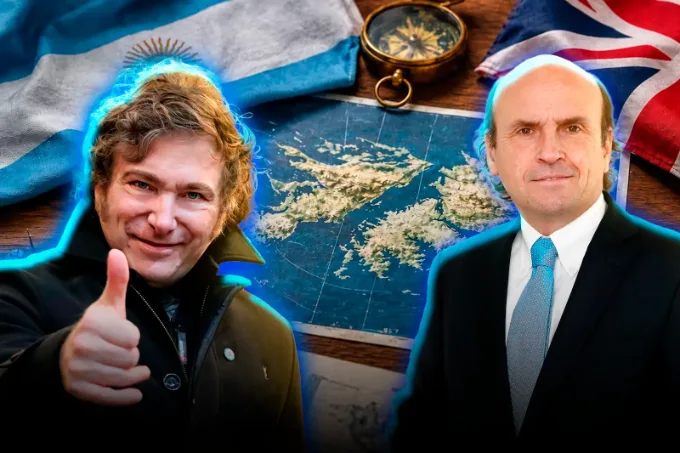
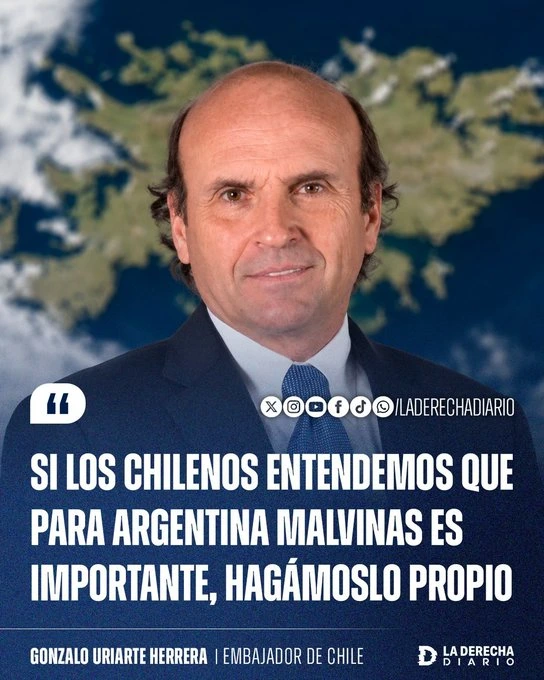
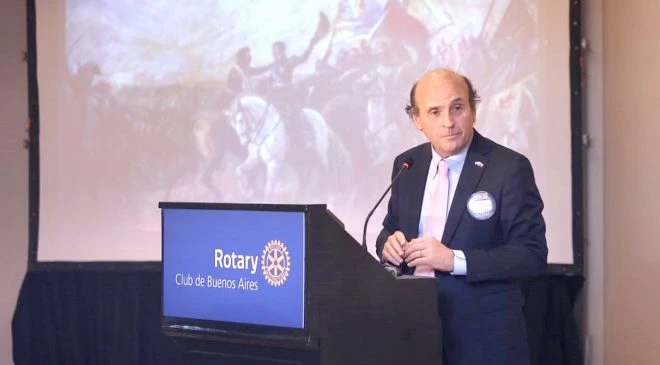
In a historic exhibition held on September 10 before the Rotary Club of Buenos Aires, the ambassador of Chile in Argentina, Gonzalo Uriarte Herrera, emphatically reaffirmed his government's strong support for the claim of Argentine sovereignty over the Malvinas Islands. With words of deep patriotism and diplomatic sensitivity, the ambassador urged his country's society to make a cultural leap of brotherhood by stating: “If Chileans understand that Malvinas is important for Argentina, let us make it our own, let us understand that it is a sacred issue, that is taught in schools and we must have the respect that is given to sacred matters”.
Subsequently, within the framework of mature and reciprocal diplomacy, he expressed the corresponding empathy towards the priorities of his nation: “And for Argentina, it is also important to empathize with Chilean sensitivity. We also expect the same respect for the issues that are essential to us, such as the issue of the Strait”.
Gonzalo Uriarte Herrera, ambassador of Chile in Argentina
The diplomatic representative emphasized that the Chilean position in favor of Argentina“is not up for discussion” and constitutes a solid state policy maintained without fissures since the presidency of Patricio Aylwin. Furthermore, Gonzalo Uriarte Herrera clarified that the request for recognition of the Strait of Magellan does not represent a political conditioning, asserting that “Mature integration does not require relativizing borders nor exacerbating nationalist interests”.
It is noteworthy that this strong support occurs in a context where President Javier Milei suspended his scheduled trip to London in October amid the growing escalation of diplomatic tension with the United Kingdom.
Beyond sovereign definitions, the ambassador laid out a broad economic agenda based on free market laws. When comparing mining development, he pointed out that while Chile exports more than 70 billion dollars in mining through the mountain range, Argentina barely reaches 5 billion dollars.
To unlock the energy potential of both countries, he proposed a perfect integration: “Argentina has excess gas, Chile lacks it. Chile has excess electrical energy in the north, Argentina lacks it. What makes sense is that the gas that you have in surplus reaches Chile and hopefully we can transform it into LNG and export it from Chilean ports”.
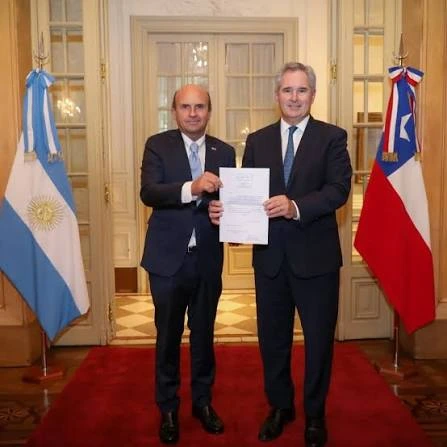
Gonzalo Uriarte Herrera and Pablo Quirno
In terms of physical integration, Uriarte Herrera urged to expedite key steps such as the Cristo Redentor pass, through which 1,500 trucks daily —many coming from Brazil— suffer paralysis due to snow. “Bad policy prevents basic solutions like a binational snow clearing system”, criticized the ambassador, proposing the implementation of digital document management and biometric reading.
He specified that, out of the 82 border crossings existing between both nations, 28 are regularized and 18 have integrated customs. Inspired by the European model of integration after bloody conflicts, the diplomat expressed his desire to build a free circulation zone similar to the Schengen area in the Southern Cone, highlighting the approval in the reviewing commission of the mining treaty of 3 protocols for cross-border mining in the province of San Juan.
To conclude his speech, Gonzalo Uriarte Herrera moved the audience by revealing that he keeps in his office the historical photographs of the embraces between presidents Roca and Balmaceda, and Menem with Frei, expressing his desire to soon hang a third image depicting President Javier Milei alongside his counterpart José Antonio Kast. The diplomat closed with a slogan of deep brotherhood: “What both countries truly need is to give each other an embrace like those given by San Martín and O’Higgins”.
Gonzalo Uriarte Herrera, ambassador of Chile in Argentina
This categorical address by Ambassador Uriarte Herrera was the diplomatic culmination of the bilateral summit held a week earlier, on September 3, at La Moneda between President Javier Milei and his Chilean counterpart José Antonio Kast, within the framework of the V Madrid Forum. The ambassador himself was present at that meeting and defined it as “hopeful, genuine, after tumultuous and tense days”.
That summit between the libertarian leaders managed to definitively ease the unusual frictions of the previous weeks.
These tensions had been provoked by statements from the head of the General Staff of the Air Force, Brigadier General Gustavo Valverde, regarding the sovereignty of the Strait of Magellan, combined with the controversy over a commercial corridor promoted by the mayor of Punta Arenas with the British administration to supply the oil exploitation in the Sea Lion field —whose drilling is scheduled for January 2027 and its first production for 2028 in the northern basin of Malvinas—.
Gonzalo Uriarte Herrera, ambassador of Chile in Argentina
During the bilateral meeting on September 3, President José Antonio Kast categorically reiterated the unconditional support of the Government of Chile for the legitimate and imprescriptible rights of sovereignty of the Argentine Republic over the Malvinas Islands, South Georgia, South Sandwich Islands, and the surrounding maritime spaces, demanding that bilateral negotiations be resumed in accordance with the resolutions of the United Nations.
In turn, President Javier Milei particularly valued the efforts of the Chilean government “to prevent the consolidation of illegal logistical activities in the disputed area, regarding the exploration and exploitation of hydrocarbon and fishing resources”.
As an institutional seal of this strategic alliance, both presidents signed a written agreement ratifying that “the legal regime of the Strait of Magellan is that established by the Treaty of 1881 and by the Treaty of Peace and Friendship of 1984, instruments that are fully in force and have definitive character for the States and that establish the sovereignty of the Republic of Chile over the entirety of the Strait”.