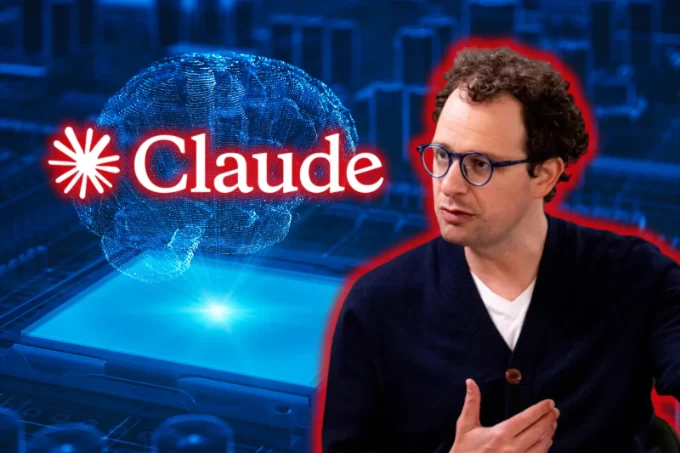
Artificial intelligence is reopening a debate about who should control the world's most advanced technologies. Dario Amodei, CEO and co-founder of Anthropic, publicly raised the possibility of governments having direct access to the technology developed by his company.
During an interview with CBS, Amodei stated that he has always found it striking that a technology with such potential is being developed and controlled by a private company. His statements were shared on social media and quickly generated a response due to the reach of the proposal.
“It has always been very strange that this technology is built by a private company”
The CBS journalist directly asked Amodei if he would be willing to hand over the technology to the government.
The response from the CEO of Anthropic was clear: “To the right combination of governments”.
The statement came after Amodei pointed out that “it has always been very strange that this technology is being built by a private company”, referring to the development of increasingly advanced artificial intelligence systems.
This raises a particularly sensitive discussion in the United States: whether the most advanced artificial intelligence capabilities should remain in the hands of private companies or come under state control, at least in certain scenarios.
Anthropic and the race for artificial intelligence
Anthropic is one of the leading American companies dedicated to the development of artificial intelligence. The company created Claude, a family of AI models that directly competes with the main systems developed by other tech companies.
The growth of these tools has made artificial intelligence a strategic issue for the United States and other powers. The most advanced models can have commercial, scientific, military, and national security applications, so their control has ceased to be exclusively a business matter.
In this context, Amodei's words take on special relevance. The CEO of Anthropic did not simply propose regulation of artificial intelligence, but acknowledged being willing to cede the technology to certain governments, as long as it is the “right combination.”
The debate over who should control AI
The discussion faces two main positions. On one side, those who believe that private companies are the main drivers of innovation and should retain control of their developments. On the other, those who argue that a technology capable of transforming the economy, security, and international politics cannot be left exclusively in the hands of corporations.
The position expressed by Amodei is particularly striking: it recognizes the strategic nature of artificial intelligence and contemplates that governments may take a direct role in its development or use.
The open question is who determines which governments are appropriate and under what conditions a potential transfer of technology should occur.
The comment also reflects the level of importance that the global race for AI has reached. What began as a competition among tech companies now increasingly involves states, concerned about the economic, military, and geopolitical impact of artificial intelligence systems.