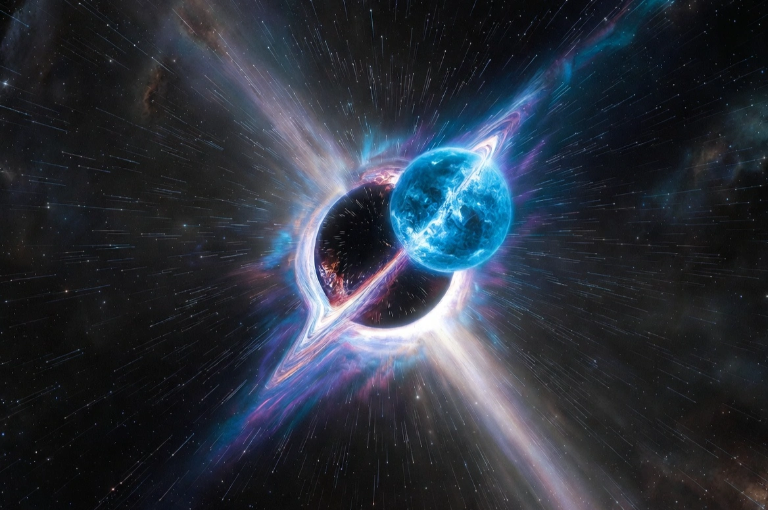
It was always thought that black holes devour everything that approaches them, but it's not quite like that. In many cases, part of the matter and energy that falls towards them escapes in the form of powerful jets of particles, known as jets. These jets are so energetic that they can influence the formation and evolution of entire galaxies.
The big problem was that, although their existence and strength were known, no one had been able to directly measure their power. Until now. An international team of scientists managed to do it for the first time in the Cygnus X-1 system, composed of a black hole and a blue supergiant star.
The results are impressive: the jets have an energy equivalent to that of 1,000 suns and move at a speed of 540 million kilometers per hour. Additionally, about 10% of the energy generated in the fall towards the black hole is transformed into these jets.
A revolutionary measurement
Until now, researchers could only observe the "traces" left by these jets in space, such as hot regions or cavities in the interstellar medium. It was like trying to calculate the power of an engine by only looking at the tire marks on the asphalt.
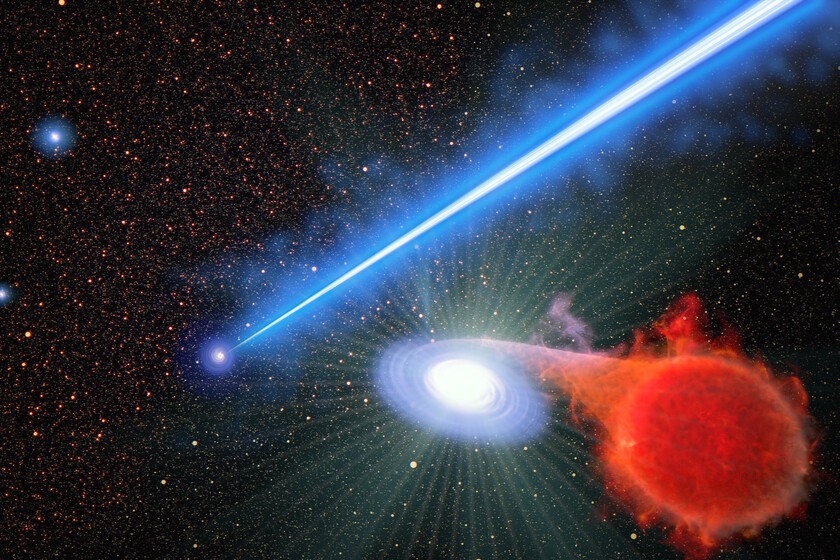
The new method completely changes that. In binary systems like Cygnus X-1, the black hole attracts gas from its companion star. That material accelerates, heats up, and generates enormous energy. Part of it is ejected outward, forming the jets.
At the same time, the star releases intense stellar winds that interact with those jets and deflect them. By analyzing how the trajectory of the jets is modified by the "resistance" of the winds, scientists were able to calculate the actual power of the jets. It's similar to measuring someone's strength by how they win an arm wrestle.
To refine the data, they complemented the observations with computer simulations. This way, they obtained a fairly precise calculation of the momentum flow and the energy involved.
Implications for the cosmos
Understanding the exact power of these jets is key because in galaxies with supermassive black holes, they can regulate star formation and reshape large regions of space. This advance opens the door to applying the method in other systems and verifying if it is reproducible.
For now, the study is limited to a single black hole, so researchers emphasize the need to repeat the measurements in more cases, especially in more massive objects. If the procedure is confirmed, it will be a valuable tool for better understanding how galaxies form and evolve.
The finding represents an important leap in high-energy astrophysics and demonstrates that, with ingenuity and detailed observations, it is possible to directly measure phenomena that seemed unattainable.