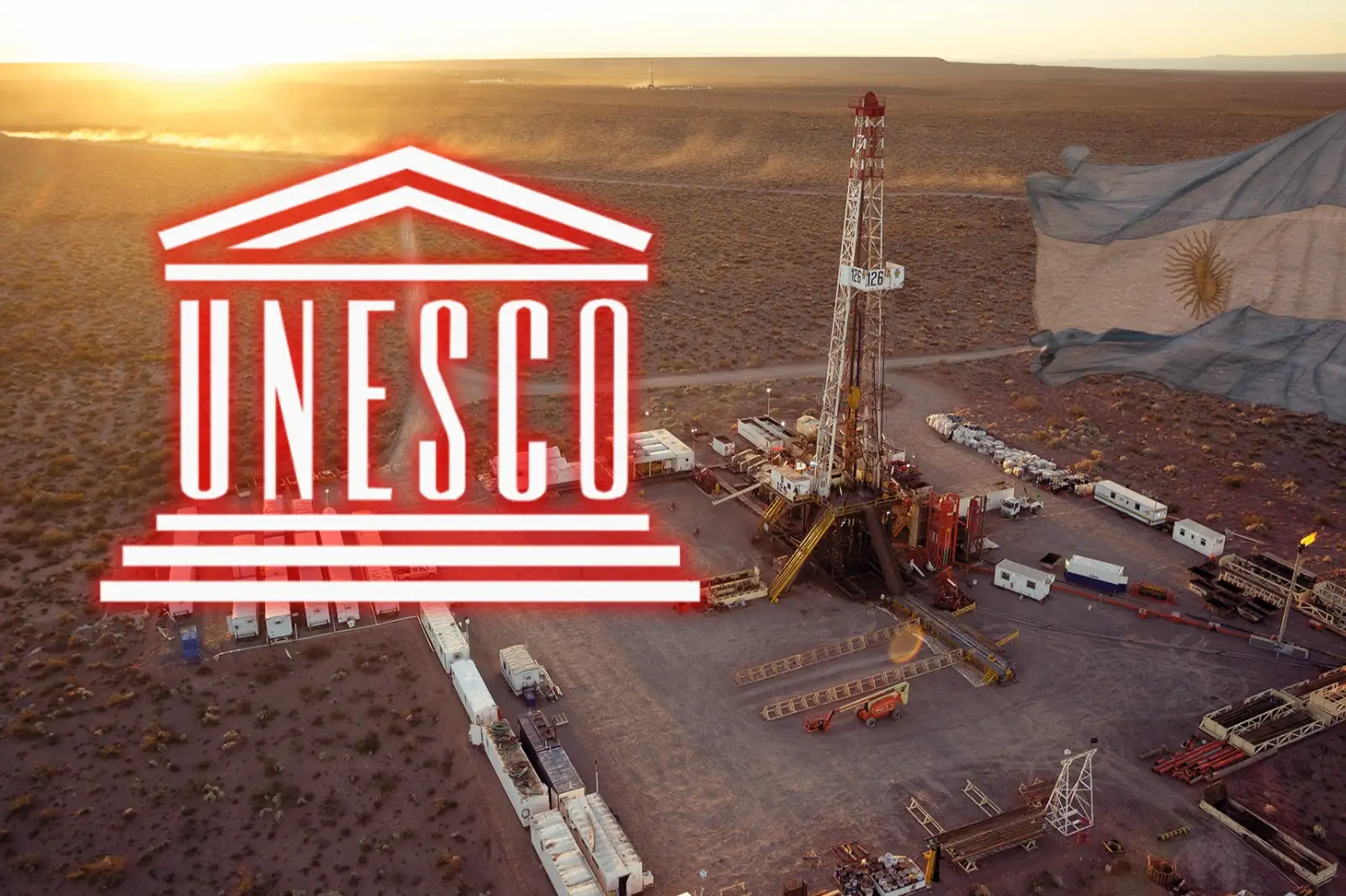







In a clear attempt at ideological guardianship over national sovereignty, UNESCO demands to halt the strategic oil pipeline Vaca Muerta Sur, a fundamental project for Argentina to regain its place as an energy power. The World Heritage Committee of UNESCO, meeting at its 48th session in Busan, South Korea, has formally requested the Argentine government to “suspend the work related to the project” of the pipeline and its terminal in Punta Colorada.
Under the pretext of protecting the ecosystem, this organization aims to interfere in a project that involves a massive investment to transport oil from the Neuquén basin to the coast of Río Negro, in order to export it to the world and generate the foreign currency that the country desperately needs.

The focus of the discord is the Vaca Muerta Oil Sur (VMOS) project, an infrastructure of 437 kilometers in length that seeks to transform the national export matrix.
The initial plan anticipates a transport capacity of 550,000 barrels per day, with a growth projection that could reach 700,000 barrels.
Despite being a strategic project driven by YPF and the main oil companies, UNESCO has set February 1, 2027 as the deadline for the government to submit additional documentation, attempting to delay a process whose crude oil export is scheduled to begin in 2026.
The "green" offensive is based on alleged risks to the Valdés Peninsula, a protected area located 30 kilometers from the Punta Colorada terminal.





