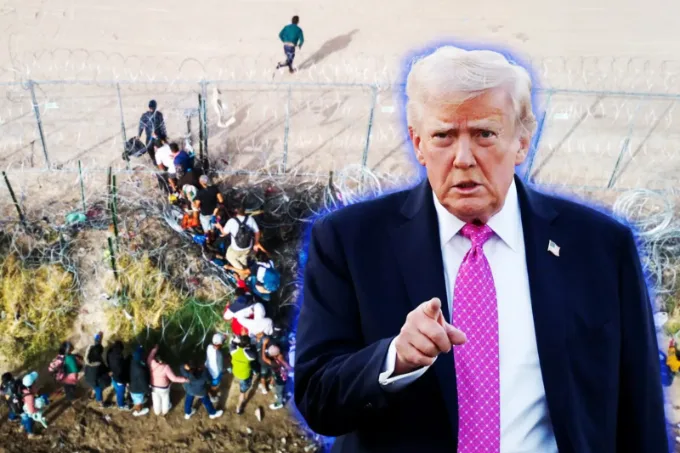
The government of President Donald Trump has intensified its strategy to enforce U.S. immigration laws through the imposition of civil fines on illegal immigrants who refuse to leave the country after receiving a final deportation order. According to the Department of Homeland Security (DHS), since the beginning of the Trump administration, approximately 103,000 fines have been issued, with a total value exceeding USD 84 billion.
The penalties include a fine of USD 998 per day for illegal immigrants who remain in the United States despite having a final expulsion order. The administration argues that these measures aim to increase incentives for those without legal authorization to remain in the country to voluntarily leave U.S. territory before facing more severe consequences.
''Our message to illegal immigrants is clear: leave now,'' stated Lauren Bis, Deputy Assistant Secretary for Public Affairs at DHS. The official warned that those who choose to remain in the United States could face fines, arrest, and deportation.
Bis also highlighted an alternative offered by the federal government through the ''CBP Home'' app. Immigrants opting for voluntary departure can receive a free flight back to their home country and a financial incentive of USD 2,600. The Trump administration presents this program as an option for those who prefer to leave the United States voluntarily rather than face detention and expulsion proceedings.
The Trump administration will impose fines on those illegal immigrants who remain in the country after receiving a deportation order
This policy is part of a strategy pushed by Trump to strengthen immigration control and ensure that deportation orders are effectively enforced. For the government, immigration laws lose their meaning if individuals who receive a final order can remain indefinitely in the country without facing consequences.
In June 2025, the DHS and the Department of Justice introduced changes aimed at streamlining the process for imposing these penalties. The new regulation eliminated a provision that granted illegal immigrants a 30-day notice period regarding the intention to impose a fine. It also allowed immigration officials to send penalties by regular mail and simplified the applicable procedures when a person decides to contest them.
The Trump administration has defended these modifications, arguing that the government needs more efficient tools to enforce existing laws. Tricia McLaughlin, who was then serving as Deputy Assistant Secretary at DHS, stated that ''the law does not enforce itself'' and that there must be consequences for those who violate it.
The Trump administration implemented measures such as the creation of platforms for illegal immigrants to self-deport and the use of conventional mail for sending sanctions
However, the policy has generated strong opposition among leftist organizations advocating for immigrants, who have questioned the magnitude of the fines. The ''Center for Justice and Legal Assistance'' filed a lawsuit in July on behalf of an illegal immigrant from Virginia who was imposed a penalty exceeding USD 1.8 million.
The individual had entered the United States in 2016 with a minor and received a deportation order in 2017. According to his lawyers, the amount imposed is disproportionate to his economic situation. Rohmah Javed, director of the organization's Immigrant Justice Program, incorrectly described the measure as a form of ''government intimidation'' and argued that these penalties could cause severe economic hardship for immigrant families.
The Trump administration, however, maintains that the penalties are a legitimate tool to reinforce immigration laws and reduce the incentive to remain illegally in the United States. From this perspective, the fines represent an additional consequence for those who receive a final expulsion order and choose to ignore it.
The debate has also reached Congress. Republican Senator Rick Scott from Florida introduced the Illegal Immigration Cost Recovery Act, an initiative that seeks to double the civil fines applicable to individuals who enter illegally or attempt to do so. The bill also contemplates increasing penalties for those who receive a final deportation order and refuse to leave the country.
Senator Rick Scott introduced a bill to double these fines and penalize employers who knowingly hire illegal immigrants
The proposal also includes greater economic penalties for employers who knowingly hire illegal immigrants without authorization to work in the United States.
Scott argues that decades of open border policies have created a significant economic burden for U.S. taxpayers. From his perspective, toughening the penalties would allow shifting some of those costs to those who violate immigration laws and to the companies that facilitate illegal employment.
Trump's immigration offensive thus reflects one of the main priorities of his administration: to strengthen border security, expedite deportations, and use economic sanctions to encourage the voluntary departure of those without legal rights to remain in the country.