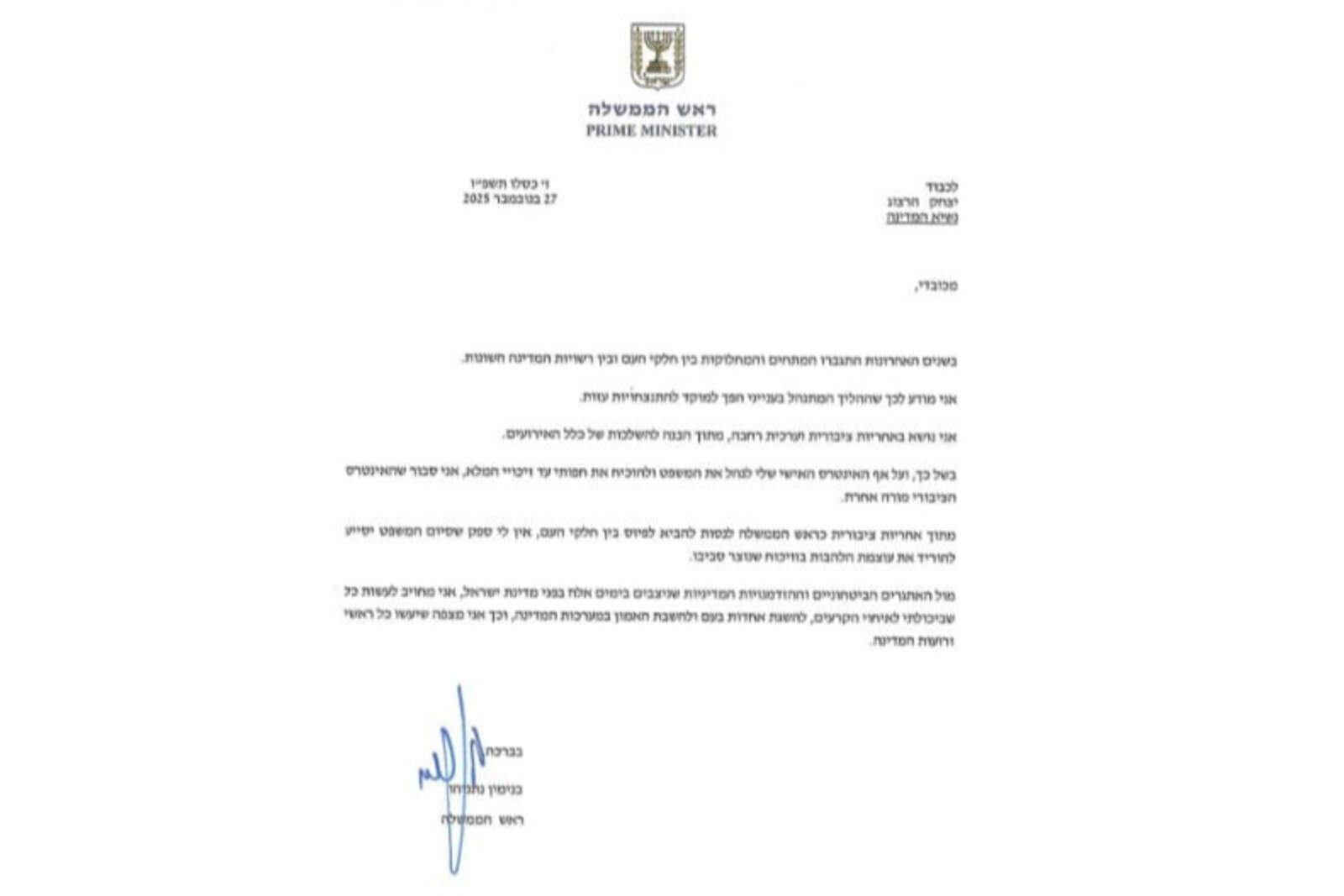
Prime Minister Benjamin Netanyahu submitted a formal request for a presidential pardon to President Isaac Herzog, an unusual step that, according to the President's Office itself, has "significant implications" both legally and politically.
The move, unprecedented for a sitting head of government, seeks — according to Netanyahu himself — to protect the country's stability at a critical moment.
The petition was delivered by his attorney, Amit Hadad, and was immediately forwarded to the Ministry of Justice, which must prepare professional opinions from the various authorities involved.
With this input, the president's legal advisor will prepare a recommendation before Herzog makes a final decision.
The request, which includes a technical letter from Hadad and a personal message from Netanyahu, has already been published in Hebrew. In both documents the burden imposed by a judicial process that has lasted for almost a decade is emphasized.
Netanyahu, in a message released after the petition was submitted, stated that the evidence known so far "completely collapses" the case and reveals "serious irregularities" in its construction.
The prime minister argued that, although he trusts in his eventual acquittal, the current circumstances require a different solution. "Israel faces enormous challenges and opportunities. National unity is indispensable," he said.
According to Netanyahu, the continuation of the trial "deepens divisions" at a time when the country needs to focus on its security and its strategic priorities.
A decisive point, he noted, was the recent court decision requiring him to testify three times a week, a burden he described as "impossible" for any citizen, but especially incompatible with the obligations of a sitting prime minister.
The request also has an international component. Former U.S. President Donald Trump has urged Herzog on several occasions to end the process, calling the trial "political" and "unjustified."
Earlier this month, Trump sent a formal letter to the Israeli president requesting the pardon, arguing that the case distracts Netanyahu from the task of leading and strengthening strategic cooperation between the United States and Israel.
Meanwhile, Likud ministers and deputy ministers sent a letter to Herzog last month appealing to the need to "restore the unity of the people" and emphasizing the president's constitutional authority to act in extraordinary circumstances.
The documentation submitted by Netanyahu goes beyond the usual arguments of unity and stability. In more than a dozen pages, his team argues that the judicial process has eroded public trust, caused institutional tensions, and weakened the country's ability to navigate an especially volatile regional environment.
Now, the decision rests with Herzog, who — according to his office — will evaluate the request "with responsibility and sincerity" once he receives all the legal material.
Whatever the outcome, Netanyahu's request marks a decisive moment in Israel's institutional life, in which legal concerns, demands of governance, and an explicit call to prioritize national cohesion are intertwined.