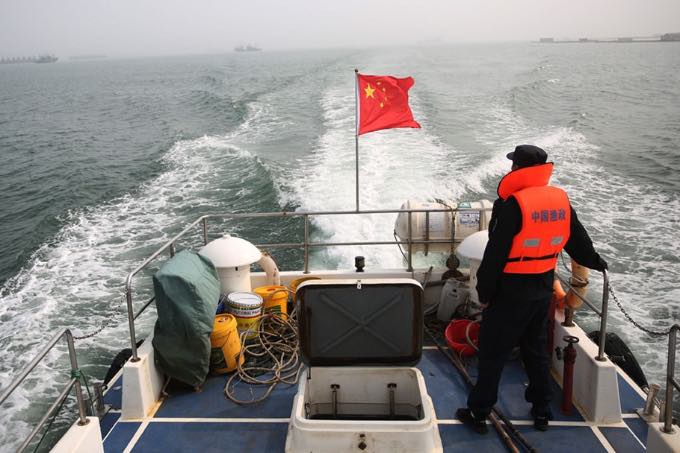
The Eastern Republic of Uruguay witnesses, once again, the usual spectacle. In Parliament and in the media, the political class tears its garments over the Cardama case: fake guarantees, advance payments without original documentation, political extensions, cross-accusations between the previous and current government, interpellations, investigative commissions, and mutual cover-ups that fill headlines. They fight over ships that never arrived, over millions of euros that vanished in a failed contract, and over who is to blame for the negligence. Meanwhile, 150 nautical miles southeast of Punta del Este, and beyond the 200-mile mark, a ghost fleet of Chinese pot fishing vessels operates with almost total impunity. Illegal, unreported, and unregulated fishing (IUU). It competes unfairly and predatory against the Eastern fleet. And no one seems interested in looking at the sea.
The data is compelling and does not allow for euphemisms. In 2024, approximately 231 foreign vessels entered Uruguayan waters to fish illegally: one ship every day and a half, according to presentations before the Special Commission of the Maritime Front of the Chamber of Deputies. Most are Chinese-flagged pot fishing vessels dedicated to squid. The National Navy has had to engage in nighttime pursuits: in a recent case, the ROU 23 “Maldonado” and a naval aircraft detected vessels with their lights on (a typical technique for squid fishing) within the Exclusive Economic Zone. There was an attempted escape, hours of pursuit, and boarding. In the hold of one of them, 11 tons of bagged squid were found. Cases like that of the Lu Rong Yuan Yu 606 are not exceptions: they are the norm.
Montevideo has consolidated itself as the main logistical hub for the Chinese fleet in the South Atlantic. It is the preferred port precisely because of the laxity of controls. Experts in IUU fishing have documented that, in recent years, of hundreds of arrivals of foreign vessels (around 300 annually on average, predominantly Chinese), inspections are minimal: in a reference period, only 10% were checked, and of that percentage, only one Chinese vessel. No effective sanctions in most cases. The same vessels that operate in the “Blue Hole” off the Argentine Patagonia—between 500 and 600 during peak season, of which 60-70% are Chinese—use Montevideo to resupply, change crews, repair, and, in many cases, unload catches of dubious origin. Some turn off their AIS (automatic identification system) for hours or days. Others enter the Uruguayan or Argentine EEZ under the pretext of “shelter from storms” and take the opportunity to fish.
The impact on Eastern fishing is direct and devastating. The local deep-sea and coastal fleet competes against a monster subsidized by the Chinese state: cheap fuel, soft loans, no real quota requirements in high seas, and a logic of industrial predation. While Uruguayan boats face labor conflicts that have paralyzed operations for weeks (estimated losses between 37 and 42 million dollars in a single recent episode), quotas reduced by half (from 70,000 to 35,000 tons in the Maritime Front) and declines in exports (from 130 million dollars in 2023 to 93.6 million in 2024), Chinese pot fishing vessels extract Illex squid and other species without effective limits. The result is predictable: stocks under pressure, prices depressed by illegal supply in international markets, and a local industry that sees its main resource vanish towards Asian ports or get laundered through opaque transshipments.
But the problem is not just economic. It is about sovereignty and the model of the country. The Chinese deep-sea fleet—estimated globally between 3,000 (official figure from Beijing) and more than 16,000 vessels according to independent analyses—does not operate as a normal commercial actor. It is an instrument of power. After exhausting its own coastal fishing grounds, China projects its fleet thousands of kilometers away: Africa, the South Pacific, the Southwestern Atlantic. In Latin America, it generates estimated annual losses of more than 1 billion dollars in wages, taxes, and lost resources. In Africa, the figure rises to 11 billion. China leads, year after year, the global index of IUU fishing. It turns off transponders, uses flags of convenience, practices transshipment on the high seas, and maintains crews under conditions that international organizations and the U.S. Department of State have classified as forced labor, passport retention, violence, and even deaths from beriberi (a malnutrition disease). In Montevideo, dozens of corpses have been disembarked in recent years: an average of one crew member dead every two months during certain periods, mostly from Chinese or associated vessels. The Uruguayan port has become, whether intentionally or not, a link in that chain.
The criticism must be direct. While Uruguay discusses a Free Trade Agreement with China, it receives hospital ships from the People's Liberation Army Navy and maintains a growing commercial relationship, allowing the same power to use its main port as an operational base for a fleet that plunders the shared resources of the South Atlantic. This is not about xenophobia: it is about strategic realism. A small country cannot afford to be the “maneuvering yard” of a power that does not respect the rules it demands from others. Chinese illegal fishing is not an isolated phenomenon of “some pirate ships”: it is state policy, subsidized, coordinated, and protected by deliberate opacity. When a vessel sanctioned by the United States for human rights violations (like the Zhen Fa 7) operates until recently off the Argentine Sea using Montevideo as a base, the message is clear: impunity pays.
One hypothesis that no one openly formulates should be raised: is there a deeper background that explains this deafening silence? The Uruguayan political class, from different parties and colors, shows a suspicious closeness to China that transcends mere commercial exchanges. Strategic agreements, high-level visits, infrastructure projects, and the systematic reluctance to confront the issue of IUU fishing create the impression that there are interests—or at least excessive diplomatic caution—that prevent addressing the elephant in the room. No one touches this issue with the forcefulness it deserves. While cover-ups multiply over Cardama, the plundering of the eastern sea remains in the background, as if it were part of an acceptable cost of the bilateral relationship. No one is specifically accused; there is simply a pattern of omission that is, at the very least, unsettling and deserves serious public debate.
The Uruguayan political class, busy with the Cardama circus—where it is debated whether the guarantees were false, whether the payments were irregular, and who lied first—does not find time to classify illegal fishing as a crime (today it is merely an administrative sanction), to truly strengthen port inspections, to demand that every vessel using Montevideo demonstrate the legality of its catches from recent months, or to invest in real maritime control capabilities. The Navy does what it can with limited resources. Local fishermen pay the price. The marine ecosystem does too.
Uruguay cannot continue to look the other way. Sovereignty is not defended only with speeches in Parliament or with media interpellations. It is defended by controlling its own sea, denying logistical bases to those who plunder, and demanding reciprocity from powers. While politics fights over a failed contract for patrol boats that were supposed to serve, precisely, to monitor these waters, Chinese ships continue to light up the night with their powerful spotlights, emptying the fishing grounds and leaving Eastern fishing at a structural disadvantage. The plundering is not invisible. It is just convenient not to see it.