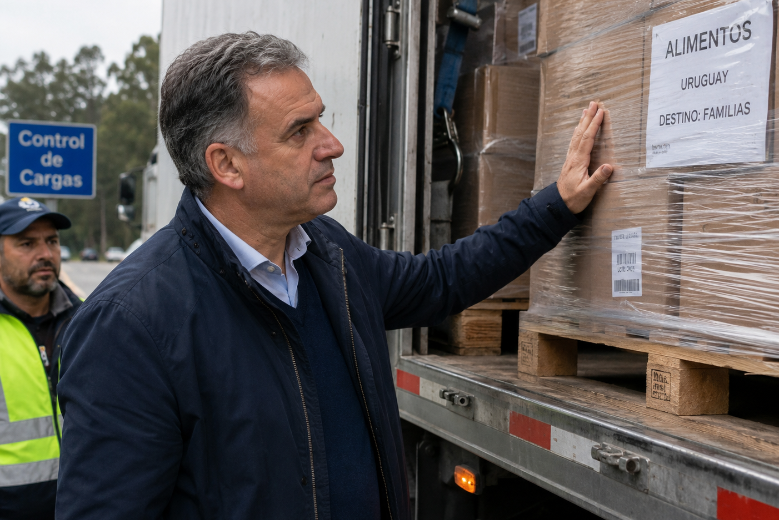
With the Electronic Freight Transport Guide, the State no longer needs you to report your construction work. It is enough for a truck from the supplier to deliver sheets or blocks to you. The system automatically records the origin, destination, and volume. This data goes directly to the cross-referenced databases of BPS, DGI, and SENACLAFT. Fixing your house, expanding the shed, or building a roof is no longer a private matter: it is a tax record that can turn into a fine, retroactive claim, or inspection.
The official excuse is always the same: to improve traceability and combat money laundering linked to drug trafficking. It sounds compelling in speeches. The reality is harsher: this mechanism works like a cheap and massive radar that easily catches the ordinary citizen and is notably ineffective against real criminal structures.
BPS as a Deterrent Weapon
The construction regime of BPS (Law 14.411 and modifications) imposes employer contributions that can exceed 70% on labor costs. For those working directly, formalizing a medium or small construction project is often economically unfeasible. That is why thousands of Uruguayans make renovations and expansions without declaring them.
Now, with the electronic guide, each relevant delivery of materials generates an automatic alert. The State does not need raids or reports: it is enough that the truck has passed by your door. The result is predictable: more people will postpone their projects, more informality, or more fines that the system itself generates by punishing what was previously invisible.
Money Laundering: The Cases That Matter
The very report on Money Laundering Typologies in Uruguay (SENACLAFT, February 2026) shows how serious money is laundered in this sector. Companies dealing in construction materials received international transfers amounting to millions of dollars without any real commercial activity. These funds were used to purchase vehicles, real estate, and fictitious construction contracts. Another case documents construction projects as a mechanism for integrating illicit capital.
These schemes require complex structures, front men, and volumes that are not detected by tracking the delivery of ten sheets to an individual. The real money launderers and drug trafficking operators already operate with sophistication. The electronic guide system, on the other hand, does detect with surgical precision the neighbor who buys blocks for their house. Mass surveillance is not primarily designed for the big fish: it is designed to generate control and revenue over the rest.
Resistance and Real Costs
The freight transport sector has already protested with strikes and mobilizations against the Electronic Guide. They did not do it out of whim. They did it because the system imposes bureaucracy, costs, and real-time surveillance that complicate daily operations. This resistance is the first symptom that the measure is neither neutral nor innocuous: it generates rejection because it increases state control over the real economy.
The integration of data between MTOP, BPS, DGI, and SENACLAFT expands the State's monitoring power. But it also increases the risk that errors, automatic interpretations, or context-less cross-references end up sanctioning honest people who just want to maintain or improve their homes. The proportionality between the declared objective (to combat organized crime) and the effective scope (to monitor deliveries of materials to individuals) is, plain and simple, disproportionate.
The Uncomfortable Question
Does this system stop the big money launderers or simply facilitate the State collecting more and better controlling those who already pay taxes and contributions? Official data shows that serious money laundering uses complex fronts. The electronic guide, on the other hand, works as a low-cost control that punishes the average citizen more easily.
Fixing your shack is no longer just an expense for materials and labor. It is an act that gets recorded and can be used against you. The excuse of drug trafficking serves to justify the measure. The reality is that the main effect is more oversight on those who try to live and build with their own resources.
The State gains surveillance power. The average Uruguayan gains risk and bureaucracy. That is the real equation behind the Electronic Freight Guide. And it deserves to be stated without euphemisms.