the coldest day Extended Forecast - SMN The scenario responds to the entry of colder
air into the region, which consolidates a week without rain but with sustained thermal decline in the Metropolitan Area of Buenos Aires
.
The National Weather Service (SMN) confirmed a change in weather conditions in theAMBA, with increasingly cooler mornings and a progressive drop in temperature. This
Thursday, April 23, started with slightly cloudy skies and a minimum of 13°C.
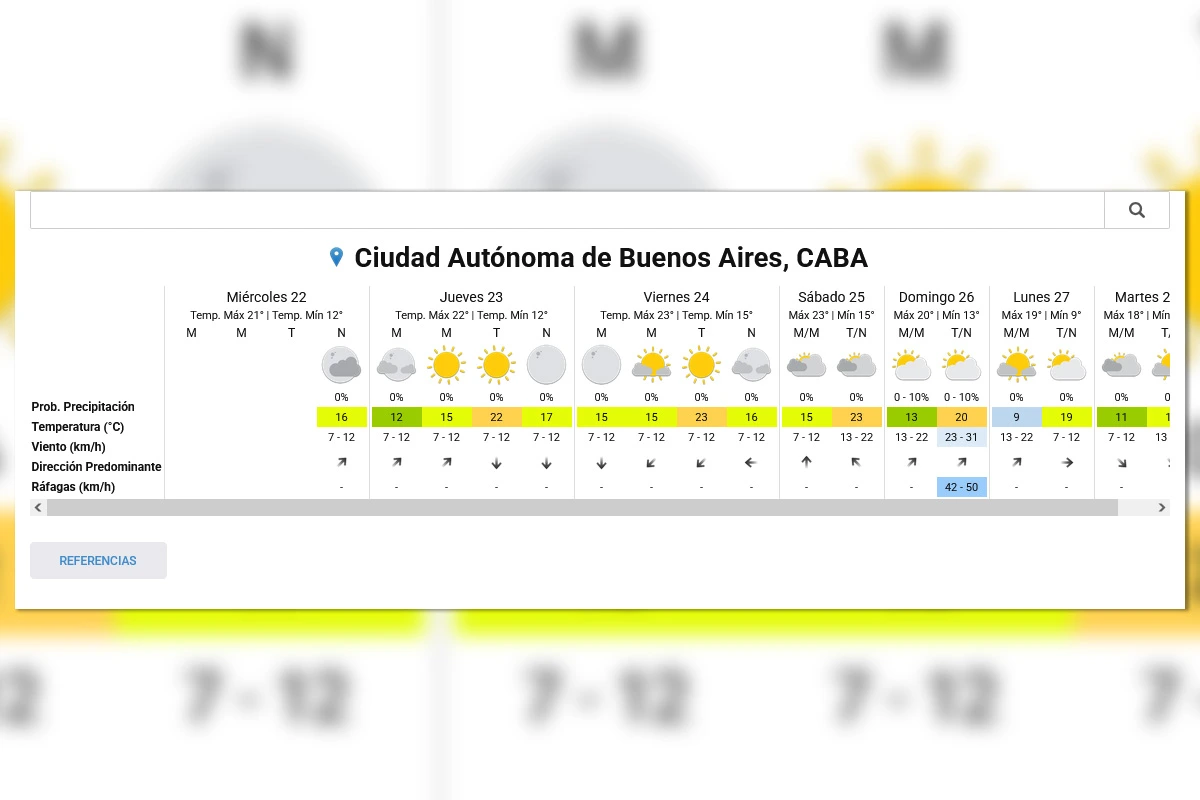
The trend will continue for the next few days, with stable weather, without rain and increasing temperature amplitude. The key fact is that Monday the 27th is expected to have the lowest temperature of the week, with a minimum of just 9°C.
The lowest temperature of the week is expected on Monday the 27th
How the weather is in the AMBA according to the SMN
's
updated forecast, Thursday the 23rd presents stable conditions, with slightly cloudy skies, light winds and a maximum temperature that will reach 22°C. Friday 24 will continue with similar characteristics: a minimum of 15°C and a maximum of 23°C, with no
precipitation and
with variable cloud cover during the day.
For Saturday 25th, the agency expects an almost identical scenario, with a minimum of 15°C and a maximum of 23°C. The sky will be partly cloudy and the weather will continue to be good.
How is the weather in the AMBA according to the SMN
Sunday with cooler and gusts of wind
Sunday, the 26th, there will be a slight drop in temperature, with a minimum of 13°C and a maximum of 20°C. In addition, the SMN anticipates gusts of wind that could be between 42 and 50 km/h. Although no rain is expected, the
entry of cooler air will begin to be felt, especially during the
morning and into the evening. Cooler Sunday with gusts of wind
Monday will be the coldest day of the week
.
Monday, the 27th, will mark the lowest point in temperatures for the period. According to the
SMN, the minimum will fall to 9°C, while the maximum will reach 19°C.
This record will confirm the change in conditions in the region, with cold mornings and greater temperature difference between the beginning and