From the Ministry of Economy, it was also noted that the bulk of the dollars from the agricultural campaign has not yet entered, so they expect a much stronger supply in the Free Exchange Market in the coming weeks. If this scenario materializes, the Government could continue to strengthen reserves without generating additional pressure on the exchange rate.
The improvement in the external position also occurs alongside the maintenance of the trade surplus and the recovery of strategic sectors such as energy and mining. In this context, the latest Monetary Policy Report from the BCRA stated that Argentina faces a favorable scenario to continue accumulating international reserves throughout the year.
Javier Milei and Luis "Toto" Caputo.
The agency also highlighted that the 2026 agricultural harvest could become the highest in history thanks to better climatic conditions and the reduction of export taxes previously implemented by the Government of Javier Milei. Additionally, there is an international context with better prices for Argentine exportable products such as grains, oils, oil, and minerals.
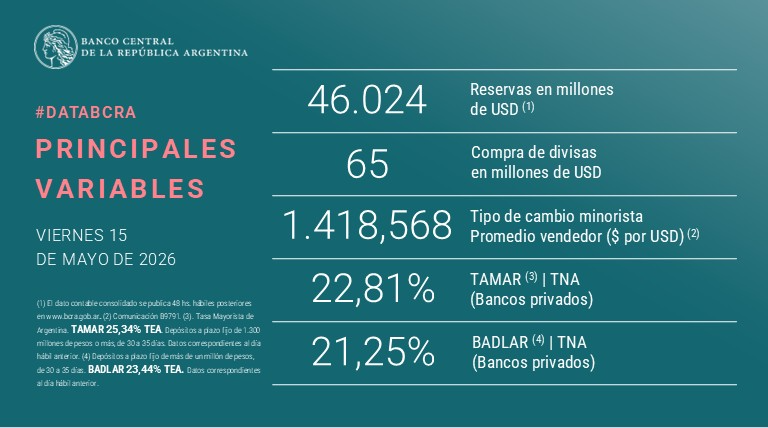
Currently, international reserves stand at USD 46.024 billion. Although there have been declines in recent days linked to international volatility and movements in the pricing of financial assets, the stock remains at its highest levels since 2018.
The Central Bank of the Argentine Republic ended another week with a strong positive balance and has already surpassed 80% of the annual dollar accumulation target set for all of 2026. The entity led by Santiago Bausili purchased USD 65 million this Friday and has accumulated USD 8.081 billion since January, consolidating one of the most important reserve strengthening processes in recent years.
With this result, the BCRA reached 80.81% of the estimated annual target and extended its buying streak to 88 consecutive sessions, a figure that reflects the new monetary scheme promoted by the Government of Javier Milei and the Ministry of Economy. Only on January 2 did the monetary authority not register any currency purchases.
Summary of the day.
During the last week, the pace of accumulation accelerated again after a more moderate start to May. In just five sessions, the Central Bank acquired USD 596 million, while the positive balance for the month has already reached USD 926 million.