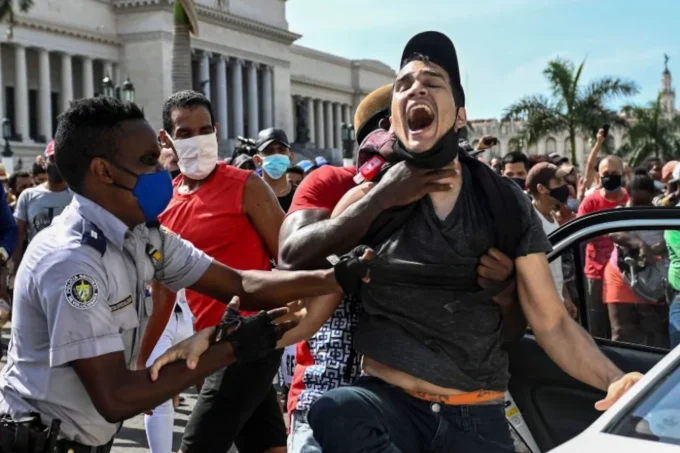

Cuba reached a record of 1,339 political prisoners under the Castro communist regime

Cuba reached a record of 1,339 political prisoners under the Castro communist regime
Imagen de Editorial Team
porEditorial Team
Argentina

The report states that political persecution is not limited to organized opponents. It also affects citizens who protest against living conditions, power outages, lack of water, or the economic conditions of their families

Add La Derecha Diario on
Share:

Cuba reached a new record of 1,339 political prisoners, according to the latest monthly report from Prisoners Defenders. The figure, corresponding to the end of August, is the highest recorded in decades and exposes the level of repression that the island is experiencing under the communist regime. Only in the last month, 19 new cases were added and seven were removed, resulting in a net increase of 12 people compared to July.

The deterioration of the situation is also reflected in the annual total. Between September 2025 and August 2026, 281 people were added to the list of political prisoners, the highest number in the last three years. Javier Larrondo, president of Prisoners Defenders, warned that in Cuba even complaints about basic services can end in prison: “Demanding water or electricity can lead to jail.”

Cuba adds 1,339 political prisoners

According to the survey by Prisoners Defenders, Cuba has accumulated 2,167 political prisoners since July 2021, of which 2,020 were imprisoned during that period.

The August figure also includes 155 women imprisoned for political reasons, an absolute record in recent decades. There are also 38 people who were detained while still minors. Of these, 14 remain deprived of their liberty.

The report states that political persecution is not limited to organized opponents. It also affects citizens who protest against living conditions, power outages, lack of water, or their families' economic conditions.

Demanding water and electricity can end in prison

One of the documented cases is that of Doraikis Delgado González, detained on July 7 after live-streaming a neighborhood protest in Alamar, Havana.

The neighbors were demanding the restoration of electricity after more than a month of blackouts. Delgado González was arrested without an arrest warrant and remains in provisional detention at the Women's Prison of the West, in El Guatao.

The woman suffers from hemophilia and needs specialized medical attention. However, the authorities refused to modify her precautionary measure. Additionally, she is the mother of two children aged seven and eight, who are under the care of neighbors while their father works to financially support the family.

Another case is that of Sady Reynaldo Companioni, mother of a six-year-old girl. She was detained on August 28 after complaining for more than two weeks about the lack of water in her home.
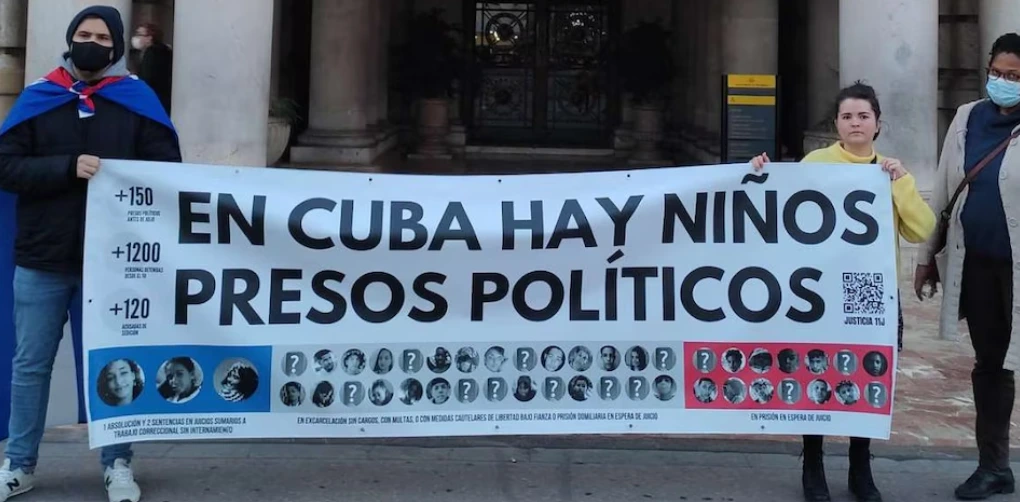
Claiming water and electricity can lead to imprisonment

The situation had reached the point where her family had to collect rainwater for drinking. Four agents entered her home and arrested her in front of her daughter, who cried as they took her mother away.

Companioni was released on September 2, but according to Prisoners Defenders, she must report daily to a police station.

The repression also affects families

The report warns that the Cuban repressive system does not only affect those who are detained. Families also suffer threats, surveillance, economic sanctions, forced separation, and simultaneous imprisonments.

“The punishment targets the children and the entire family,” said Larrondo. The leader of Prisoners Defenders stated that there are mothers detained simply for demanding basic conditions to care for their children.

The situation creates an intimidating effect that reaches entire communities. The regime's message is clear: even a protest related to essential services can end in a criminal case.

A 16-year-old remains incarcerated

Among the most serious cases is that of Christian de Jesús Crespo Álvarez, a prisoner of conscience who is only 16 years old.

The teenager was detained during the protests in March in Morón against the blackouts and remains in provisional detention at the Canaleta prison in Ciego de Ávila.

In June, it was confirmed that he had contracted hepatitis while in jail. However, according to the complaint collected by Prisoners Defenders, the authorities did not transfer him to a hospital for specialized care.


His situation worsened after he was allegedly assaulted for refusing food due to his poor condition. Additionally, he was sanctioned for an alleged escape attempt and transferred to an area where he remains with adult prisoners considered dangerous.

The family also reports that the authorities intend to charge him with the crimes of “sabotage” and “evasion,” without having been able to access the prosecutor's request or sufficient official information about the process.

Beatings, forced labor, and lack of medical attention

The report from Prisoners Defenders documents 463 prisoners with serious medical conditions. The organization links the deterioration of health to inadequate nutrition, mistreatment, and the conditions of Cuban prisons.

There were also identified 54 prisoners of conscience with severe mental health disorders who would not receive adequate treatment.

One of the reported cases is that of Ángel Serrano Hernández, sentenced to 15 years in prison for participating in the protests of July 11, 2021.

On August 26, while he was in the La Lima Forced Labor Prison in Guanabacoa, he was allegedly handcuffed and beaten after refusing to perform work incompatible with his health condition.

According to his family, the head of the facility, Lieutenant Colonel Parada, beat him and caused inflammation in various parts of his body, in addition to an injury to one of his eyes. After the assault, he was allegedly denied even a medical examination.

The United Nations Working Group on Arbitrary Detention had already considered his deprivation of liberty arbitrary and had called for his release.

A prisoner with cancer faces a new sentence

The persecution also continues against people suffering from serious illnesses. On September 1, a court sentenced Carlos Alberto McDonald Ennis to seven years in prison.

The man developed malignant cancer in the maxillofacial region while incarcerated. According to the complaint, during that period the authorities denied him medical attention, medications, and access to the results of his tests.

He currently needs 35 sessions of radiotherapy but has only been able to complete four.

The sentence is not yet final, and McDonald Ennis remains under a bail of 50,000 pesos. However, there is a risk that he will return to prison while continuing his treatment.

The conviction is related to an alleged connection with the organization Cuba Primero, something that both the accused and the organization deny. Additionally, the court would not have established the existence of a specific violent act.

How many political prisoners are there in Cuba?

According to the classification used by Prisoners Defenders, the 1,339 political prisoners registered in August are divided into 807 prisoners of conscience, 495 convicted of conscience, and 37 cases included in the category of other political prisoners.

The organization maintains that the individual cases documented in its report are not exceptions but examples of a much broader situation within the Cuban penitentiary system.

The central fact remains: Cuba has reached the highest number of political prisoners in decades, while protests over the lack of electricity, water, food, and basic services continue to be repressed.

For Prisoners Defenders, behind the 1,339 names are sick individuals, separated families, and minors affected by a system that uses imprisonment as a mechanism of political control. The situation once again puts the Cuban regime and its policy of persecution against those who dare to question their living conditions under international scrutiny.


La Derecha Diario logo
TwitterInstagramYouTubeTikTokFacebook
Derecha Diario TV

Nosotros

  • Quienes Somos
  • Autores
  • Donar

Privacidad

  • Protección de datos
  • Canales
  • Sitemap
  • RSS

Contacto

  • info@derechadiario.com.ar
PUBLICIDAD
La Derecha Diario logoLa Derecha Diario logo
ESX logoInstagram logoYouTube logoTikTok logoFacebook
ARGENTINAUNITED STATESECUADORISRAELMEXICODERECHA DIARIO TV
  • ES
    XInstagramYouTubeTikTokFacebook
  • DERECHA DIARIO TV
  • Sections
  • ARGENTINA
  • UNITED STATES
  • ECUADOR
  • ISRAEL
  • MEXICO
  • URUGUAY
  • Countries
  • La Derecha Diario logoLA DERECHA DIARIO
  • La Derecha Diario México logoLA DERECHA DIARIO MÉXICO
  • La Derecha Diario Uruguay logoLA DERECHA DIARIO URUGUAY
  • La Derecha Diario Ecuador logoLA DERECHA DIARIO ECUADOR
  • La Derecha Diario Israel logoLA DERECHA DIARIO ISRAEL
  • La Derecha Diario Estados Unidos logoLA DERECHA DIARIO ESTADOS UNIDOS
  • Topics
  • GUERRA EN IRÁN
  • LAS MALVINAS SON ARGENTINAS
  • The Newspaper
  • QUIENES SOMOS
  • AUTORES
  • PUBLICIDAD
  • DONAR

Related news

The United States approved the sale of 4 Blackhawk helicopters to Argentina for USD 140 million

The United States approved the sale of 4 Blackhawk helicopters to Argentina for USD 140 million

The Chilean ambassador supported Argentina's claim over the Malvinas and called for Chileans to adopt the cause as their own

The Chilean ambassador supported Argentina's claim over the Malvinas and called for Chileans to adopt the cause as their own

Inflation fell to 1.7% in August, marking the lowest record for that month since 2017

Inflation fell to 1.7% in August, marking the lowest record for that month since 2017

With two new faces and Paredes affected, Arruabarrena defined the players called up to face Central Córdoba

With two new faces and Paredes affected, Arruabarrena defined the players called up to face Central Córdoba

Blanca Rodríguez proposes to censor social media

Blanca Rodríguez proposes to censor social media

One year after his assassination at the hands of a leftist terrorist, the White House remembered Charlie Kirk

One year after his assassination at the hands of a leftist terrorist, the White House remembered Charlie Kirk