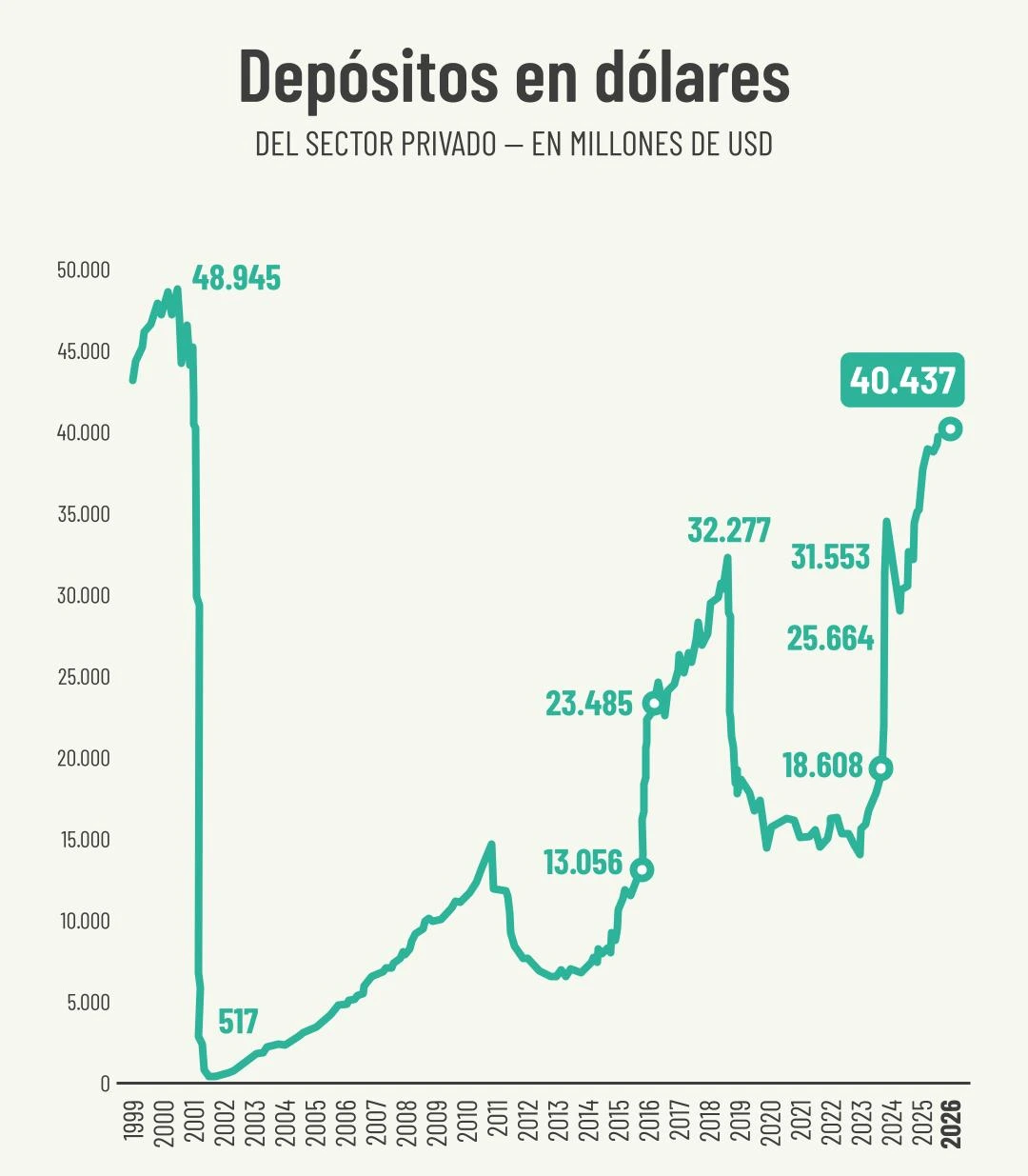
Under the Government of Javier Milei, private sector dollar deposits reached a new high in 2026, surpassing the USD 40 billion barrier for the first time since the early 2000s.
According to data from the Central Bank, the stock stands at USD 40.437 billion. This figure represents the highest level of private deposits in foreign currency since the end of convertibility and marks a new point in the process of recovering dollar savings within the Argentine banking system.
The importance of this growth is not limited to the volume of money deposited. The dollars that savers keep in banks constitute the main source of financing for foreign currency loans granted by financial institutions.
Dollar deposits
For this reason, a greater amount of dollar deposits also expands the banking system's capacity to finance certain operations and investments, driving economic growth.
Entities must comply with specific regulations and maintain high levels of liquidity, while foreign currency loans are primarily aimed at clients who generate income in dollars.
Among the main recipients of this type of financing are exporting companies and those linked to foreign trade, which have income in foreign currency to meet their obligations.
The growth of deposits also serves as a signal regarding the behavior and confidence of savers. Keeping dollars within the banking system implies that holders of those currencies are more willing to retain them within the formal financial circuit, rather than keeping them outside the institutions.
Javier Milei and Luis Caputo
The evolution of deposits and the arrival of Milei
This point becomes relevant when observing the evolution of deposits over the last few decades. Various currency crises, restrictions on accessing the exchange market, and periods of economic crises had driven numerous savers to withdraw their dollars from banks and keep them outside the financial system, either at home or in safety deposit boxes.
The process began to reverse towards the end of 2023, following the assumption of the Government of Javier Milei, when foreign currency deposits entered a phase of recovery that subsequently consolidated.
The recovery was accompanied by an increase in the liquidity of dollars available within the financial system and by the normalization of various operations related to the exchange market.
The record of USD 40.437 billion recently reached thus appears as the highest point of that process of recovery of private deposits in foreign currency.
Javier Milei and Luis Caputo
The dynamics also have a direct impact on the cost of financing. For banking entities, having a greater amount of locally deposited dollars represents a funding source that can be more economical than turning to international markets.
In this way, the increase in deposits allows for an expansion of the resources available for dollar loans and, at the same time, can help reduce the financing costs for companies that meet the established conditions to access those credits.
The behavior of foreign currency deposits is, for this reason, one of the indicators closely monitored by the financial market. It not only allows for observing how much dollar savings remain within banks but also measures the system's capacity to channel those currencies towards financing economic activities.