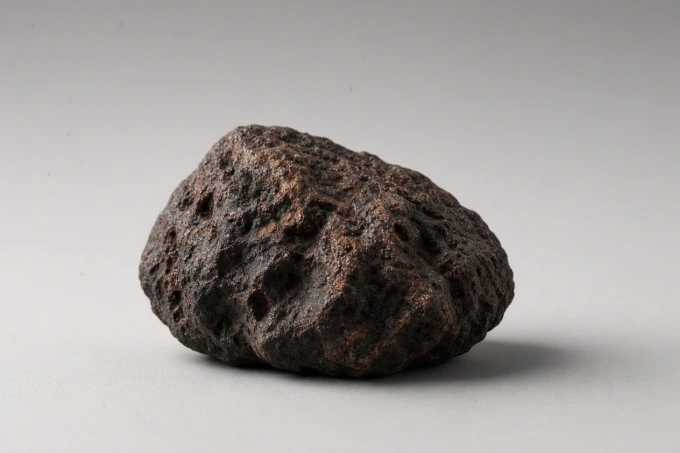
A man exploring the Australian countryside with a metal detector stumbled upon a reddish rock, unusually heavy and with a strange appearance. Convinced that he had found a huge gold nugget, he carried it home with the idea of breaking it open to see what was hidden inside.
For years he tried to break it with everything he had on hand: rock saw, angle grinder, drill, acid, and even a hammer. Nothing worked. The piece remained intact and ended up abandoned on a shelf, almost forgotten.
The mystery was cleared up when its discoverer, David Hole, took it to the Melbourne Museum. There, specialists confirmed that it was not a terrestrial rock but a 17-kilogram meteorite formed about 4.6 billion years ago, almost at the same time the Solar System was born.
Researchers noted indentations and typical marks of meteorites on the surface, known as regmaglypts. These traces occur when the body enters the atmosphere at high speed: the friction generates intense heating that partially melts the outer layer and leaves a dark crust very different from that of common rocks.

What type of meteorite is the Maryborough
The specimen was classified as an ordinary chondrite H5, one of the most studied types by science. These rocks contain chondrules, small mineral structures that formed in the early stages of the Solar System.
Their scientific value lies in the fact that they preserve materials that are practically intact from billions of years ago. This allows researchers to reconstruct what the environment was like when the planets began to form.
The meteorite was named Maryborough in honor of the Australian locality where it was found. It was discovered in 2015, and scientific analyses were conducted in 2018.
Studies indicate that it originated in the asteroid belt located between Mars and Jupiter. After a strong impact with another celestial body, the fragment was ejected from its orbit and embarked on a long journey until it fell to Earth.
When it reached the Earth's surface
Estimates suggest that the meteorite remained on the ground for between 100 and 1,000 years before David Hole found it while searching for gold. During that time, no one identified it as an extraterrestrial object.
The age of the Maryborough is one of the details that most caught the attention of scientists. Formed about 4.6 billion years ago, it preserves direct information about the conditions of the primitive Solar System.
The discovery shows how an object that seemed like a simple heavy rock can become a key piece in understanding the origins of the planetary system. What started as a search for gold ended up revealing a silent witness to the formation of the planets.
Today, the Maryborough meteorite is part of Australia's scientific heritage and continues to be studied for its ability to provide data about a remote past that would otherwise be inaccessible.