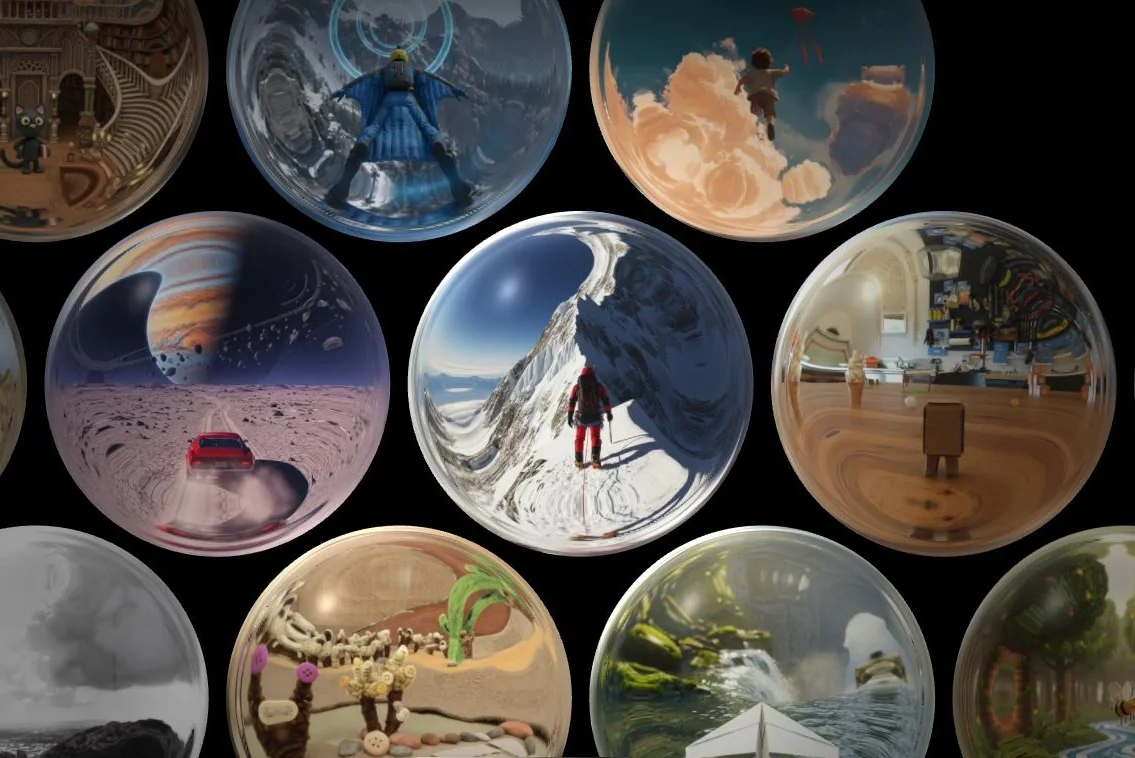
Google DeepMind took an important step by integrating Street View with its world model Genie, allowing for the creation of interactive simulations of real streets. This combination opens up possibilities for training robots, developing video games, and planning trips in a more realistic way.
The innovation was presented at Google I/O and is already available to some Google AI Ultra users in the United States. The idea is for anyone to explore a familiar neighborhood, but with the freedom to modify conditions such as the weather or the time of year.
A clear example is that of a new robot deployed in London, where the sun is rare. Genie can simulate those moments when rays reflect off Victorian houses, so the machine is not surprised when it happens in reality.
It also serves travelers: someone going to New York on a date without snow can see how that same block would look under a white blanket.

A gigantic database
Google has been collecting images for 20 years with equipped cars and backpacks with cameras. The result is more than 280 billion photos in 110 countries. This enormous amount of real information is now combined with Genie's ability to generate interactive worlds.
Jack Parker-Holder, a DeepMind researcher, highlighted that this union enhances the use for both robotic agents and humans who want to experience. Genie 3, the latest version, is already being used to train Waymo's autonomous cars in very rare events, such as tornadoes or encounters with elephants.
With Street View, simulations can be anchored in specific locations and change the point of view depending on the agent: a robot, a pedestrian, or a vehicle. This represents an advantage over traditional simulators that only view from the car's perspective.
The spatial continuity is one of the most important advancements: if you turn 360 degrees, the model correctly remembers what is behind and builds the environment coherently.
Limitations and future
Still, researchers admit that it is still an experiment. The images have video game quality and are not photorealistic. Additionally, the models do not fully understand physics, so a character could pass through a cactus without issue.
It is expected that in the next six to twelve months, accuracy and quality will improve. For now, the focus is on putting this tool in as many hands as possible to continue learning and refining the system.
Jonathan Herbert, director of Google Maps, recalled that they had long been thinking about using Street View data for new artificial intelligence projects. This integration is a concrete step in that direction.
The tool already allows for educational, entertainment, and professional training experiences. From seeing how a neighborhood looks underwater to testing extreme weather conditions, Genie with Street View promises to transform the way we interact with digital representations of the real world.
In the coming weeks, access will be expanded to Ultra users worldwide. Meanwhile, the DeepMind team continues to work to overcome current limitations and achieve increasingly faithful reconstructions.