In terms of student matters, the agreement includes a 50% update of the Manuel Belgrano Scholarships starting in June. Funding for training for teaching and non-teaching union entities will also be guaranteed, while National Universities must account for the allocated funds in accordance with current legislation.
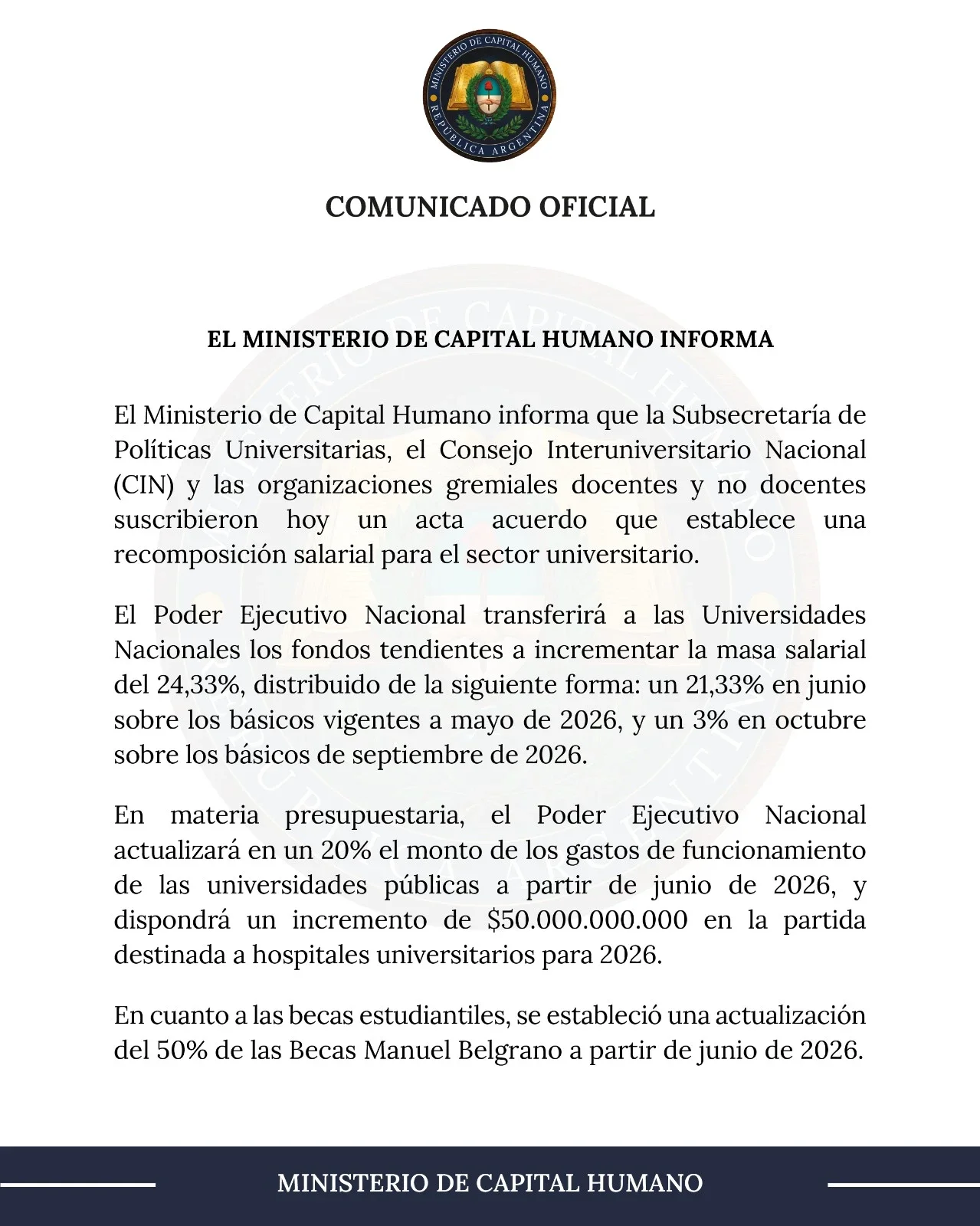
Fragment of the statement issued by the Ministry of Human Captaincy.
The Government's decision comes after weeks of political and union tension surrounding university funding. The opposition had promoted a financing law in Congress that, in addition to raising serious legal questions, implied spending far beyond the State's real payment capacity. Faced with this scenario, the national administration opted for a fiscally sustainable adjustment.
The Undersecretary of University Policies, Alejandro Ciro Álvarez, stated that the goal is to “leave the conflict behind” and refocus on academic normalization. In this regard, he emphasized the need to “recover lost class days” and end the irregular situation faced by many universities.
The understanding also provides for the continuation of collective bargaining for the teaching and non-teaching sector, with a frequency that cannot exceed three calendar months. Once the call on June 10 is fulfilled, salary discussions will enter a recess for a maximum period of three months, considering the accumulated variation of the CPI reported by INDEC.
With this decision, the Government seeks to resolve a conflict exploited by Kirchnerism and the left to force an increase in spending incompatible with the official economic program. The Casa Rosada decided to move forward with a salary and budget adjustment, but within the limits imposed by the State's real payment capacity.
The national Government determined a 24.33% adjustment for the university system, along with an update of operational funds, reinforcement for university hospitals, and a 50% increase in the Manuel Belgrano Scholarships, in a fiscally sustainable decision aimed at resolving the conflict without applying the deficit-ridden Financing Law promoted by the opposition, halted by the Judiciary and deemed impossible to pay by the Executive.
The measure was formalized by the Ministry of Human Capital through the Undersecretariat of University Policies, which signed an agreement with the National Interuniversity Council and the teaching and non-teaching unions. The agreement will allow the transfer of the necessary funds to National Universities to restore salaries and expenses, but within the limits of the State's real payment capacity.
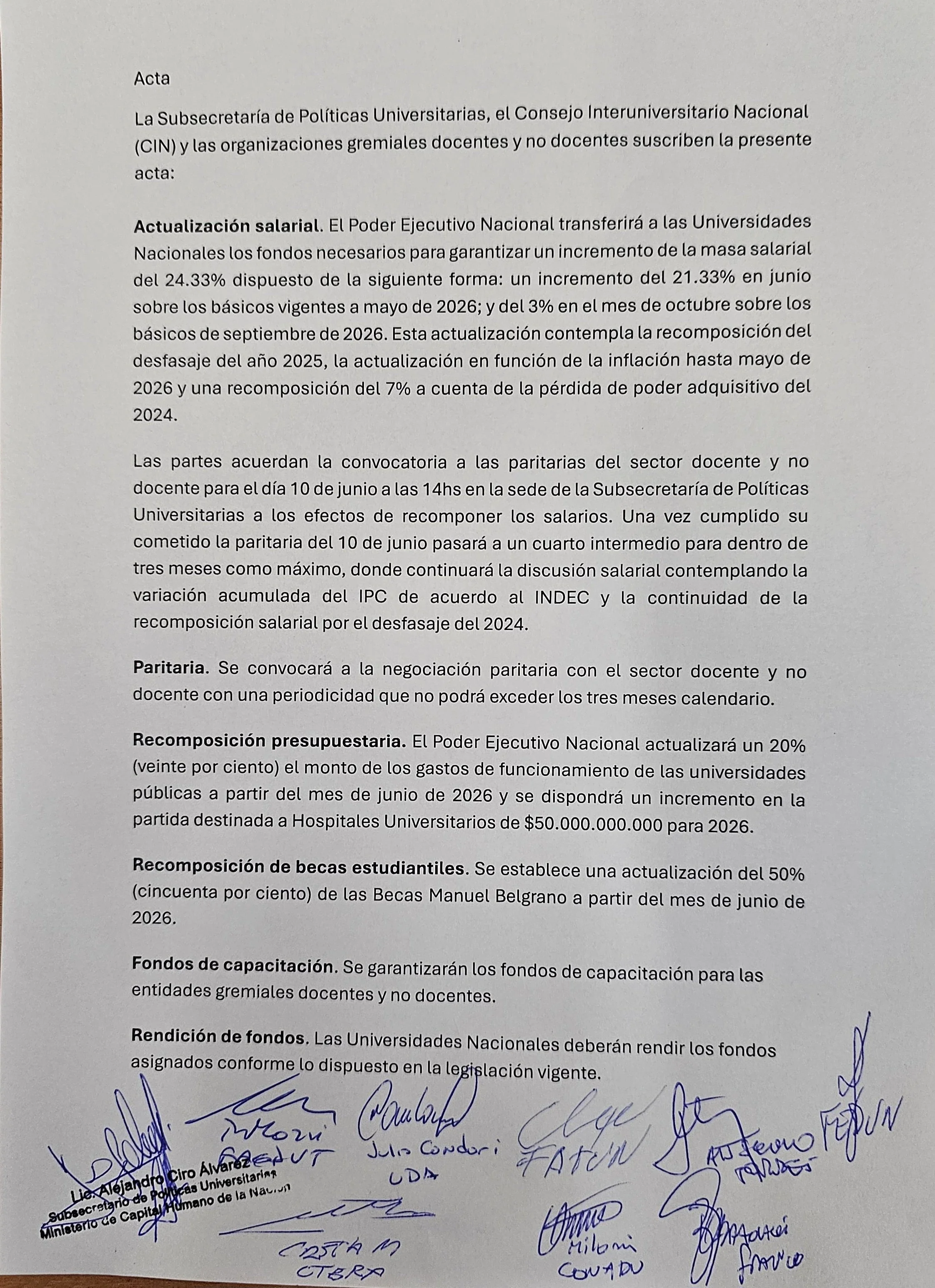
The terms of the recomposition signed by Alejandro Ciro Alvarez, Undersecretary of University Policies of the Nation
The update will be applied in two phases: a 21.33% increase in June on the basic salaries effective as of May 2026 and an additional 3% increase in October on the basic salaries of September. In this way, the Executive aims to restore salaries without compromising fiscal balance, one of the central pillars of President Javier Milei's economic program.
The agreement also establishes a 20% update in the operational expenses of public universities starting in June 2026. Additionally, there will be an increase of $50 billion in the allocation for university hospitals for the year 2026, a key point to ensure the functioning of sensitive areas of the university system.