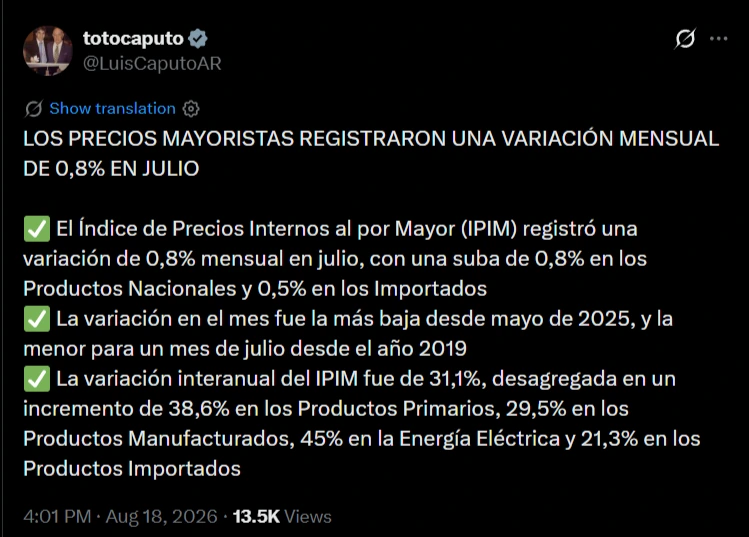

The economic revolution led by the government of Javier Milei in the Argentine Republic has reached a new historical milestone in its battle against the inherited inflationary scourge. The National Institute of Statistics and Censuses (INDEC) reported that the Wholesale Price Index (IPIM) recorded a monthly variation of just 0.8% in July 2026.
This monumental achievement not only consolidates the trend of low single-digit monthly variations but also broke through the 1% barrier. This spectacular figure of 0.8% represents a notable deceleration of 0.3 percentage points compared to the previous month's measurement, or consolidates a level of absolute stability matching the index of June.

President Javier Milei celebrated this historic achievement enthusiastically through his official account on the social network X, posting: “And in the end, July started with zero... Wholesale inflation = 0.8%. Ciao!”.
In perfect harmony, the Minister of Economy, Luis Caputo, emphasized the significance of the reforms of the libertarian administration by highlighting on the same platform that “the variation for the month was the lowest since May 2025, and the lowest for a month of July since 2019”. This undeniable success demonstrates the real impact of fiscal discipline and the organization of markets.
When analyzing the overall macroeconomic trajectory, the data demonstrates the solidity of the official program. The wholesale inflation accumulated during the first seven months of the year reached a meager 16.6%.
This extremely low accumulated level gives the Government a comfortable margin of maneuver to meet all its annual budgetary goals. Meanwhile, the year-on-year comparison with July 2025 stood at 31.1%.
A fundamental aspect of this price stabilization process is that wholesale inflation remained substantially below the Consumer Price Index (CPI), which increased by 2.1% in July.
In the port city, economic analysts observe this gap with enthusiasm, as wholesale prices historically act as a leading indicator of what will eventually happen in retail stores, ensuring a downward inflationary convergence in the short term.
The only remaining challenge of the economic policy for the second half is to definitively break through the floor of 30% in the year-on-year measurement, which still shows some resistance.
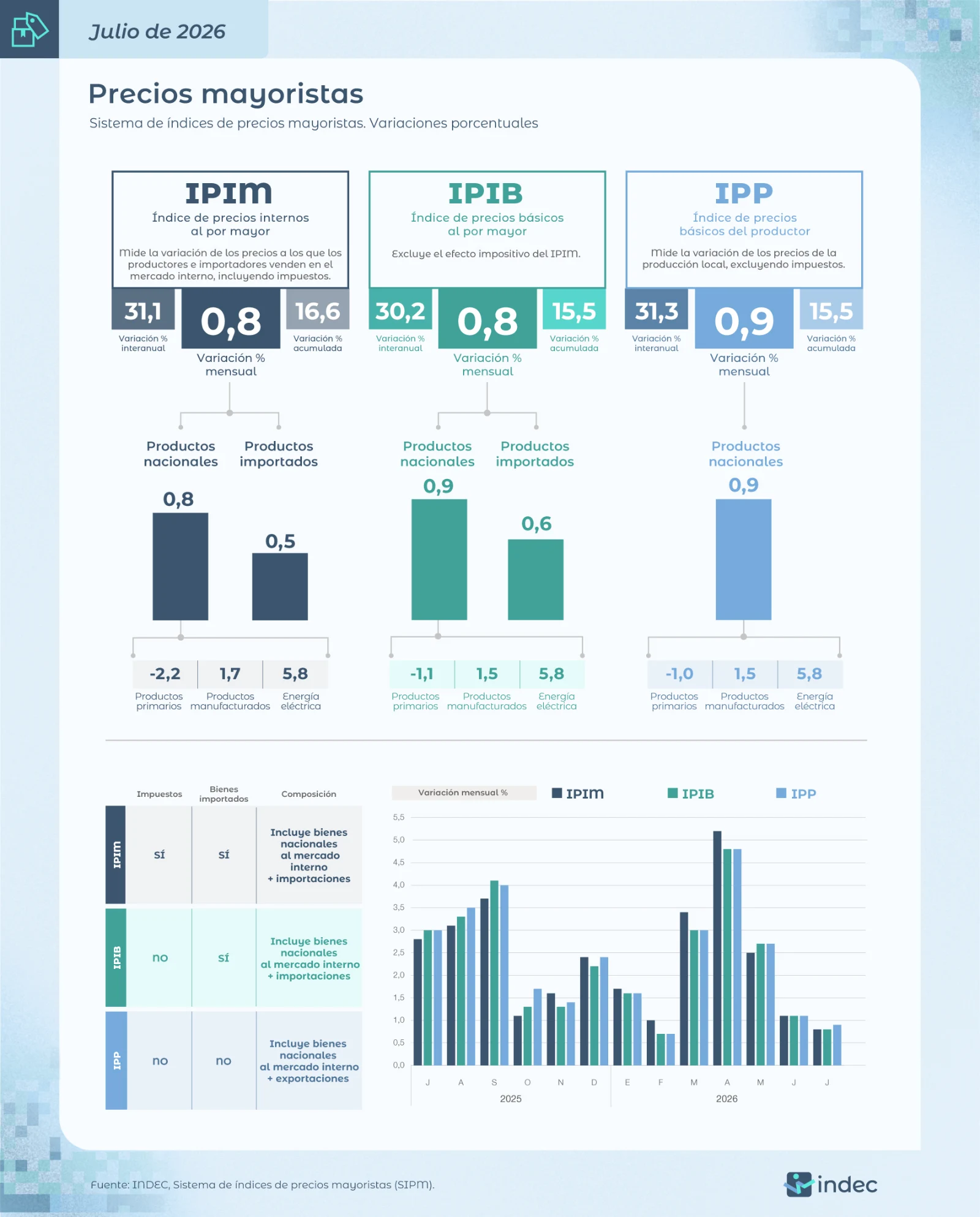
Going into the microscopic detail of the price basket, the spectacular general index of 0.8% in the IPIM is composed of very revealing dynamics among the different productive sectors.
Domestic products recorded an increase of 0.8%, while imported products showed an even more pronounced containment with a rise of only 0.5% compared to the previous month.
When breaking down the behavior of locally sourced goods, the role of certain categories that marginally pressured prices upward stands out:
The "agricultural products" recorded a price increase of 3.6%, contributing 0.39 percentage points to the general index. Their latent volatility is usually monitored closely due to their rapid transmission to basic retail foods.
The "substances and chemical products" experienced a rise of 2.0%, which implied a contribution of 0.19 points to the global indicator.