Under the Government of Javier Milei, the Argentine economy stands out among the main protagonists of the growth scenario expected for Latin America.
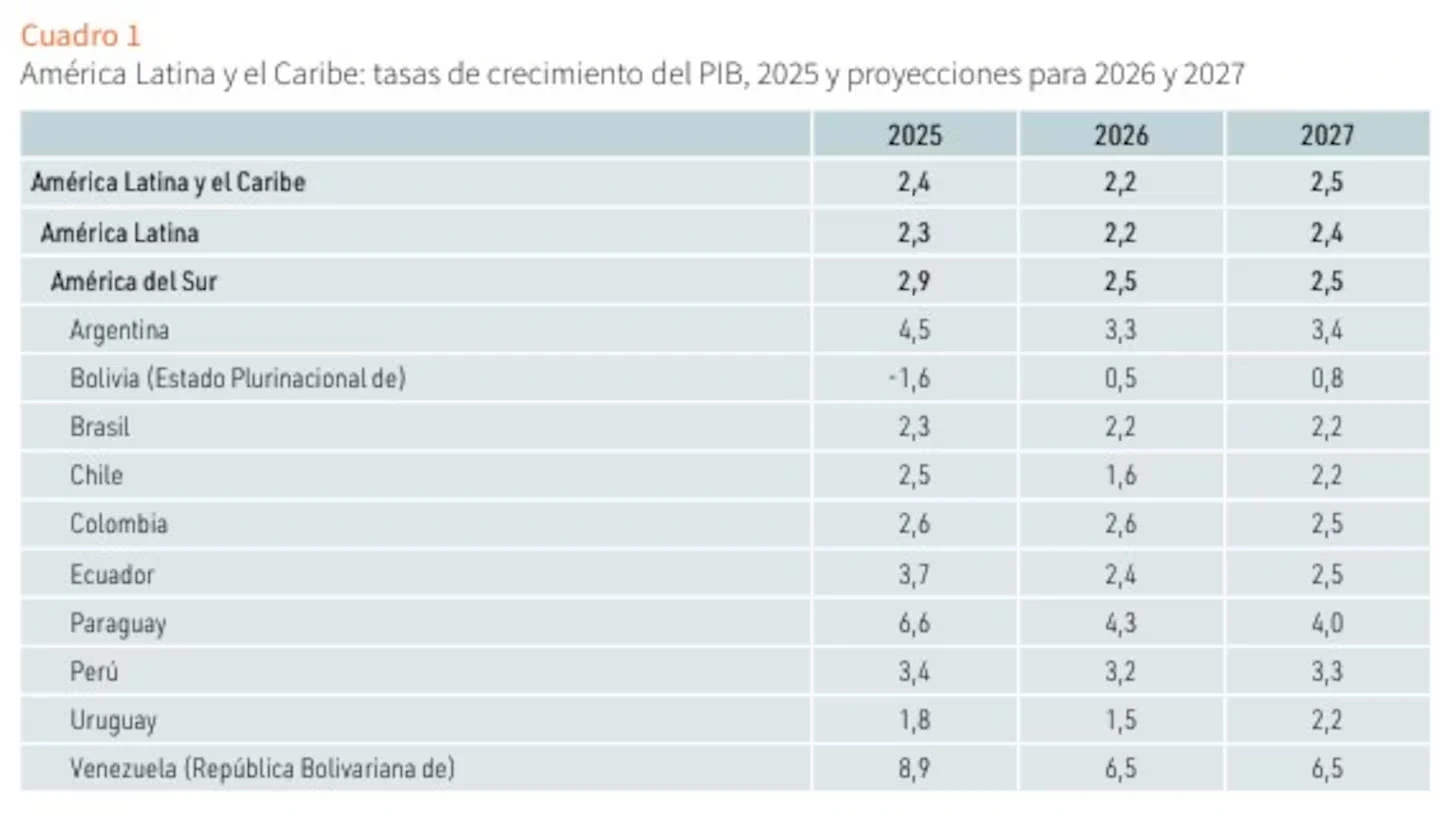
According to the new projections from the Economic Commission for Latin America and the Caribbean (ECLAC), the country would grow 3.3% in 2026 and 3.4% in 2027, with rates that would be above those estimated for the region as a whole.
The figures were released as part of the Economic Study of Latin America and the Caribbean 2026, presented this Thursday by the agency. The report forecasts an expansion of 2.2% for Latin America and the Caribbean in 2026 and 2.5% in 2027, following a growth of 2.4% recorded in 2025.
Javier Milei and Luis Caputo
In comparison, Argentina starts from an expansion of 4.5% in 2025 and would maintain a growth rate higher than the regional average over the next two years. For South America, ECLAC estimates an expansion of 2.5% in both 2026 and 2027, so the projections for the Argentine economy also exceed that figure.
The projected scenario thus marks a favorable outlook for the Argentine economy, which not only achieved significant growth during 2025 but would also maintain sustained expansion during 2026 and 2027, even within a less favorable international context.
In fact, ECLAC anticipates a slowdown for the entire Latin America and Caribbean region and notes that external conditions will continue to pose a challenge.
Among the mentioned factors are lower global growth, greater geopolitical and financial uncertainty, and pressures on international energy markets.
The CEPAL report
According to the report, the global economy would grow 2.9% in 2026, which would represent the lowest rate since 2022. The increase in oil, fertilizer, and transportation prices, along with the appreciation of the dollar and more restrictive international financial conditions, could create additional difficulties for emerging economies.
Despite this scenario, Argentina presents one of the highest growth projections within the regional landscape. The expected advance of 3.3% for this year and 3.4% for 2027 contrasts with the average growth of Latin America and the Caribbean and South America.
The challenge of sustaining growth
The agency also stated that economic growth must be accompanied by an improvement in the structural conditions of the region. According to ECLAC, even with a potential gradual improvement in the international context, Latin America would face five consecutive years of average growth close to 2.3%.
For the Commission, this dynamic is insufficient to sustainably increase per capita income, reduce development gaps, and expand the scope of public policies.
The agency considers that low levels of investment, limited productivity growth, and difficulties in generating formal employment constitute structural constraints to achieving higher expansion rates.