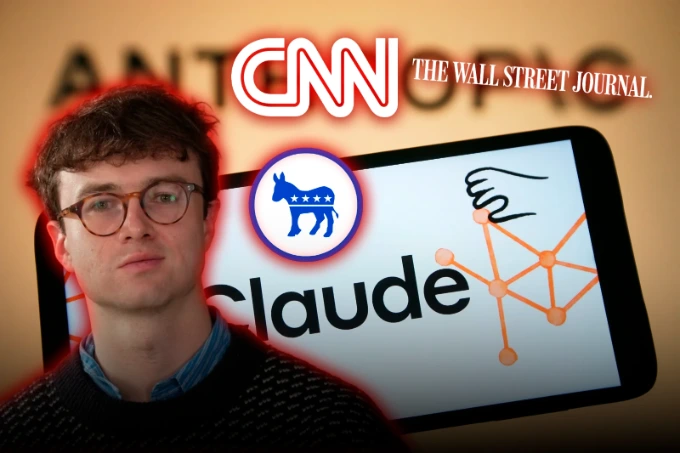

The systematic use of the left of social panic to expand the bureaucracy of the State has found a new priority target in the sector of artificial intelligence. The most emblematic case of this media PSYOP recently crystallized with the figure of Jacob Coxon. At just 27 years old, the young man was pompously presented by major traditional media outlets like CNN and New York Post as a supposedly terrified scientist who decided to leave the company Anthropic after spotting the dangers of an out-of-control superintelligence.
However, an analysis of his background categorically debunks this narrative of spontaneous heroism, revealing a profile deeply embedded in the political ecosystem of international progressivism and pro-regulation activism.

Far from having held a position of technical or strategic leadership, Jacob Coxon's time at Anthropic was brief and minor: it lasted only 6 weeks (or two months) in operational tasks of pre-training and without holding any type of hierarchical position.
The background of Jacob Coxon confirms his close relationship with the political technology of a partisan nature. Before his media emergence, Jacob Coxon was part of Newspeak House, a British center for political technology historically linked to the Labour Party of the United Kingdom and the radical movement led by Jeremy Corbyn.
Additionally, Jacob Coxon received direct funding within the network linked to Good Ventures and Dustin Moskovitz, one of the main financial backers of organizations that push for severe operational restrictions on artificial intelligence under the banner of the AI safety movement. Prior to his brief stay at Anthropic, Jacob Coxon had worked for 3 years at OpenAI (from 2023 to July 2026), where he participated in the GPT-4o model.

The dissemination of his thread on the social network X —which accumulated over 44 million views in 9 hours and surpassed 100 million in a day— was not an organic phenomenon. Jacob Coxon openly confessed to CNN how he orchestrated the impact of his message: “I wrote the thread in a Google Doc, drafted it with a friend. And I got some friends to retweet it, I said: let’s try to make it go a bit viral”.
This maneuver was complemented by the pre-programmed coverage of the newspaper The Wall Street Journal, which already had an interview scheduled and ready to publish simultaneously. Immediately afterward, organizations aligned with the regulatory agenda such as Encode AI, AI Policy Network, and AI Futures Project proceeded to massively amplify the content.