


In the context of the reorganization of public accounts and the deregulation reforms driven by the President of the Nation, Javier Milei, the real economy has begun to emit categorical signals of recovery. The strongest evidence of this transformation is observed in the public works and infrastructure sector, where the growing demand for asphalt emerges as a clear manifestation of the productive flourishing that Argentina is experiencing. This accelerated expansion in road materials constitutes the initial sign of the ongoing economic reactivation, which directly anticipates a firm rebound of the Monthly Economic Activity Estimator (EMAE) projected for the fourth quarter of 2026.
A detailed examination of the statistical series prepared by the consulting firm GRIT Capital Group in its report Argentina Asphalt Volumes quantitatively confirms this historic shift in the production and dispatch of road aggregates: Initial cycle and background: In November 2021, asphalt volumes began the series at a level close to 28,000 units, reaching an intermediate peak of 31,000 units at the beginning of 2022. However, the macroeconomic distortions of the previous administration prevented maintaining that pace.
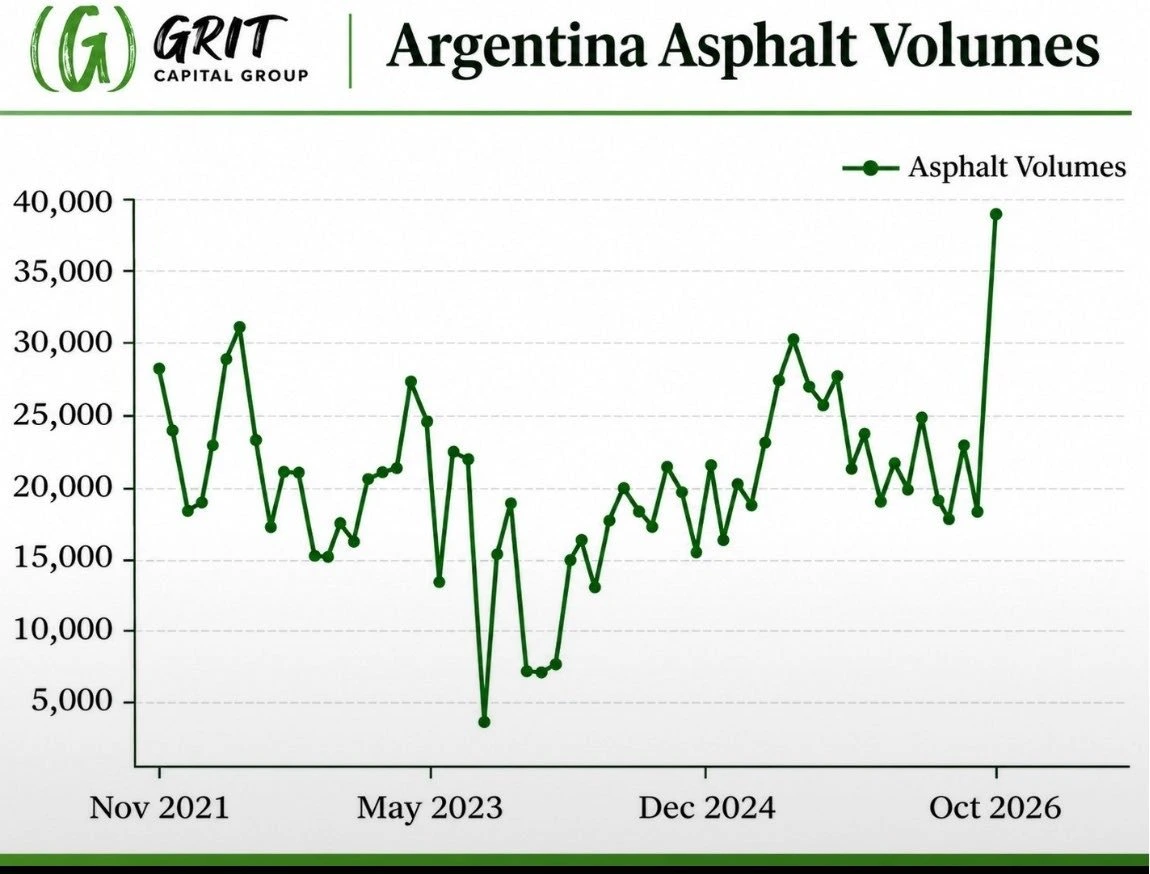
The floor of the collapse inherited from Kirchnerism: As a consequence of the inherited crisis, the sector suffered a drastic collapse towards 2023, falling below 5,000 units and registering its lowest point of approximately 3,600 units shortly after May 2023.